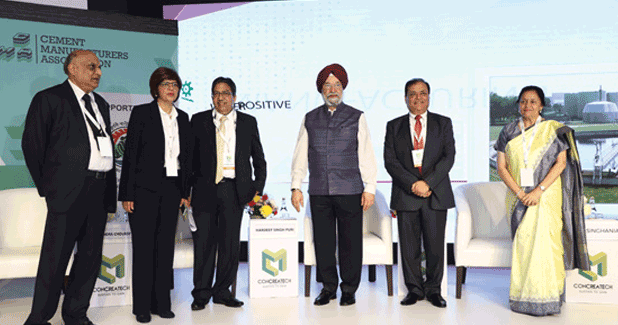
The first edition of Cement Manufacturers Association (CMA) CONCREATECH conference successfully culminated in New Delhi. The event saw the industry make a concerted attempt to not only remove misapprehensions around it but also stake a rightful claim as one of the key drivers in the India growth story.
There is 0 per cent tax on salt, cement is 28 per cent, steel is 18 per cent, paint is 18 per cent and Surf is 18 per cent. We often say that India is still a base economy of roti, kapda aur makaan (food, clothing and shelter). On roti that I am taking as sugar and salt, the price is high the tax is low. On kapda, I am taking it as Surf, the price is very high but the tax is still low. But on makaan, which is cement and meant for the poor, the price is the lowest while the tax is the highest!" This statement made by Ajay Kapur, Managing Director & CEO, Ambuja Cement during a panel discussion at the Cement Manufacturers Association organised CONCREATECH 2018 amply captured the prevailing sentiment within the Indian cement industry. No wonder then that it drew a prolonged round of applause from the assembled audience.
The captains of what is now the world’s second-largest cement industry after China assembled in late November for CMA’s first CONCREATECH conference, in New Delhi. The event was supported by the federal government’s Ministry of Environment, Forest and Climate Change. Leading policymakers, economists and industry leaders shared insights on the cement industry’s achievements and anxieties as well as its commitment to the UN General Assembly’s Sustainable Development Goals (SDG) for 2030.
In his inaugural address, Hardeep Singh Puri, Union Minister of State with Independent Charge, Ministry of Housing and Urban Affairs (MoHUA) said, "Between now and 2030, India needs to build 700 to 900 million square metres of urban space every year, which is equivalent to a Chicago. And I would like to tell you that it’s already being done." He elaborated on how government programmes like Swachh Bharat Mission, housing for all under the Pradhan Mantri Awas Yojana (PMAY), Atal Mission for Rejuvenation and Urban Transformation (AMRUT), construction of metro rail projects and development of smart cities were providing an impetus to development. "These five flagship programmes and an economy which is growing, offer a massive opportunity to our own economic entities and our partners throughout the world."
Puri urged the industry to ensure that by the next CONCREATECH it also became the "world’s greenest cement industry". He added that MoHUA would shortly announce a global green construction technology challenge.
REMOULDING THE NARRATIVE
The head of a leading cement major admitted in a private gathering that ICR also attended that the Indian cement industry was negatively perceived over allegations such as cartelisation. "We suffer from a problem of perception as over the past several decades we as an industry have failed to properly communicate the important role played by the sector in the nation’s development." Therefore, the urgency to change the discourse around the sector was quite palpable in the press conference that the CMA office bearers addressed on the sidelines of the event.
As recently as July this year, Nitin Gadkari, Minister for Roads & Highways had informed lawmakers in parliament that cartel pricing by cement makers was proving to be a stumbling block in his ministry’s mission to build more concrete roads across India. The minister had warned that unless the practice was discontinued, the government might be forced to bring cement under the Essential Commodities Act to ensure greater price uniformity.
In response to a question on the issue, Dr. Shailendra Chouksey, outgoing President CMA and Whole Time Director JK Lakshmi Cement observed, "Proof of the pudding lies in the eating. These days wholesale cement prices are listed in all newspapers. If you minus the cost of freight and then check the ex-factory price, there has hardly been a 2 per cent change in the last two years." Pointing out that the GST on cement was the same as on luxury goods, he urged the government to reconsider the high tax component on the commodity.
"We have approached the Ministry of Finance and also spoken to the GST Council to impress upon them the irony of the situation. If cement, which is an essential item, removed from the category of luxury goods, its consumption will increase in rural India," he added. CMA’s larger objective is to position cement as a sustainable product that helps in the conservation of local resources. It was highlighted how the industry was playing a commendable role through its various corporate social responsibility (CSR) initiatives long before that was made mandatory by law. "The industry has been taking various initiatives to uplift the communities wherever it is located by not just providing a push to the economic activity in the area but also through facilitation of transportation, employment, schools, horticulture and introduction of latest technologies," surmised Chouksey.
"All cement plants are trying to contribute in a big way to increase employability, to enhance livelihood and to also harvest water. Today, many of the cement plants are water positive," stressed Mahendra Singhi, the newly elected President CMA and Managing Director & CEO, Dalmia Bharat Cement.
Aparna Dutt Sharma, Secretary-General, CMA asserted, "In fact, if you were to look at numbers alone, then we (cement industry) are far ahead of the pack. We spend much more than the mandated 2 per cent on CSR, almost 4 per cent. DEMAND RECOVERY TO BE PROLONGED The cement industry also welcomed the revival in demand since 2016. Averred Chouksey, "The last 12 months have seen 12-14 per cent growth. Since it is coming from those sectors where there are very sustainable efforts going on, we have a very reasonable ground to expect that this demand growth may not really be temporary but it is here to stay." He attributed the recovery to factors like the government’s infrastructure creation drive, housing for all scheme, developments around the Swachh Bharat Mission and growth in GDP numbers.
KK Maheshwari, Managing Director, Ultratech Cement added, "Clearly the experience in India as well as globally has been that while housing is the largest segment of demand, it’s never the highest growth driver in any economy, including in China that has seen a huge growth in cement production and consumption. It is always infrastructure, which has the highest growth rate, and the proportion of cement demand that varies from 15-25 per cent at different points of time followed by industrial and commercial segments." He attributed the growth to especially the ongoing work in roads & highways and railway sectors. Even in the otherwise stressed construction industry on account of concerns around the Real Estate Regulation and Development Act (RERA), the low-cost housing scheme has resulted in a growth rate of 9 per cent.
"If you tend to look at smaller periods, yes, the industry went through an awfully bad period for five-six years. But if you look at the 25-year history, the industry has grown at about 7 per cent. Once the momentum picks up on things like infrastructure, the experience is that it continues unless there is a huge fiscal stress resulting in a total dislocation, which we hope, won’t be the case," opined Maheshwari.
The apex body of India’s largest cement manufacturers, CMA was founded in 1961. Now in its 57th year, it counts both private and state-owned companies in the fold. The maiden edition of CONCREATECH saw an enthusiastic participation by its members from all across the country. Sessions on a wide range of themes like nation building, sustainable development, leadership, supply chain management and adoption of low carbon solutions were also organised. Going forward, the symposium will be held every two years in order to initiate dialogue and build partnerships for a constructive agenda around the world’s fastest growing major economy’s cement sector.
– MANISH PANT


















 Concrete3 weeks ago
 Concrete3 weeks ago
 Concrete4 weeks ago
 Concrete3 weeks ago