Connect with us

Concrete

PROMECON introduces infrared-based tertiary air measurement system for cement kilns

Published

on

Shares

The new solution promisescontinuous, real-time tertiary air flow measurement in cement plant operations.

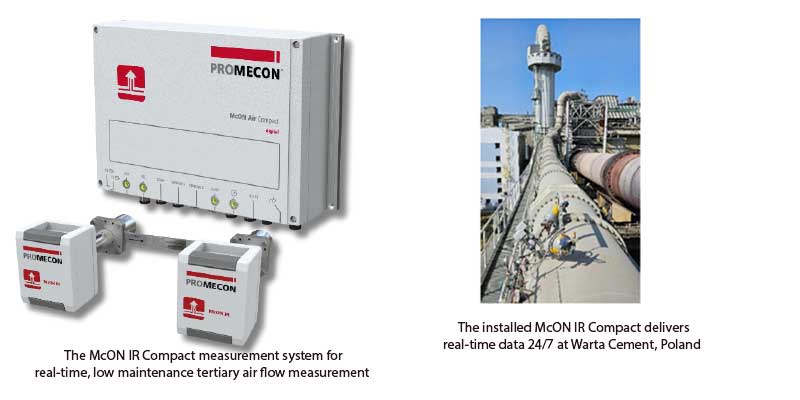
PROMECON GmbH has launched the McON IR Compact, an infrared-based measuring system designed to deliver continuous, real-time tertiary air flow measurement in cement plant operations. The system addresses the longstanding process control challenge of accurate tertiary air monitoring under extreme kiln conditions. It uses patented infrared time-of-flight measurement technology that operates without calibration or maintenance intervention.

Precise tertiary air measurement is a critical requirement for stable rotary kiln operation. The McON IR Compact is engineered to function reliably at temperatures up to 1,200°C and in the presence of abrasive clinker dust. Its vector-based digital measurement architecture ensures that readings remain unaffected by swirl, dust deposits or drift. Due to these conditions conventional measurement systems in pyroprocess environments are often compromised.

The system is fully non-intrusive and requires no K-factors, recalibration or periodic readjustment, enabling years of uninterrupted operation. This design directly supports plant availability and reduces the maintenance overhead typically associated with process instrumentation in high-temperature zones.

PROMECON has deployed the McON IR Compact at multiple cement facilities, including Warta Cement in Poland. Plant operators report that the system has aided in identifying blockages, optimising purging cycles for gas burners, and supplying accurate flow data for AI-based process optimisation programmes. The practical outcomes include more stable kiln operation, improved process control, and earlier detection of process disturbances.

On the energy side, real-time tertiary air data enables reduction in induced draft fan load and helps flatten process oscillations across the pyroprocess. This translates to lower fuel and energy consumption, fewer unplanned shutdowns, and a measurable reduction in NOx peaks. This directly reflects on the downstream cost implications for plants operating SCR or SNCR systems for emissions compliance.

Concrete

JK Cement Declared Preferred Bidder For Gilund Limestone Block

Shares Edge Higher As Company Wins Rajasthan Block

Published

on

By

Shares


JK Cement gained after being declared preferred bidder for the Gilund Limestone Block in Chittorgarh, Rajasthan, a lease area of 370.96 hectares. The firm saw its shares trade at Rs. 5550.05, up by 28.45 points or 0.52 per cent from the previous close of Rs. 5521.60 on the BSE. The scrip opened at Rs. 5569.15 and touched a high of Rs. 5625.00 and a low of Rs. 5531.00.

The stock recorded turnover of 1742 shares on the counter and the BSE group A stock with face value Rs. 10 has a 52 week high of Rs. 7565.00 on 20-Aug-2025 and a 52 week low of Rs. 4670.05 on 12-Jun-2026. Last one week high and low stood at Rs. 5625.00 and Rs. 5329.00 respectively. The promoters holding in the company stood at 45.66 per cent, while institutions and non-institutions held 40.61 per cent and 13.73 per cent respectively.

The e-auction conducted by the Government of Rajasthan resulted in the company being declared preferred bidder for the mining lease, and the allocation will enable the company to plan phased development of the deposit, subject to regulatory approvals. The Gilund block spans 370.96 hectares and its allocation is intended to support raw material security for the company’s cement operations in the region. The designation follows the government auction process and will allow the company to plan development and integration of the deposit into its supply chain.

The current market capitalisation stands at Rs. 430.38 billion (bn), reflecting market response to the mining news and prevailing valuation levels for the sector. Investors and analysts will watch for formal allotment and related disclosures that can clarify timelines, capital expenditure and expected production profiles. The report is intended for informational purposes and does not constitute investment advice, and market participants are advised to consult advisers before making decisions.

Continue Reading

Concrete

Star Cement Named Preferred Bidder For Boro Lakhindong Block

Preferred bidder for limestone mining lease in Assam

Published

on

By

Shares


Star Cement has been declared the preferred bidder for the mining lease for Boro Lakhindong West Block following e-auctions conducted by the Government of Assam. The block is located in Boro Lakhindong Village, Umrangso Tehsil, Dima Hasao District, Assam, and extends over an area of 123 hectares. The estimated limestone resource is 207.822 million (mn) tonnes (t), a quantity that will supply raw material for cement production and support the company’s manufacturing operations in the region.

The company is engaged in the manufacturing and selling of cement clinker and cement and distributes products across the north-eastern and eastern states of India. Star Cement operates plants and logistics networks that procure and process limestone to produce clinker for cement, and the addition of Boro Lakhindong is presented as a strategic enhancement of feedstock availability. The preferred bidder status secures rights to the specified lease area under the terms of the auction process.

Financial results for the company in the fourth quarter of fiscal year 2026 showed a consolidated net profit rise of 20.24 per cent to Rs 1,481.0 mn on an 11.54 per cent increase in revenue to Rs 11,735.5 mn compared with the corresponding quarter of the previous year. Those results reflected higher sales volumes and revenue growth in the company’s primary markets and are cited in company disclosures accompanying the lease announcement. The reported performance provides context to the company’s ability to pursue and finance new mining lease opportunities.

Market reaction to the declaration was modest, with the scrip rising zero point thirty six per cent to trade at Rs 212 on the BSE. The award of the Boro Lakhindong lease concludes the e-auction process for the west block and assigns operational rights to Star Cement as the preferred bidder, subject to completion of statutory and contractual formalities.

Continue Reading

Concrete

KERC Proposal To Cut Rooftop Solar Export Tariff Raises Concern

Consumers and advocates urge regulator to reconsider change

Published

on

By

Shares


The Karnataka Electricity Regulatory Commission (KERC) has proposed a reduction in the tariff paid for surplus electricity that rooftop solar installations export to the grid, prompting concern among consumers, renewable energy advocates and industry specialists. The proposal arrives while the Central government and state governments are promoting clean energy adoption and offering subsidy schemes to encourage rooftop solar deployment. Thousands of households in Karnataka, particularly in Bengaluru, have invested substantial sums in rooftop systems to reduce reliance on conventional power and support state renewable targets.

Stakeholders have raised questions about the implications of a lower export tariff for the financial attractiveness of rooftop solar investments and the pace of the state transition to renewables. Industry analysts warned that a reduction in compensation for excess generation could discourage new installations and extend payback periods for existing systems. Current messaging from authorities, which simultaneously promotes adoption while proposing lower export rates, has been described by user groups as creating contradictory signals for consumers.

Experts argued that policy measures should focus on grid modernisation rather than reducing consumer benefits, with investments in transmission and distribution networks needed to manage higher volumes of distributed solar generation. Consumer groups and renewable advocates are preparing written submissions to the regulator and are urging retention of incentives that support household adoption of rooftop systems. KERC has invited public objections and suggestions as part of a consultation process that will determine the final tariff framework.

The outcome of the consultation is expected to influence the future growth of rooftop solar across the state and shape investor confidence in small-scale renewable projects. Residents who have already installed rooftop panels are monitoring developments closely because changes to compensation mechanisms may affect household finances and the speed of return on investment. Observers noted that coherent policy, aligned incentives and grid upgrades would be essential to sustain momentum in the rooftop solar sector.

Continue Reading

Video Thumbnail
â–

    SIGN-UP FOR OUR GENERAL NEWSLETTER


    Trending News

    SUBSCRIBE TO THE NEWSLETTER


    Don't miss out on valuable insights and opportunities to connect with like minded professionals.


      This will close in 0 seconds