Indian Cement Review explores how cement manufacturers are combining advanced filtration, pollution-control technologies, cleaner fuels, carbon capture and digital monitoring to reduce emissions and achieve more sustainable, compliant and efficient operations.
India’s cement industry faces the dual challenge of meeting growing infrastructure demand while reducing its environmental footprint. According to the India Brand Equity Foundation (IBEF), cement production reached 491.4 million tonnes in FY2025–26, an 8.6 per cent year-on-year increase. As production expands, controlling particulate matter, nitrogen oxides (NOx), sulphur oxides (SOx) and carbon dioxide (CO2) is becoming increasingly important. The American Council for an Energy-Efficient Economy (ACEEE) estimates that cement production accounts for approximately 6 to 7 per cent of India’s greenhouse gas emissions, underlining the need for effective emissions-management strategies.
The challenge is particularly complex because cement emissions arise from both fuel combustion and the chemical conversion of limestone into clinker. According to NITI Aayog’s Roadmap for Cement Sector Decarbonisation, the sector emitted approximately 246 million tonnes of CO2-equivalent in 2023, with an emissions intensity of 0.63 tonnes of CO2-equivalent per tonne of cement. Meanwhile, the Central Pollution Control Board (CPCB) has established particulate-matter emission standards for cement plants, reinforcing the importance of effective dust collection and pollution-control systems. For manufacturers, the priority is to combine advanced filtration, cleaner fuels, process optimisation and emerging carbon-capture technologies to meet regulatory requirements while maintaining production efficiency and cost competitiveness.
Understanding emissions
Emissions from cement manufacturing originate primarily from kiln operations, fuel combustion and the chemical conversion of limestone into clinker. CO2 is released both when fossil fuels are burned to generate heat and when limestone decomposes during calcination. According to the International Energy Agency (IEA), around two-thirds of direct CO2 emissions from cement production arise from the chemical process of clinker production, with the remainder largely associated with fuel combustion. Alongside greenhouse gases, cement plants generate particulate matter (PM) during crushing, grinding, kiln operations and material handling, while nitrogen oxides (NOx) form at high combustion temperatures and sulphur oxides (SOx) can arise from sulphur present in raw materials and fuels.
Dr LP Singh, Director General, National Council for Cement and Building Materials, at the 16th Edition of the Conference on Alternative Fuel & Raw Material Usage (AFR) said, “AFR offers the Indian cement industry a significant opportunity to advance decarbonisation while addressing waste management challenges. The fly ash journey demonstrates how innovation and industry collaboration can transform waste into a valuable resource. Replicating this success with AFR will require addressing quality, technology and economic challenges through stronger collaboration among industry, researchers and policymakers to accelerate the transition to a circular economy.”
The scale of these emissions varies with raw-material composition, kiln technology, fuel mix and pollution-control equipment. A 2026 report by the American Council for an Energy-Efficient Economy (ACEEE) estimates that limestone calcination contributes approximately 56 per cent of India’s cement-sector emissions, fuel combustion 32 per cent and electricity use 12 per cent. Meanwhile, India’s Central Pollution Control Board (CPCB) identifies crushers, coal mills, raw mills, kilns, clinker coolers, cement mills and packing plants as major sources of particulate emissions. Understanding these sources is essential to selecting appropriate controls, from bag filters and electrostatic precipitators to combustion optimisation and carbon capture, while ensuring compliance with environmental standards.
Advanced air pollution control
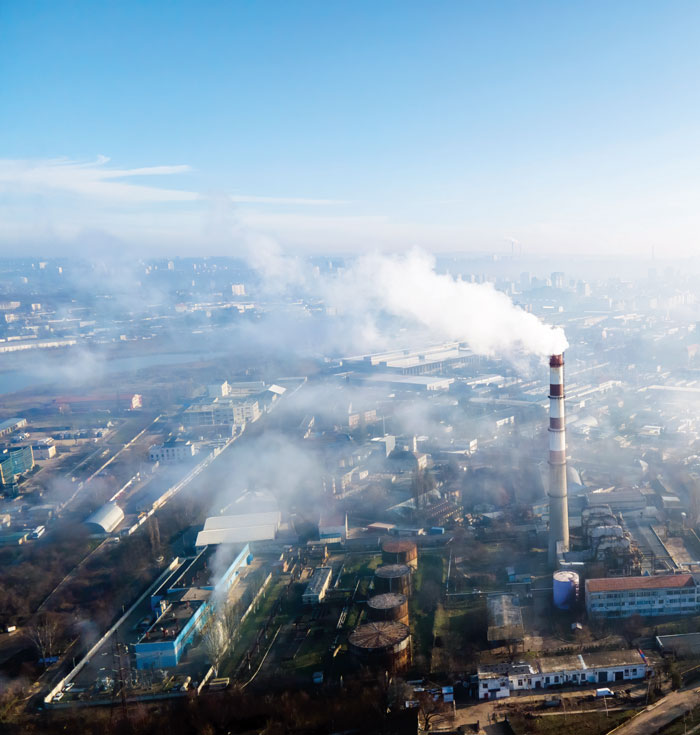
Particulate matter is generated at several stages of cement manufacturing, including limestone crushing, raw-material grinding, kiln operations, clinker cooling, cement milling and packing. Modern air pollution control systems use electrostatic precipitators (ESPs) and bag filters to capture dust before exhaust gases are released into the atmosphere. ESPs remove particles by electrically charging them and collecting them on plates, while bag filters trap dust as gases pass through specialised filter media. Enclosed conveyors, covered storage, efficient dust extraction and automated material-handling systems further help prevent fugitive emissions across the plant.
The Central Pollution Control Board (CPCB) identifies crushers, coal mills, raw mills, kilns, clinker coolers, cement mills and packing plants as major sources of particulate emissions. Its guidance highlights the use of ESPs, baghouse filters and hybrid filtration systems to control dust at these points. The World Bank Group’s Environmental, Health, and Safety Guidelines for Cement and Lime Manufacturing also recommend enclosing material-transfer points, using water sprays and dust suppressants, and maintaining paved roads and effective housekeeping to limit fugitive dust. Combining high-efficiency filtration with preventive maintenance and improved material handling is therefore essential to reducing dust emissions and maintaining compliance with applicable standards.
Controlling NOx and Sox
NOx and SOx require targeted control strategies because they arise from different sources within cement manufacturing. NOx forms mainly during high-temperature kiln combustion, while SOx emissions depend on the sulphur content of fuels and raw materials. Low-NOx burners, staged combustion and optimised kiln operating conditions help limit NOx formation, while selective non-catalytic reduction (SNCR) and selective catalytic reduction (SCR) reduce NOx in exhaust gases through chemical reactions. For SOx, manufacturers can optimise raw-material selection and kiln conditions or deploy suitable gas-treatment systems to capture sulphur compounds before release.
The World Bank Group’s Environmental, Health, and Safety Guidelines for Cement and Lime Manufacturing (2022) provide indicative emission levels of 600 mg/Nm3 for NOx and 400 mg/Nm3 for SO2 from cement kiln stacks, subject to the guideline’s specified operating and measurement conditions. European Commission best available techniques (BAT) conclusions also identify low-NOx burners, staged combustion and SNCR as key NOx-control options, with SCR available where appropriate. For cement manufacturers, selecting the right combination depends on kiln design, fuel and raw-material chemistry, emissions targets and operating costs; continuous monitoring is essential to verify performance and maintain compliance.
Carbon capture and low-carbon cement
Decarbonising cement requires solutions that go beyond improving energy efficiency because a substantial share of emissions comes from the chemical decomposition of limestone during clinker production. Clinker substitution offers an immediate pathway to reduce this impact by incorporating supplementary cementitious materials (SCMs), such as fly ash, blast furnace slag and calcined clay, into cement formulations. Limestone calcined clay cement (LC3) and other blended cements can lower clinker content while maintaining the performance required for construction. These innovations also encourage the productive use of industrial by-products and locally available materials, helping manufacturers reduce the carbon intensity of cement.
Carbon capture, utilisation and storage (CCUS) offers another pathway for addressing residual process emissions. According to the Global Cement and Concrete Association’s Cement Industry Net Zero Progress Report 2024/25, CCUS is expected to contribute 36 per cent of the cement and concrete industry’s emissions reductions by 2050 under its net-zero roadmap. In India, the Department of Science and Technology announced five CCU testbeds for the cement sector in 2025 to demonstrate technologies that capture CO2 and convert it into value-added products, including concrete aggregates and synthetic fuels, as reported by the Press Information Bureau. Scaling these innovations will depend on technological maturity, investment, infrastructure and standards that support wider adoption of low-carbon cement.
Extending emission control beyond the plant
Emission control in cement manufacturing must extend beyond the production line to include the transportation of raw materials, fuels and finished cement. Road transport contributes to fuel consumption, greenhouse gas emissions and particulate pollution, particularly around plant gates, loading areas and distribution routes. Optimising truck movements, reducing vehicle idling and improving fleet utilisation can help minimise these impacts. Covered conveyors, enclosed loading systems and effective dust suppression at material transfer points can further reduce fugitive dust during handling and transportation.
Vinita Singhania, Chairperson and Managing Director, JK Lakshmi Cement, said, “At JK Lakshmi Cement, we are focused on integrating sustainable practices across our operations while ensuring long-term business efficiency. With a fleet of 70+ electric vehicles currently operating across our logistics network, we are making tangible progress in adopting cleaner transportation solutions. The transition to EV-based clinker dispatches on the Sirohi–Kalol route is an important milestone in this journey and reinforces our commitment to scaling sustainable logistics as part of our broader decarbonisation strategy.”
Shifting suitable freight from road to rail, improving vehicle maintenance and adopting digital logistics platforms can further support emission reduction across the cement supply chain. GPS based fleet tracking and route optimisation can reduce unnecessary travel, while bulk cement transportation can help limit packaging waste and handling related dust. Integrating these measures with plant level emissions monitoring provides a more comprehensive approach to pollution management, recognising that cleaner cement manufacturing depends not only on controlling emissions at the kiln but also on how materials and products move through the supply chain.
Anand Mimani, CEO – EV and New Energy Business, Blue Energy Motors, says “As India accelerates its transition towards a lower-carbon future, decarbonising freight transportation will be critical to achieving meaningful emissions reductions. Electric heavy-duty trucks are increasingly proving their ability to deliver the performance, reliability and economics required for commercial operations. This deployment is a strong example of how clean mobility solutions can help industries reduce transportation-related emissions while advancing their broader sustainability ambitions.”
Digital monitoring and regulatory compliance
Continuous Emissions Monitoring Systems (CEMS) are helping cement manufacturers move from periodic testing towards real-time emissions tracking. These systems measure pollutants such as particulate matter (PM), nitrogen oxides (NOx) and sulphur dioxide (SO2), transmitting data to plant operators and regulatory authorities. The Central Pollution Control Board (CPCB) identifies cement as a sector requiring online monitoring of PM, NOx and SO2, with data connected to regulatory servers. Integrating CEMS with automated process controls and analytics can help operators identify emission spikes, investigate their causes and adjust kiln combustion, fuel feed or pollution-control equipment before deviations persist.
However, monitoring is only effective when the data is reliable and acted upon. A 2024 report by the Council on Energy, Environment and Water (CEEW) highlights the need to improve the accuracy and credibility of India’s industrial emissions-monitoring data, despite the widespread adoption of CEMS. Regular calibration, equipment maintenance, data validation and cross-checking against approved reference methods are therefore essential. When combined with predictive analytics and automated alerts, reliable emissions data can strengthen regulatory reporting, support faster corrective action and help cement plants balance environmental compliance with operational efficiency.
Conclusion
Emission control in cement plants requires a comprehensive approach that combines advanced pollution-control technologies, energy efficiency and process innovation. From high-efficiency bag filters and NOx and SOx treatment systems to alternative fuels, low-carbon cement formulations and carbon capture, these solutions offer multiple pathways to reduce the industry’s environmental footprint. Digital monitoring and real-time analytics further strengthen these efforts by enabling manufacturers to identify emission spikes, optimise plant operations and improve regulatory compliance. The challenge lies in integrating these technologies effectively while maintaining production reliability and cost competitiveness.
As India’s cement demand continues to grow, the industry must move beyond compliance-driven measures towards a proactive, long-term emissions-reduction strategy. Greater investment in research and development, modern infrastructure, reliable emissions monitoring and collaboration between manufacturers, technology providers and policymakers will be essential to scaling effective solutions. Ultimately, the future of cleaner cement manufacturing will depend on translating technological advances into measurable environmental improvements, ensuring that industrial growth goes hand in hand with resource efficiency, responsible production and India’s broader decarbonisation ambitions.















 Concrete4 weeks ago
 Concrete4 weeks ago

 Concrete4 weeks ago
 Concrete4 weeks ago