Cement is never used as cement alone but is always converted to a value-added product in practice. Therefore application of cement becomes extremely important. The cement producers have a dedicated department that looks into the applications of product. Now onwards, we shall try and cover it through a series of articles in a structured way.
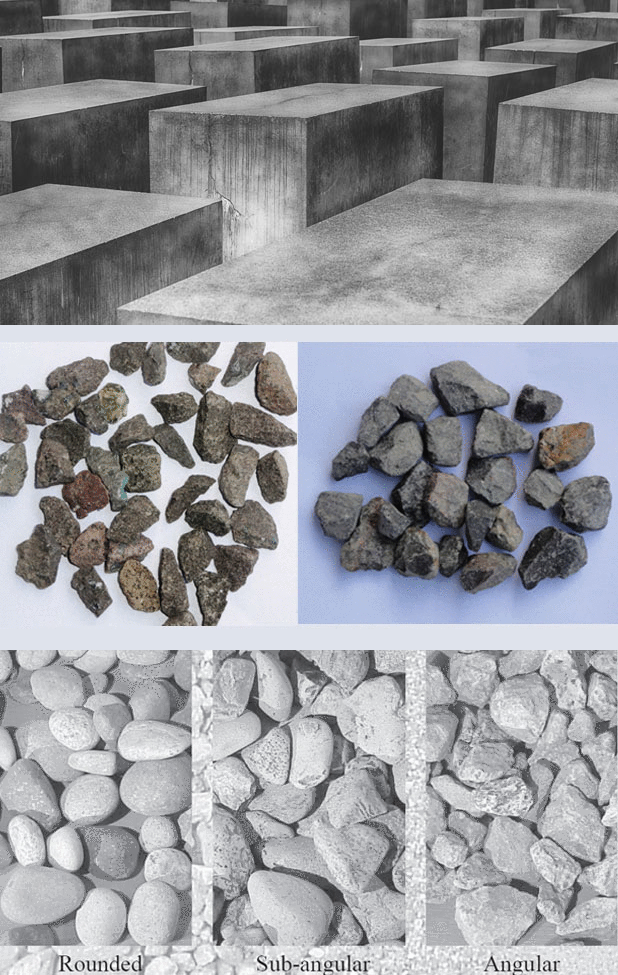
Construction aggregate, or "aggregate", is a broad category of coarse to medium grained particulate material used in construction that includes sand, gravel, crushed stone, slag, and recycled concrete and geosynthetic aggregates. Aggregates are the most mined materials in the world.
Cement concrete is a cement and water paste in which aggregate particles are embedded. Aggregate usually occupies approximately 60 to 75 per cent of the volume of concrete. Besides reducing volume changes due to drying shrinkage of the cement-water paste, aggregate is inexpensive filler that reduces the cost of the concrete. Aggregate properties significantly affect the workability of plastic (concrete in the wet stage) concrete and the durability, strength, thermal properties, and density of hardened concrete. Types of rocks
Aggregates are generally sourced from natural materials or from industrial by products. Natural aggregates come from rock, of which there are three broad geological classifications. Igneous rock: These rocks are primarily crystalline and are formed by the cooling of molten rock material beneath the earth’s crust (magma).Sedimentary rocks: These rocks are formed from deposited insoluble material (e.g., the remains of existing rock deposited on the bottom of an ocean or lake). This material is transformed to rock by heat and pressure. Sedimentary rocks are layered in appearance and are further classified based on their predominant mineral as calcareous (limestone, chalk, etc.), siliceous (chert, sandstone, etc.) or argillaceous (shale, etc.).Metamorphic rock: These are igneous or sedimentary rocks that have been subjected to heat and/or pressure great enough to change their mineral structure so as to be different from the original rock.
Natural sands and gravels are the product of weathering and the action of wind or water, while stone sands and crushed stone are produced by crushing natural stone. Screening and washing may be used to process aggregates from either of these categories. Aggregates may be produced from igneous, sedimentary, or metamorphic rocks, but the presence or absence of any geological type does not, by itself, make an aggregate suitable or unsuitable for use in concrete. The acceptance of an aggregate for use in concrete on a particular job should be based upon specific information obtained from tests used to measure the aggregate quality, or upon its service record, or both. Synthetic aggregates may be either by products of an industrial process, such as blast-furnace slag, or products of processes developed to manufacture aggregates with special properties, such as expanded clay, shale or slate that are used for lightweight aggregates. Some lightweight aggregates such as pumice or scoria also occur naturally. Other classifications of aggregates may be based upon bulk density and particle shape, but these, as well as the ones previously discussed, serve mainly as aids in describing an aggregate. To understand the role played by aggregate in the performance of concrete, it is necessary to define specific aggregate properties and show their effect on concrete properties.Aggregates generally divided into two groups: Fine and Coarse aggregates.
Fine aggregates or natural or manufactured of particle size ranging from 10 mm to 0.075 mm. Coarse aggregates size ranging from 10 mm to 80 mm. The most commonly used maximum size of aggregate is 20 or 25 mm.Fine & Coarse aggregates
– IS-383 – 2016 Specification for concrete
– IS-2386 Part – I to VIII – Method of testWhy use aggregates?
We use aggregates mainly to reduce the cost of the concrete. Roughly aggregates would cost between 12 to 25 per cent of the cement price. Use of aggregate reduces thermal cracking. About 100 kg of OPC produces about 12o C temperature rise. Aggregates can reduce shrinkage, 10 percent of reduction in aggregate volume can double the shrinkage of concrete. High aggregate to cement ratio is desirable as it mainly influences cement content in concrete. Effect of aggregate size: Larger the (maximum) size; increases strength, decrease total surface area of aggregate that decreases required cement content. Improves rut resistance but increases problem with segregation of particles. Smaller maximum size can reduce segregation, reduces road noise, decreases tyre wear specially while transporting of ready mixed concrete. Why to specify sizes?
The foremost reason for specifying the size of aggregates is to control the cost of concrete, have a homogenous mix with higher bulk density, effectively use the water content and control the consumption of cement and other cementious
materials. By playing with the size of aggregates one can modify workability, pumpability, porosity and shrinkage of concrete.
Fine aggregates are nothing but the sand used in concrete. The size is down 4.75 mm to 0.075 mm and the content is usually 35 per cent to 45 per cent by mass or volume of total aggregate. Grading of aggregates: Grading is nothing but the particle-size distribution of an aggregate as determined by a sieve analysis using wire mesh sieves with square openings. As per IS:2386 (Part-1) for fine aggregate, 6 standard sieves with openings from 150 ?m to 4.75 mm. (150 ?m, 300 ?m, 600 ?m, 1.18 mm, 2.36 mm, 4.75mm) are used. For coarse aggregates , 5 sieves with openings from 4.75 mm to 80 mm. (4.75 mm, 10 mm, 12.5 mm, 20 mm, 40 mm and may be onwards). ?m is microns and 1 micron (?m) is 0.001 mm.
Grain size distribution for concrete mixes should be such that it will provide a dense strong mixture. Ensure that the voids between the larger particles are filled with medium particles. The remaining voids are filled with still smaller particles until the smallest voids are filled with a small amount of fines.
Generally in the city of Mumbai and around three type of aggregates are used which are termed as CA I( coarse aggregate),CA II and FA fine aggregates. For coarse aggregates the sizes vary from 20-25mm for CAII and 10-12 mm for CAI, the remaining third is Fine aggregate or Sand. The proportion of sand in concrete being 35 to 45 per cent, availability and price of sand has a direct impact on the production of concrete.
Fineness Modulus (FM) is a result of aggregate sieve analysis is expressed by a number called Fineness Modulus. It is obtained by adding the sum of the cumulative percentages by mass of a sample aggregate retained on each of a specified series of sieves and dividing the sum by 100. This measurement is important while designing concrete mixes with given materials at site.
Sand or fine aggregates is further graded in three categories and the following limits may be taken as guidance:Fine sand : Fineness Modulus : 2.2 – 2.6Medium sand : F.M. : 2.6 – 2.9Coarse sand : F.M. : 2.9 – 3.2
Sand having a fineness modulus more than 3.2 will be unsuitable for making satisfactory concrete.Colour of aggregates: Normally the colour of aggregates depend on the source of rock from which it is derived. The colour of aggregates that we see in Karnataka, Maharashtra and in the Northen part of India is much different. However colour has hardly any influence on the properties of concrete. But in case of decorative concretes the colour needs to satisfy the designer’s requirements. Tests on Aggregates: Fine aggregates
These are summarised as Grading, Silt & Clay content, Specific Gravity, Water absorption & moisture content, Soundness, Alkali Aggregate Reactivity, Organic Impurities and Soft Particles, Bulkage. We shall cover some of the important ones.
Impurities in fine aggregate and its effect: Clay particles, Shale, Mica, Weathered agate, Organic impurities-humus, sugar etc. These impurities lead to High water absorption, Low strength, High shrinkage, Retardation. (Slow strength gain for concrete).
Estimation of stilt content and organic impurities is very simple and can be easily carried out at site laboratory. It is recommended that every site laboratory must carry out these tests to ascertain the suitability of fine aggregates. Tests on Coarse aggregates:
– Specific gravity
– Dry Loose Bulk Density/Dry Relative Bulk Density
– Absorption & Surface moisture
– Shape
– Soundness
(Test methods – IS 2386 Part I to VIII)Tests on Coarse aggregates:
– Aggregate Crushing Value
– Aggregate Impact Value
– Aggregate Abrasion Value
– Alkali Aggregate Reactivity
(Test methods – IS 2386 Part I to VIII)Mechanical properties
Aggregate Crushing Value: Not more than 45 percent for other than wearing, surface and 30 percent for wearing surface.
Aggregate Impact Value: Not more than 45percent for other than wearing, surface and 30 percent for wearing surface.
Aggregate Abrasion Value: Not more than 50 per cent for other than wearing surface and 30 percent for wearing surface.
Aggregate Elongation & Flakiness: Not more than 40 percent (combined)
Soundness: (Loss after 5 cycles)
For fine aggregate: maximum 10 percent with sodium sulphate and 15 percent with magnesium sulphate.
For Coarse aggregate: maximum 12 percent with sodium sulphate and 18 percent with magnesium sulphate.
We thankfully acknowledge for making the articles available to us originally written by Suhas Dhuri and S Krishnan of e cube consultants, Thane and Prof. Gaurav H Tondan published on Linked in.Compilation by Vikas Damle Ex. Editor of ICR.




















 Concrete3 weeks ago
 Concrete3 weeks ago
 Concrete4 weeks ago
 Concrete3 weeks ago