Vikram Gulliani, Business Line Manager, Air and Gas Applications, Compressor Technique, Atlas Copco (India), explores how intelligent, energy-efficient and digitally connected compressor technologies are redefining the backbone of India’s Construction 4.0 revolution.
India is on the verge of an infrastructure revolution. With government initiatives such as National Infrastructure Pipeline (NIP) and Gati Shakti Master Plan, India is earmarking investments in infrastructure that will stretch into the multi-trillions to build modern cities, highways, ports and industrial corridors. This rapid acceleration, often termed as ‘Construction 4.0,’ calls for more than just better equipment and digital applications; it calls for dependable support systems, of which compressed air is one of the most important.
Compressed air powers everything from drilling, blasting, tunneling, and concrete spraying to pneumatic tools and energy efficient operation. However, despite its widespread use, conventional air compressors alone won’t be sufficient to meet the demands of the paradigm shift occurring in India’s infrastructure sector. The time for intelligent, environmentally friendly, and digitally enabled compressor solutions that take efficiency, uptime, and environmental effects into account has finally arrived.
Here’s how compressor technology transforms and empowers Construction 4.0 in India.
Crucial changes in construction needs
Since the construction industry has always dependent on heavy machinery, many of which rely on compressed air solutions. All these factors are still crucial in today’s time; however, the contractors and other infrastructure developers nowadays need much more:
• Reliability in hazards of extreme dust, humidity, and ambient temperature: Many projects take place in remote or extreme locations thus, compressors must deliver reliable performance without restriction regardless of dust and/or humidity or ambient extremes
• Smart technology integration: Under Construction 4.0, contractors are seeking data-based insights! Contractors require a compressor with smart controllers and telematics to execute monitoring of air quality, fuel consumption, maintenance capability, and predictive diagnostics.
• Mobility and size: The world is becoming densely populated, urbanised and this is leading to an increase in restrictions where equipment is operated. A compressor occupies very little space and provides a level of portable mobility and minimum noise with higher efficiency.
Energy efficiency as an epicentre
Energy efficiency is the epicenter of the nation’s infrastructure ambition. Construction is energy-intensive and compressed air represents a significant portion of the operational costs. Usually, contractors are focused on the purchase price rather than total lifecycle costs and efficiencies, but with escalating fuel prices and slow-moving projects contractors are finally beginning to examine energy efficiency during project timelines.
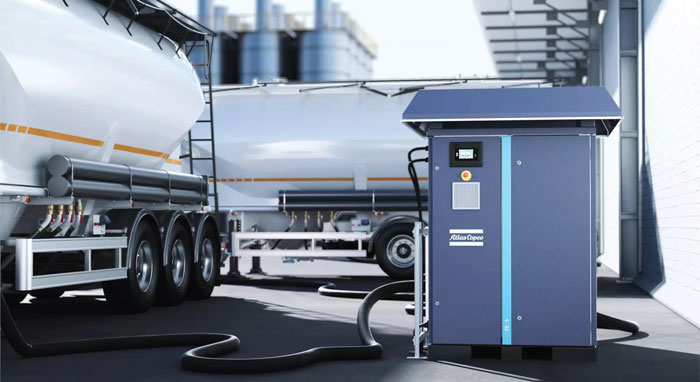
• Efficient bulker unloading with low pressure solution: For efficient bulker unloading of materials such as cement and fly ash, compressed air at a controlled pressure is essential. The typical pressure requirement lies in the range of 1.3 to 1.9 bar(g), with a strict upper safety limit of 2.5 bar(g). Delivering air beyond this threshold can risk damage to the bulker or pipeline system. The most efficient solution is to use a low-pressure compressor that generates pressure in this range rather than using a pressure-reducing valve which leads to loss of energy.
• Use of PRV to achieve low pressure is wrong wractice: Pressure Reducing Valves (PRV) are safety devices, not regulators. PRV are not designed for continuous blowing off pressurised air. Using them continuously highlights the poor and oversized design of the air system. This action also results in waste on money and energy as PRV keeps venting, compressed air is wasted leading to higher compressor load, increased energy consumption, and higher CO2 footprint. A sustainable approach will entail using the right product that runs
on the required limits, resulting in energy
efficient action.
• Fuel efficient portable compressors: In specialist applications, a diesel-driven compressor with fuel management features will offer reduced diesel consumption and emissions and increased runtime. The airflow demand varies with tanker size and unloading time, generally ranging between 500 and 1,300 m³/h depending on material bulk density. To achieve consistent unloading performance, oil-free and dry compressed air should be ensured through proper cooling and moisture separation, supported by adequately sized pipelines, valves, and monitoring instruments. For this application, low-pressure screw compressors designed for up to 2.5 bar(g) are preferred over lobe blowers, as they provide the reliability, efficiency, and air quality required for safe bulker unloading operations.
• Optimised air flow: Delivery of the correct air pressure at the right time. Energy efficient compressors will deliver less air and minimised leakages and wasted capacity. The use of VSD in general industry is considered to save energy, however not in this application. As the blower ramps up, any clogging or material buildup in the conveying line causes a false pressure to rise. The VSD interprets this as a signal to reduce motor RPM, which reduces airflow. But in reality, the system needs more flow, not less, to clear the blockage. The blower, instead of helping, slows down further worsening the clog. This feedback loop continues until the blower trips shut down. This phenomenon is known as hunting. A correctly sized fixed flow positive displacement compressor is an ideal solution
• Digital monitoring for energy signals: Connected compressors can provide contractors with real-time data providing them with the ability to benchmark energy use, identify inefficiencies and to take corrective action in real time. Energy efficiency is not just a cost advantage; it is increasingly a differentiator in compliance
and branding.
Maintaining efficiency in the face of urbanisation
Rapid urbanisation creates opportunities and unprecedented challenges. These challenges include aggressive timelines and zero downtime.
This is when our equipped compressor solutions become critical:
• Uptime assurance through smart diagnostics: Connected compressors can provide advance warnings of faults before they occur. For example, Atlas Copco’s smart monitoring platforms use IOT to notify operators of any alarming fault indicators, allowing them to perform maintenance to avoid unplanned stoppage.
• Sustainability without compromise: High-performance compressors with emissions-compliant engines, filtration with fine filters, and sound suppression technology are leading to contractors meeting defined sustainability requirements while still achieving peak performance.
• Flexibility across applications: Whether it’s deep foundation drilling, road building, or sandblasting, compressors need to seamlessly adapt. Contractors achieve flexibility by using multi-mode machines that can manage pressure level switching or flow optimisation and thereby eliminate multiple units.
• Service network and support: Technology alone is not enough to achieve up time. There are contracts that have a requirement for a service network to manage availability of parts, engineers for technical support, and local response. This part of the solution can and usually is a real differentiator. Atlas Copco has been extending its service footprint in India for this precise reason. Achieving sustainability and performance is no longer a compromise; it is a requirement.
Future prospects for the industry
Looking forward, India’s construction and infrastructure will be growing at levels never seen previously. The government projects US$ 1.4 trillion on infrastructure spending by 2030. Smart compressed air solutions will be the backbone to that transition, happening better, faster, greener and more reliable.
We see a few key hospitality opportunities coming:
• Digitally connected sites: The rapid evolution of IoT and cloud solutions will allow compressors to act as intelligent nodes in a connected construction world that provides real time analytics to project managers managing multiple projects.
• Hydrogen and electric compressors: With India’s plans to ramp up green energies, moving towards alternative fuel compressors that will support the transition away from diesel fuel and provide solutions that align with national targets for
net-zero.
• Circularity and lifecycle services: In addition to the machine side of the business, the industry will increasingly examine service models that support circularity throughout the lifecycle. The industry focuses on refurbishment services, remote diagnostics, and pay-per-use models for customers to confidently embrace sustainability.
• Skill development for Construction 4.0: Developing a smarter workforce is an important factor in the implementation of smarter machines. A training approach to encourage familiarisation with digital tools, sustainability and building data literacy through predictive maintenance.
Construction 4.0 is not simply about adopting different digital tools; it is about developing and growing a smarter, greener, and more resilient infrastructure ecosystem that can provide the
base point for economic growth. Compressors,
while less front and center than other machines, are vital enablers of this process. By evolving compressors from the traditional machines of the past to intelligent, energy-efficient, and sustainable elements, we are helping construction companies address their challenges of growth while assuming greater responsibility.
As India builds its future, railways, metros, and cities of the future, smart compressor solutions
will ensure every breath of compressed air helps the project along.
About the author:
Vikram Gulliani, Business Line Manager – Air and Gas Applications, Atlas Copco India, brings 18 years of diverse industrial experience, leveraging his global product and business development expertise to drive the AGA division’s growth in India.





















 Concrete4 weeks ago
 Concrete4 weeks ago
 Concrete4 weeks ago
 Concrete4 weeks ago