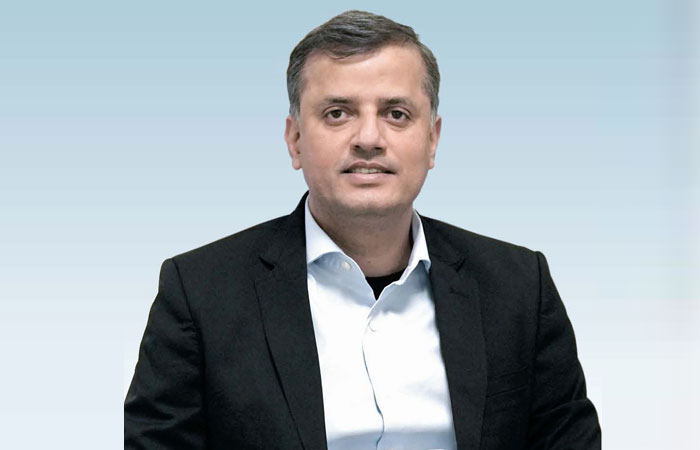
Vijay Mishra, Commercial Director, Knauf India, discusses building a blueprint for a low-carbon future in India’s construction ecosystem, by integrating recycled gypsum, energy-efficient production, and green-certified solutions.
As India’s built environment continues its rapid expansion, the conversation around sustainable construction has moved from concept to necessity. Knauf India is combining innovation, localisation and circularity to help reduce embodied carbon across the value chain. Their mission is clear: to make every product lighter, cleaner, and more future-ready. In this interaction, Vijay Mishra, Commercial Director, Knauf India talks about aligning the company’s growth with India’s green building goals.
How does Knauf India view its role in supporting emission reduction and sustainability across the broader construction and materials ecosystem?
At Knauf India, we see our role not just as a product manufacturer but as a partner in building a low-carbon future for India’s construction ecosystem. The built environment contributes significantly to global emissions, and the only way forward is to rethink how materials are designed, produced, and used. We’re working to embed sustainability right through the value chain — from using synthetic and recycled gypsum to reducing process waste and energy intensity in our plants. The idea is simple: if every component of a building is engineered to use fewer resources, last longer, and be recoverable at end-of-life, we can collectively make a big dent in construction-related emissions.
Circular innovation is central to your strategy. How are recycled gypsum and take-back programs reducing environmental impact?
Circular innovation sits at the core of how Knauf operates globally, and we’re bringing that same philosophy to India. We use synthetic gypsum, which is a by-product from industrial desulphurisation processes, in place of mined gypsum — this helps reduce extraction and keeps valuable material in circulation. Internationally, Knauf runs ‘Take-Back’ programmes that collect gypsum board waste from construction and demolition sites, recycle it, and feed it back into production. In India, we are exploring similar models, starting with pilot initiatives around waste segregation and recovery from large projects. Gypsum, unlike many materials, can be recycled endlessly without losing its properties — and that’s a huge opportunity for our industry to close the material loop and bring down overall environmental impact.
What contribution can material reuse and recovery models make toward lowering embodied carbon in building materials?
Material reuse and recovery models can transform the carbon equation for construction materials. Every tonne of gypsum we recycle means one less tonne to mine and process — and that translates to meaningful carbon savings. Beyond that, when materials are designed to be taken apart, reused, or reprocessed, we reduce demolition waste and the need for virgin inputs. The embodied carbon of a product doesn’t only come from manufacturing — it’s tied to the entire lifecycle. If we design materials that live longer and return safely into the cycle, we make our buildings far more efficient from an emissions standpoint.
Plasterboards are rapidly replacing traditional POP — what makes them a more sustainable and energy-efficient alternative?
That’s true — plasterboards have essentially become the default choice for ceilings across most Indian cities today. Twenty years ago, the ceiling market was largely unorganised — dominated by manually produced POP sheets. Back then, the entire market was barely `65 crore. Today, it’s over `5,000 crore, and growing rapidly. This shift has been driven by both economics and sustainability.
POP sheets required labour-intensive casting and drying under the sun — a process that was cheap but highly inefficient and inconsistent. Post-COVID, as labour costs rose and timelines became tighter, the industry naturally moved toward plasterboard systems that are factory-made, consistent, and far less wasteful. A plasterboard ceiling requires less material, produces minimal site waste, and delivers better thermal and fire performance. From an environmental standpoint, these boards are energy-efficient to manufacture, use recycled content, and are quicker to install — reducing on-site emissions and water use.
With India’s ceiling market expanding rapidly, how is Knauf ensuring growth remains aligned with green building standards?
India’s ceiling market still has tremendous headroom for growth. To put it in perspective, plasterboard consumption here is only 0.13 square metres per capita, compared to a global average of 1.4, and over 2.5–3 in countries like Thailand or Vietnam. That tells you how early we are in the journey. But we want that growth to happen responsibly. All our products are manufactured under BIS and ISI-certified processes and align with GRIHA and IGBC green building parameters. Our DewBloc Moisture-Resistant board, for example, is designed for India’s diverse climates — especially high-humidity regions — ensuring durability and lower replacement rates, which directly translates to lower lifecycle emissions. We are deeply focused on localisation — producing closer to our markets, sourcing locally, and designing products suited to India’s building typologies. That combination — localisation plus circular thinking — is what will make this growth both scalable and sustainable.
Can you share how localisation and zero-process waste practices are improving both efficiency and emission performance?
Localisation is key to sustainability. Manufacturing close to our markets reduces transportation emissions, supports local employment, and shortens supply chains. Our plants are designed with closed-loop water systems and near zero process waste, meaning almost everything that goes into production is either part of the product or recycled back. We also source a significant portion of raw materials locally, which not only helps emission control but also aligns with the government’s ‘Make in India’ vision. It’s a practical approach — efficient, sustainable, and economically sensible.
How do government programmes like PMAY influence the demand for eco-friendly and emission-conscious interior systems?
PMAY and similar housing initiatives are redefining the way we think about affordability and sustainability.
Earlier, the focus in mass housing was primarily on cost and speed. Today, there’s a growing awareness that energy-efficient, durable materials actually reduce lifecycle costs. Lightweight systems like gypsum boards make faster, cleaner, and more energy-efficient construction possible, which aligns perfectly with the government’s push for sustainable urban housing.
As public sector projects increasingly adopt green building frameworks, it naturally creates more demand for emission-conscious materials.
What innovations in gypsum technology or material science could further support low-carbon construction?
There is some really exciting work happening globally and within Knauf in material science.
Innovations like bio-based additives, lightweight core formulations, and moisture- and fire-resistant boards are making gypsum systems even more durable and efficient. Another area is design for disassembly — creating systems that can be easily taken apart and reused, which directly supports circular construction. The long-term goal is to create materials that perform better in buildings and are responsible at the end of their life — that’s where low-carbon construction truly begins.
– Kanika Mathur

















 Concrete1 month ago
 Concrete4 weeks ago
 Concrete1 month ago
 Concrete3 weeks ago