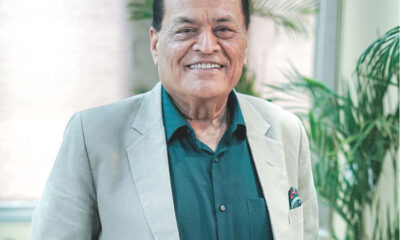
Ganesh W Jirkuntwar, Senior Executive Director and National Manufacturing Head, Dalmia Cement (Bharat), discusses how green cement is redefining the future of construction with lower emissions, innovative technologies and a commitment to sustainability.
As climate change accelerates, the cement industry faces mounting pressure to decarbonise. From low carbon cements to near-zero emissions technologies, the future of sustainable construction is taking shape. In this insightful interview with Ganesh W Jirkuntwar, Senior Executive Director and National Manufacturing Head, Dalmia Cement (Bharat), we explore the evolution of green cement, the innovations driving change and the challenges
still ahead.
What exactly is green cement, and how does it differ from traditional cement?
Green cement can be defined from various attributes. Global definitions of green cement and concrete are evolving in both the developed and developing world. International organisations and global coalitions such as International Energy Agency (IEA) and Industrial Deep Decarbonisation Imitative (IDDI), are working towards globally accepted definitions of green, near-zero carbon cement. However, in a broader perspective, a low carbon cement, green cement or near-zero carbon cement would be more eco-friendly due to adoption of inherent green manufacturing process, such as use of recycled waste, renewable energy, (Scope 1 and Scope 2) and avoidance of emissions in downstream value chain (Scope 3). Such cements utilise secondary cementitious materials (SCMs) such as:
- Fly ash: A byproduct from coal-fired thermal power plants rich in silica and alumina, ideal for enhancing cement properties.
- Ground Granulated Blast Furnace Slag (GGBS): A steel industry byproduct that, when finely ground, can substitute for clinker and dramatically cut emissions.
- Calcined clay: A thermally treated form of clay that improves reactivity and serves as a low-carbon alternative raw material.
By integrating these materials, more eco-friendly low carbon cements can be produced to reduce the carbon footprint significantly.
What are the key environmental benefits of using low carbon cement?
Low carbon cement offers multiple environmental advantages:
- Lower carbon emissions: By reducing the clinker content and using SCMs, such cements drastically cut CO2 emissions.
- Energy and water efficiency: Its production consumes less energy and water compared to traditional methods.
- Waste utilisation: It promotes the circular use of industrial byproducts, thereby reducing landfill burden and conserving natural resources.
These features make low carbon cement a pivotal player in sustainable construction.
Can low carbon cement match the durability and strength of conventional cement?
Yes, low carbon cement not only matches but, in some cases, exceeds the durability of traditional cement. It offers superior resistance to chemical attack, chloride penetration and sulphate exposure, making it particularly well-suited for marine and industrial environments. Cements made with materials like fly ash or slag can achieve compressive strength comparable to that of Ordinary Portland Cement (OPC), though they may exhibit a slower initial strength gain that improves significantly over time. Additionally, blended low carbon cement typically has a lower heat of hydration, which helps minimise thermal cracking in large-scale structures, enhancing overall durability and structural integrity.
What innovative technologies are being used to produce low carbon cement?
Innovations in low cement production include:
- Waste Heat Recovery Systems (WHRS) that harness excess heat from cement kilns to generate clean energy.
Use of alternative fuels including biomass and industrial waste, to replace fossil fuels.
- Nuclear, heat electrification and green hydrogen to cater the base fuel and energy requirements while making the energy delivery free fromCO2 emissions.
- Digitalisation and AI for optimising energyuse and reducing emissions across theproduction lifecycle.
- Carbon Capture and Storage (CCS) technologies are in nascent stages but are capable of delivering green cement, a further up step in the trajectory of decarbonisation of the cement sector.
These technologies collectively enable a more efficient and sustainable production process. At the same time, presently, the sector is commercially producing the low carbon cement and levers to produce green cement are in nescient stages.
Low carbon cements can be cost-effective over the long term.
What challenges does the industry face in adopting low carbon and green cement on a large scale?
Several key challenges persist:
1. Process emissions from raw materials: A major portion of emissions comes from the calcination of limestone, a core ingredient. These emissions are process-related and hard to eliminate without transformative innovation.
2. High energy demand: Cement manufacturing requires extremely high temperatures, typically achieved using fossil fuels, making the transition to cleaner energy sources difficult.
3. Technology costs: Decarbonisation tools like CCUS and advanced WHR systems require significant capital investments, limiting access for smaller manufacturers.
4. Policy and regulatory gaps: The industry requires robust government policies and incentives to support the shift to low-carbon alternatives without compromising competitiveness.
5. Limited financial support: The absence of targeted financial incentives can deter large-scale investments in sustainable technologies and infrastructure.
Are governments and regulators supporting the shift to low carbon and green cement?
There is growing support from governments and regulatory bodies globally. Through a combination of procurement policies, financial support, regulatory reforms and international partnerships, governments and regulators are actively facilitating the shift towards 100 per cent low carbon cements in the short term and green cement in the longer term to achieve broader climate objectives.
How do you see the future of low carbon and green cement in global construction?
Low carbon and green cement is the only possible future for the cement industry. We have more than 90 per cent global GDP targets to switch to Net Zero by 2050 or beyond. In such a scenario, policy, regulatory and technology developments would happen in this direction only.
Cement production is a major contributor to greenhouse gas emissions, primarily due to the high energy required to heat kilns and the chemical process that transforms limestone into calcium oxide. Despite the inherent challenges—chief among them being energy intensity and emissions from limestone India’s cement industry is demonstrating leadership through innovation. By leveraging SCMs, enhancing energy efficiency, substituting fossil fuels with alternative energy sources, utilising waste heat for power generation and adopting innovative production techniques and process improvements.
Technologies like solar energy, renewable biomass fuels and electrification of kilns are transforming the landscape. Across the globe, companies are rethinking manufacturing to align with clean energy goals, and green cement is at the heart of this transformation.
In 2018, Dalmia became the world’s first cement company to share an ambition to become a carbon negative cement group at the world stage, which subsequently changed the entire sector’s discourse. To reach our ambition, we have focused on recycling, reusing resources and integrating alternative materials and fuels into our production processes. At the same time, delivery of carbon negative ambition is also subject to the external conducive environment for development of new innovative solutions such as CCUS, heat electrification, nuclear energy, etc.
Today, our operations maintain one of the lowest net carbon footprints in the global cement sector. Our exit month figure for FY25 was further reduced to 453 kg of CO2 per tonne of cement. As global population growth drives demand for housing and infrastructure, the need for sustainable construction is more urgent than ever. In this context, both India and the world must accelerate the transition toward a zero-carbon future. Environmentally conscious consumers are increasingly opting for greener alternatives. By adopting green practices, cement companies can meet this evolving demand, gain a competitive market edge and position themselves as responsible, forward-thinking businesses.
– Kanika Mathur


















 Concrete4 weeks ago
 Concrete3 weeks ago
 Concrete2 weeks ago
 Concrete4 weeks ago