

Concrete
Driving Growth with Sustainable Aggregates

Jim O’Brien gives insights into the aggregates industry globally and the contribution of Global Aggregates Information Network (GAIN™) towards it.
Starting with just 5 members in 2010, the Global Aggregates Information Network (GAIN™) now has over 20 members spread across all 6 continents (see Figure 1), representing around 77 per cent of global aggregate production of over 41 billion metric tonnes (bnt).
Since the pandemic, GAIN members hold quarterly virtual meetings, each focused on a specific topic. The recent physical GAIN meeting, its 6th global meeting, was held in Queenstown on the South Island, hosted by the Aggregates and Quarry Association (AQA) of New Zealand, with nine GAIN regions in attendance. The wide-ranging agenda focused on sharing best practices on key industry challenges, and found the industry to be in resilient recovery post-pandemic and poised to address and benefit from future sustainability challenges and opportunities. Unfortunately there was no participation from India.
Updating Global Tonnage by Country/Region
One function of GAIN is to compile the best annual estimates of aggregates production from data provided by GAIN members, the situation as of mid 2023 being shown in table 1.
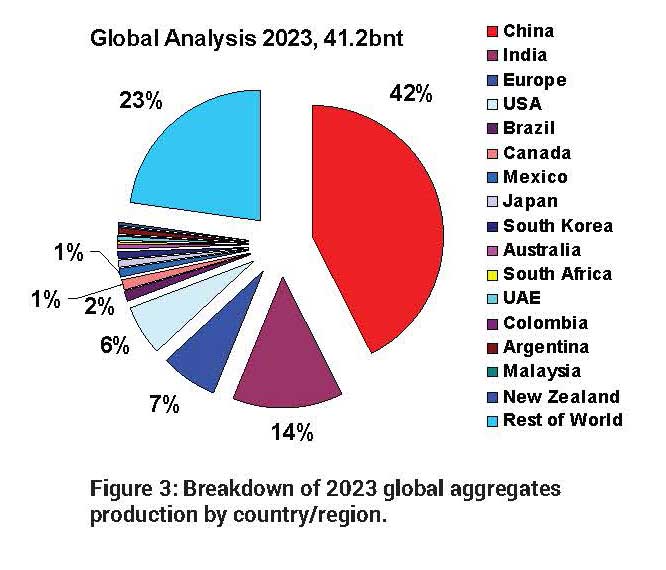
As the table shows, the GAIN total of 34.1bnt in 2019 has actually declined to 31.7bnt in 2023, the decline of 2.4bnt being mainly due to economic slowing in China plus the lingering impacts of COVID in developing regions. When estimates for non-GAIN countries are added (based on national populations x their estimated ton/capita), the global totals of 44.0bnt in 2019 has actually declined by 6.5 per cent to 41.2bnt in 2023. The breakdown by region is illustrated in Figure 3, still dominated by China at 42 per cent, with India coming second at 14 per cent, followed by Europe and the USA, these top four comprise 69 per cent of the global demand.
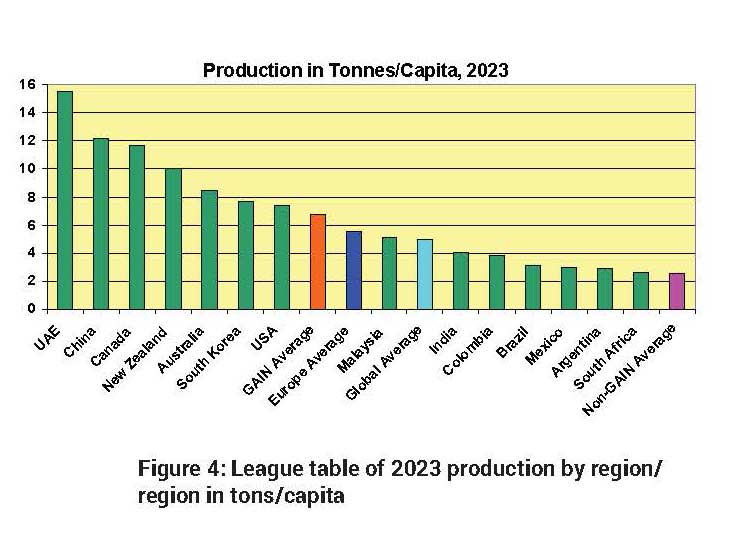
Figure 4 summarises the tonne per capita trends, again illustrating major growth potential in developing regions. The global average is 5t/c; for GAIN members the average is 6.8t/c and the non-GAIN average is 2.6t/c. For any country, the demand in tons per capita can be empirically related to GDP per capita – or more precisely, the rate of change in GDP/capita – plus upward adjustments for national terrain ruggedness and winter climate severity.
Looking specifically at India, production suffered a significant decline in 2020 during the pandemic, but is now back into strong growth with an estimated 5.6bnt for 2023, corresponding to 3.9t/c, only one-third that of China. While it is the second largest and fastest growing aggregates market globally, its aggregates industry remains highly fragmented, unfortunately without a much-needed fully-fledged national aggregates association. The current growth is being driven principally by massive infrastructural investments in roads, railways, ports and airports.
Most regions globally are in positive growth in 2023. It is hoped that the pre-COVID global demand of 44bnt could be regained by 2025, but that will depend predominantly on Chinese demand remaining stable. Looking ahead towards 2030, assuming a positive global geopolitical outlook with resultant economic growth, coupled with the twin demands of population growth and urbanisation, there is a possibility for global demand to reach 50bnt by 2030. These figures demonstrate that aggregates are by far the most used product on the planet, with the industry having an economic value similar to that of the cement sector, both points often overlooked.

The Environmental Product Declarations (EPDs),finds the average scope 1 emissions to be less than 5kgCO2/t of product.
Charting a Sustainable Future for Aggregates
A priority topic in the GAIN New Zealand meeting agenda was sustainability. Aggregates Europe-UEPG presented its pioneering roadmap ‘Neutral Aggregates 2050’. It analyses the life-cycle of aggregates, which are characterised as a high-volume, low-energy, highly-durable, fully-recyclable product.
Based on Environmental Product Declarations (EPDs), the average Scope 1 emission is found to be less than 5kgCO2/t of product, meaning that the aggregates industry emissions (despite aggregates being 10 times greater in tonnage than cement) are an order of magnitude lower than those for the cement industry. Transport to site has typically less than 5kgCO2/t Scope 3 emissions, underlining the desirability to locate quarries close to market.
Water Management
Aggregates Europe-UEPG is also developing Water Management Guidelines. These Guidelines had been developed from a massive database of studies in 240 sites in several European countries, indicating an average consumption of 92 litres/t of product. The document concludes with detailed practical guidelines on how to optimise water management in all types of extraction sites, both hard rock and sand and gravel. There are similar initiatives in other regions, particularly in water-stressed areas.
Restoration and Biodiversity
Quarry restoration and biodiversity are universally increasing in importance amongst all GAIN members, with the industry now having many excellent case studies, which have been acknowledged by Sustainable Development Awards in many countries.
Technical Challenges
China described innovations in crushing and screening performance, with better control of product gradations and increased power efficiency. Plant design is more modular, more compact on space, enclosed as far as possible, with extensive controls on both dry and wet emissions, often using long conveyor belts instead of truck haulage. Plant design flexibility, with high standards of environmental performance and low unit production cost, are key to the future.
Digitisation
In Europe, there were also impressive updates on digitalisation in the form of the EU-funded DigiEcoQuarry Project, which optimises all aspects of the quarrying process through digitalisation, as well as improving health, safety, environmental and social performance. The five pilot sites are focused on reserve optimisation, as well as blasting and mobile plant optimisation, best process and production controls. The results are expected to be highly beneficial for the wider industry.
Circularity
Likewise, the ROTATE Project is also EU-funded, its purpose being to increase the security of the supply of raw materials in Europe, while optimising the extraction and processing, increasing recycling and circularity. It involves 21 partners in 11 countries. The project focus is on better processing solutions, improving operating efficiencies, valorisation of by-products and wastes, as well as improving overall social aspects.
Access to Resources
Achieving access to resources, particularly near to major urban areas, for the coming decades is a universal challenge for GAIN members. The common drivers are migration, population growth, urbanisation, with the need to upgrade ageing infrastructure, and to provide resilience in climate adaptation. These challenges are even greater through ever-stricter regulations on air quality and water management.

Restoration of quarries and biodiversity are universally increasing in importance amongst all Global Aggregates Information Network – GAIN – members.
Addressing Irresponsible Extraction
GAIN members are committed to responsible extraction, and in parallel continue to cooperate with UNEP in its campaign against irresponsible sand extraction. Aggregates Europe-UEPG has agreed to work with its Pioneering Working Group within its Global Sand Observatory with the common intention of addressing this significant challenge in developing regions.
Enhancing Industry Image
Post-pandemic, there is a pronounced labour shortage across the industry, plus much raised work-life balance expectations. GAIN members shared valuable experiences in making the industry more attractive to young people. GAIN members also shared insights on recruitment campaigns, training programs and skills development. The global aggregates industry is estimated to employ 3.5 million people worldwide, offering great career opportunities.
PR and Communications
GAIN members are enhancing communications to all stakeholders, explaining also the vital roles the industry is playing in providing an essential product through local employment, caring for the environment, promoting recycling and fostering biodiversity.
GAIN Continues to Grow Globally
GAIN sees the formation of a fully-fledged national aggregates association in India as a top priority; possibly this could be encouraged by its well-established cement and concrete associations. GAIN is also growing its membership in South-East Asia, Latin America, the Middle East, in Central Asia and in Africa, driving the sustainability agenda for aggregates even more globally.
ABOUT THE AUTHOR:
Jim O’Brien, GAIN Convenor is a veteran of the building materials industry. He spent 39 years at CRH plc. He has spearheaded the formation of the Global Aggregates Information Network (GAINTM), a voluntary liaison network of regional and national aggregates associations around the world.









Concrete
Nuvoco Marks 10 Years, Targets 35 MMTPA Capacity by FY28
Nuvoco celebrates a decade of growth, targeting 35 MMTPA cement capacity by FY28.

Concrete
J&K Government Notifies City Gas Distribution Policy
Policy targets PNG and CNG expansion across all 20 districts
Concrete
JSW Cement Commissions 1 MTPA Grinding Unit at Nagaur
Nagaur unit lifts JSW Cement’s grinding capacity to 25.10 MTPA


Nuvoco Marks 10 Years, Targets 35 MMTPA Capacity by FY28

J&K Government Notifies City Gas Distribution Policy

JSW Cement Commissions 1 MTPA Grinding Unit at Nagaur

JSW Cement Commissions 1 MTPA Unit in Rajasthan

Wonder Cement appoints Mahesh Singh as VP Corporate Brand Communication
Nuvoco Marks 10 Years, Targets 35 MMTPA Capacity by FY28
J&K Government Notifies City Gas Distribution Policy
JSW Cement Commissions 1 MTPA Grinding Unit at Nagaur
JSW Cement Commissions 1 MTPA Unit in Rajasthan
Wonder Cement appoints Mahesh Singh as VP Corporate Brand Communication
-

 Concrete4 weeks ago
Telangana to Supply Subsidised Cement for Indiramma Houses
-

 Concrete2 weeks ago
Andhra Pradesh Clears Rs. 30 bn My Home Cement Plant
-

 Concrete2 weeks ago
JSW Cement Receives Rs. 2.3 bn GST Demand Notice
-

 Concrete4 weeks ago
Centre Defers Clearance for Limestone Mine Near Bustard Habitat