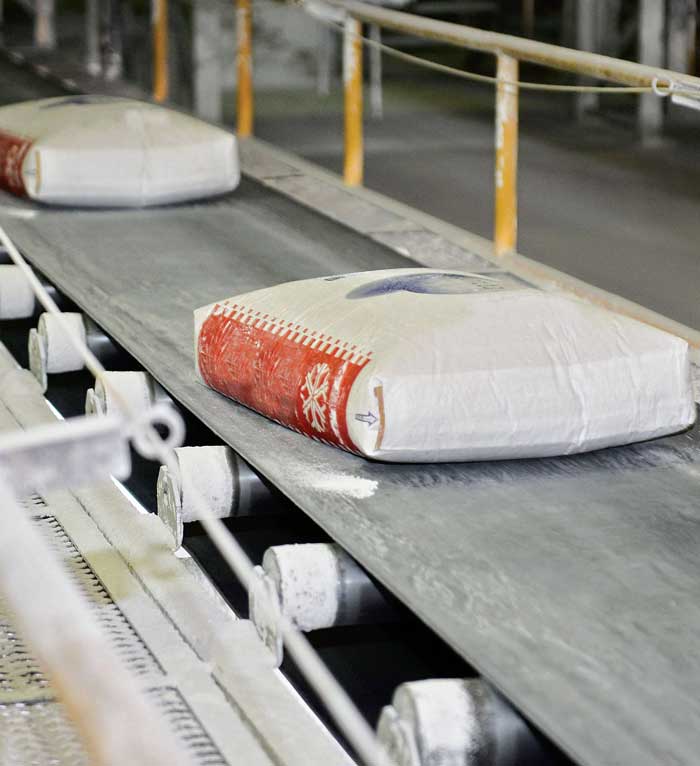
As a cement bag leaves a plant, it transcends from being a product to being a carrier of quality and brand reputation. No longer a despatch activity, today, cement packaging is a strategic link between production, logistics and the market. Together with automation and traceability, packaging is what holds product integrity and brand credibility together. ICR explores the growing importance of digital traceability, improved bag materials and automated packing systems.
In today’s cement industry, the journey of a bag from plant to project site is as critical as the product itself. As supply chains stretch across multiple touchpoints, from dispatch yards and transport networks to dealer warehouses and retail outlets, packaging has moved beyond its traditional role to become a key enabler of product integrity, operational efficiency and brand trust. With logistics accounting for nearly 20 per cent to 25 per cent of total cement costs and packaging contributing another 5 per cent to 7 per cent (CMA India, 2023; McKinsey, 2022), even minor inefficiencies can significantly impact margins. Additionally, industry estimates suggest that 1 per cent to 3 per cent of cement losses occur due to handling, pilferage and packaging issues, while global usage exceeds 30 billion cement bags annually (World Cement Association, 2023). As demand for reliability grows and supply chains become more complex, the focus is shifting towards smarter packaging systems backed by automation and traceability—turning every bag into a data point that enhances visibility, control and competitiveness.
Role of packaging in cement distribution
Cement packaging has traditionally been viewed as a functional necessity, designed primarily to protect the product from moisture and contamination during transit. However, with increasing distribution complexities and longer supply chains, packaging is now expected to ensure durability across diverse climatic conditions, particularly in markets like India where temperature and humidity variations are significant. According to a report by the Cement Manufacturers’ Association (CMA), nearly 2–3 per cent of cement losses occur due to handling and packaging inefficiencies, highlighting the need for more robust and reliable packaging systems (CMA India, 2023).
Marta Bortolotti, Division Manager Consumables, Haver & Boecker, says, “A bag serves as a powerful branding tool and a visual business card for each company. While some companies work with multiple providers for packaging, partnering with a single OEM expert, who understands the product, equipment, and production goals, provides unbeatable efficiency and peace of mind. With an integrated approach, every bag becomes a powerful asset for the brand and business.”
“When it comes to product packaging, every element, from design and materials to compatibility with machinery, product and closure type, plays a vital role in achieving both efficient function and a positive brand image. To maintain a competitive edge, producers must carefully evaluate their packaging choices” she adds.
In addition, packaging is increasingly being recognised as a key touchpoint for branding and differentiation. High-quality printed bags, especially BOPP laminated and block-bottom bags, not only improve shelf appeal but also enhance stacking efficiency and storage optimisation. A study by Smithers (2022) highlights that advanced packaging formats can improve pallet stability and reduce transportation losses by up to 15 per cent, thereby directly impacting logistics efficiency. This shift reflects a broader industry trend where packaging is becoming integral to both operational performance and market positioning.
From protection to performance
The choice of packaging materials in the cement industry has evolved significantly over the years, moving from paper-based sacks to polypropylene (PP) woven bags and now to advanced laminated structures. PP woven bags dominate the market today due to their strength, moisture resistance, and cost-effectiveness, accounting for over 70 per cent of cement packaging in emerging economies (MarketsandMarkets, 2023). These materials offer improved durability, reducing breakage and spillage during transportation.
The focus is now shifting towards performance-driven packaging that balances strength, sustainability and cost. Innovations such as BOPP laminated bags and block-bottom valve bags provide superior sealing, better print quality, and improved stacking efficiency.
Ana Juraga, Content Writer, Cortec Corporation says, “By adopting VpCI® films and papers, a facility eliminates the need for petroleum-based rust preventatives and the subsequent hazardous solvents required for their removal. This directly reduces the plant’s (VOC emissions and prevents the generation of solvent-contaminated runoff. In many jurisdictions, the reduction of hazardous waste at the point of origin is a key metric for industrial environmental compliance. Moving from a ‘wet’ preservation cycle to a ‘dry’ molecular cycle allows cement producers to streamline their environmental reporting while improving worker safety by removing hazardous chemicals from the workshop.”
According to Allied Market Research (2023), the global industrial packaging market is expected to grow at a CAGR of 4.5 per cent, driven by demand for high-performance and sustainable materials. At the same time, the environmental impact of plastic-based packaging is pushing manufacturers to explore biodegradable and recyclable alternatives, although cost remains a major constraint in large-scale adoption.
Understanding bag traceability
As cement distribution networks become more complex, the need for end-to-end visibility has become critical. Bag traceability enables manufacturers to track each unit from the plant to the dealer and end user, ensuring accountability and transparency across the supply chain. According to Deloitte (2022), companies implementing supply chain traceability systems have seen a 20–30 per cent improvement in operational efficiency and a significant reduction in losses due to pilferage and mismanagement. In the cement industry, where high volumes and low margins dominate, even marginal improvements can lead to substantial cost savings.
Traceability also plays a crucial role in combating counterfeit products, which remain a persistent challenge in developing markets. The OECD (2021) estimates that counterfeit goods account for 3.3 per cent of global trade, and the construction materials sector is not immune to this issue. By integrating traceability features such as unique identification codes and digital tracking systems, manufacturers can ensure product authenticity and build greater trust among dealers and customers. Moreover, traceability data can be leveraged for demand forecasting, inventory optimisation, and improved decision-making, making it a strategic asset rather than just a compliance requirement.
Technologies enabling traceability
A range of technologies is enabling effective bag traceability in the cement industry, each offering varying levels of sophistication and cost implications. Barcodes and QR codes are widely adopted due to their low cost and ease of implementation, allowing basic tracking and authentication.
Dr SB Hegde, Global Cement Industry Leader says, “The global cement packaging sector is expanding steadily, supported by growing infrastructure demand and increased emphasis on reliable and moisture-resistant packaging solutions. The cement packaging market is projected to grow steadily in the coming decade as companies adopt automation, smart packaging technologies and integrated logistics systems to improve despatch efficiency and supply chain transparency. In this context, benchmarking against global indicators helps cement plants identify performance gaps and adopt best practices such as automated bagging systems, QR-based traceability, ERP-linked despatch monitoring, and predictive maintenance of packing equipment.”
Meanwhile, RFID technology provides real-time tracking and enhanced data capture, although higher costs have limited its widespread adoption. According to McKinsey (2023), digital supply chain technologies, including IoT and RFID, can reduce logistics costs by up to 15 per cent and improve service levels by 20 per cent, making a strong case for their integration into cement packaging systems.
Combating leakage, pilferage and counterfeiting
Leakage and pilferage remain major challenges in cement logistics, particularly in markets with fragmented distribution networks. Industry estimates suggest that losses due to pilferage and handling inefficiencies can account for up to 1–2 per cent of total sales volume, directly impacting profitability (CMA India, 2023). Traceability systems help address these challenges by providing real-time visibility into product movement, enabling faster detection of anomalies and accountability at every stage of the supply chain.
Additionally, digital authentication mechanisms embedded in packaging can significantly reduce the circulation of counterfeit products, protecting both brand reputation and customer trust. A report by PwC (2022) highlights that companies implementing advanced tracking systems have seen a 30–50 per cent reduction in shrinkage, underscoring the tangible benefits of traceability.
Digital supply chains and erp systems
The integration of packaging systems with digital supply chains and ERP platforms is transforming how cement companies manage their operations. By linking packaging data with enterprise systems, manufacturers can achieve real-time visibility into production, inventory and distribution. This integration enables seamless coordination between different functions, from manufacturing to logistics and sales. According to SAP (2023), companies with integrated digital supply chains can improve forecast accuracy by up to 25 per cent and reduce inventory holding costs by 20 per cent, leading to more efficient operations.
Furthermore, digital integration facilitates data-driven decision-making, allowing companies to optimise routes, manage inventory levels, and improve customer service. Advanced analytics and AI-driven insights can help identify inefficiencies, predict demand patterns, and enhance overall supply chain resilience. As cement companies continue to invest in digital transformation, the convergence of packaging and digital systems will play a pivotal role in achieving end-to-end supply chain optimisation.
Balancing strength, cost and environmental impact
Sustainability is becoming a key focus area in cement packaging, driven by regulatory pressures and growing environmental awareness. The use
of plastic-based packaging materials has raised concerns due to their long degradation periods and environmental impact. According to the World Economic Forum (2023), only 9 per cent of global plastic waste is recycled, highlighting the urgent need for sustainable alternatives.
Cement manufacturers are increasingly exploring recyclable, biodegradable, and reusable
packaging solutions, although cost and performance trade-offs remain significant challenges. Achieving the right balance between strength, cost, and environmental impact will be critical for the future of cement packaging.
The future of cement packaging lies in the convergence of smart technologies and digital supply chains. Smart packaging solutions, embedded with sensors and IoT capabilities, can provide real-time data on product condition, location, and handling, enabling greater transparency and control. According to Gartner (2023), by 2027, over 50 per cent of supply chains will invest in real-time visibility technologies, reflecting the growing importance of digitalisation in logistics.
In addition, advancements in AI, blockchain and cloud computing are expected to further enhance traceability and data security. Blockchain-based systems, for instance, can provide tamper-proof records of product movement, ensuring authenticity and trust across the supply chain. As the cement industry continues to evolve, the adoption of smart packaging and digital technologies will be essential for improving efficiency, reducing costs, and meeting sustainability goals.
Conclusion
Cement packaging is undergoing a significant transformation, evolving from a basic protective function to a strategic enabler of efficiency, traceability and sustainability. As the industry grapples with rising costs, complex supply chains and increasing environmental concerns, packaging and traceability systems are emerging as critical components of operational excellence. The integration of advanced materials, digital technologies, and data-driven insights is reshaping how cement is packaged, transported and delivered.
Looking ahead, companies that invest in smart packaging and robust traceability systems will be better positioned to navigate industry challenges and capitalise on emerging opportunities. By embracing innovation and sustainability, the cement industry can build more resilient and efficient supply chains, ensuring long-term growth and competitiveness.


















 Concrete3 weeks ago
 Concrete3 weeks ago
 Concrete4 weeks ago
 Concrete3 weeks ago