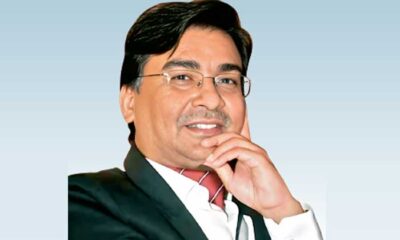
Dr Hitesh Sukhwal, Deputy General Manager – Environment, Udaipur Cement Works Limited (UCWL) takes us through the multifaceted efforts that the company has undertaken to keep emissions in check with the use of alternative sources of energy and carbon capture technology.
Tell us about the policies of your organisation for the betterment of the environment.
Caring for people is one of the core values of our JK Lakshmi Cement Limited. We strongly believe that we all together can make a difference. In all our units, we have taken measures to reduce carbon footprint, emissions and minimise the use of natural resources. Climate change and sustainable development are major global concerns. As a responsible corporate, we are committed with and doing consistent effort small or big to preserve and enrich the environment in and around our area of operations.
As far as environmental policies are concerned, we are committed to comply with all applicable laws, standards and regulations of regulatory bodies pertaining to the environment. We are consistently making efforts to integrate the environmental concerns into the mainstream of the operations. We are giving thrust upon natural resource conservation like limestone, gypsum, water and energy. We are utilising different kinds of alternative fuels and raw materials. Awareness among the employees and local people on environmental concerns is an integral part of our company. We are adopting best environmental practices aligned with sustainable development goals.
Udaipur Cement Works Limited is a subsidiary of the JK Lakshmi Cement Limited. Since its inception, the company is committed towards boosting sustainability through adopting the latest art of technology designs, resource efficient equipment and various in-house innovations. We are giving thrust upon renewable and clean energy sources for our cement manufacturing. Solar Power and Waste Heat Recovery based power are our key ingredients for total power mix.
What impact does cement production have on the environment? Elaborate the major areas affected.
The major environmental concern areas during cement production are air emissions through point and nonpoint sources due to plant operation and emissions from mining operation, from material transport, carbon emissions through process, transit, noise pollution, vibration during mining, natural resource depletion, loss of biodiversity and change in landscape.
India is the second largest cement producer in the world. The Indian cement industry is well known for its energy and natural resource efficiency worldwide. The Indian cement industry is a frontrunner for implementing significant technology measures to ensure a greener future.
The cement industry is an energy intensive and significant contributor to climate change. Cement production contributes greenhouse gases directly and indirectly into the atmosphere through calcination and use of fossil fuels in an energy form. The industry believes in a circular economy by utilising alternative fuels for making cement. Cement companies are focusing on major areas of energy efficiency by adoption of technology measures, clinker substitution by alternative raw material for cement making, alternative fuels and green and clean energy resources. These all efforts are being done towards environment protection and sustainable future.
Nowadays, almost all cement units have a dry manufacturing process for cement production, only a few exceptions where wet manufacturing processes are in operation. In the dry manufacturing process, water is used only for the purpose of machinery cooling, which is recirculated in a closed loop, thus, no polluted water is generated during the dry manufacturing process.
We should also accept the fact that modern life is impossible without cement. However, through state-of-the-art technology and innovations, it is possible to mitigate all kinds of pollution without harm to the environment and human beings.
Tell us about the impact blended cement creates on the environment and emission rate.
Our country started cement production in 1914. However, it was introduced in the year 1904 at a small scale, earlier. Initially, the manufacturing of cement was only for Ordinary Portland Cement (OPC). In the 1980s, the production of blended cement was introduced by replacing fly ash and blast furnace slag. The production of blended cement increased in the growth period and crossed the 50 per cent in the year 2004.
The manufacturing of blended cement results in substantial savings in the thermal and electrical energy consumption as well as saving of natural resources. The overall consumption of raw materials, fossil fuel such as coal, efficient burning and state-of-the-art technology in cement plants have resulted in the gradual reduction of emission of carbon dioxide (CO2). Later, the production of blended cement was increased in manifolds.
If we think about the growth of blended cement in the past few decades, we can understand how much quantity of , (fly ash and slag) consumed and saved natural resources like limestone and fossil fuel, which were anyhow disposed of and harmed the environment. This is the reason it is called green cement. Reduction in the clinker to cement ratio has the second highest emission reduction potential i.e., 37 per cent. The low carbon roadmap for cement industries can be achieved from blended cement. Portland Pozzolana Cement (PPC), Portland Slag Cement (PSC) and Composite Cement are already approved by the National Agency BIS.
As far as kilogram CO2 per ton of cement emission concerns, Portland Slag Cement (PSC) has a larger potential, other than PPC, Composite Cement etc. for carbon emission reduction. BIS approved 60 per cent slag and 35 per cent clinker in composition of PSC. Thus, clinker per centage is quite less in PSC composition compared to other blended cement. The manufacturing of blended cement directly reduces thermal and process emissions, which contribute high in overall emissions from the cement industry, and this cannot be addressed through adoption of energy efficiency measures.
In the coming times, the cement industry must relook for other blended cement options to achieve a low carbon emissions road map. In near future, availability of fly ash and slag in terms of quality and quantity will be reduced due to various government schemes for low carbon initiatives viz. enhance renewable energy sources, waste to energy plants etc.
Further, it is required to increase awareness among consumers, like individual home builders or large infrastructure projects, to adopt greener alternatives viz. PPC and PSC for more sustainable
resource utilisation.
What are the decarbonising efforts taken by your organisation?
India is the world’s second largest cement producer. Rapid growth of big infrastructure, low-cost housing (Pradhan Mantri Awas Yojna), smart cities project and urbanisation will create cement demand in future. Being an energy intensive industry, we are also focusing upon alternative and renewable energy sources for long-term sustainable business growth for cement production.
Presently, our focus is to improve efficiency of zero carbon electricity generation technology such as waste heat recovery power through process optimisation and by adopting technological innovations in WHR power systems. We are also increasing our capacity for WHR based power and solar power in the near future. Right now, we are sourcing about 50 per cent of our power requirement from clean and renewable energy sources i.e., zero carbon electricity generation technology. Usage of alternative fuel during co-processing in the cement manufacturing process is a viable and sustainable option. In our unit, we are utilising alternative raw material and fuel for reducing carbon emissions. We are also looking forward to green logistics for our product transport in nearby areas.
By reducing clinker – cement ratio, increasing production of PPC and PSC cement, utilisation of alternative raw materials like synthetic gypsum/chemical gypsum, Jarosite generated from other process industries, we can reduce carbon emissions from cement manufacturing process. Further, we are looking forward to generating onsite fossil free electricity generation facilities by increasing the capacity of WHR based power and ground mounted solar energy plants.
We can say energy is the prime requirement of the cement industry and renewable energy is one of the major sources, which provides an opportunity to make a clean, safe and infinite source of power which is affordable for the cement industry.
What are the current programmes run by your organisation for re-building the environment and reducing pollution?
We are working in different ways for environmental aspects. As I said, we strongly believe that we all together can make a difference. We focus on every environmental aspect directly / indirectly related to our operation and surroundings.
If we talk about air pollution in operation, every section of the operational unit is well equipped with state-of-the-art technology-based air pollution control equipment (BagHouse and ESP) to mitigate the dust pollution beyond the compliance standard. We use high class standard PTFE glass fibre filter bags in our bag houses. UCWL has installed the DeNOx system (SNCR) for abatement of NOx pollution within norms. The company has installed a 6 MW capacity Waste Heat Recovery based power plant that utilises waste heat of kiln i.e., green and clean energy source. Also, installed a 14.6 MW capacity solar power system in the form of a renewable energy source.
All material transfer points are equipped with a dust extraction system. Material is stored under a covered shed to avoid secondary fugitive dust emission sources. Finished product is stored in silos. Water spraying system are mounted with material handling point. Road vacuum sweeping machine deployed for housekeeping of paved area.
In mining, have deployed wet drill machine for drilling bore holes. Controlled blasting is carried out with optimum charge using Air Decking Technique with wooden spacers and non-electric detonator (NONEL) for control of noise, fly rock, vibration, and dust emission. No secondary blasting is being done. The boulders are broken by hydraulic rock breaker. Moreover, instead of road transport, we installed Overland Belt Conveying system for crushed limestone transport from mine lease area to cement plant. Thus omit an insignificant amount of greenhouse gas emissions due to material transport, which is otherwise emitted from combustion of fossil fuel in the transport system. All point emission sources (stacks) are well equipped with online continuous emission monitoring system (OCEMS) for measuring parameters like PM, SO2 and NOx for 24×7. OCEMS data are interfaced with SPCB and CPCB servers.
The company has done considerable work upon water conservation and certified at 2.76 times water positive. We installed a digital water flow metre for each abstraction point and digital ground water level recorder for measuring ground water level 24×7. All digital metres and level recorders are monitored by an in-house designed IoT based dashboard. Through this live dashboard, we can assess the impact of rainwater harvesting (RWH) and ground water monitoring.
All points of domestic sewage are well connected with Sewage Treatment Plant (STP) and treated water is being utilised in industrial cooling purposes, green belt development and in dust suppression. Effluent Treatment Plant (ETP) installed for mine’s workshop. Treated water is reused in washing activity. The unit maintains Zero Liquid Discharge (ZLD).
Our unit has done extensive plantations of native and pollution tolerant species in industrial premises and mine lease areas. Moreover, we are not confined to our industrial boundary for plantation. We organised seedling distribution camps in our surrounding areas. We involve our stakeholders, too, for our plantation drive. UCWL has also extended its services under Corporate Social Responsibility for betterment of the environment in its surrounding. We conduct awareness programs for employees and stakeholders. We have banned Single Use Plastic (SUP) in our premises. In our industrial township, we have implemented a solid waste management system for our all households, guest house and bachelor hostel. A complete process of segregated waste (dry and wet) door to door collection systems is well established.
Tell us about the efforts taken by your organisation to better the environment in and around the manufacturing unit.
UCWL has invested capital in various environmental management and protection projects like installed DeNOx (SNCR) system, strengthening green belt development in and out of industrial premises, installed high class pollution control equipment, ground-mounted solar power plant etc.
The company has taken up various energy conservation projects like, installed VFD to reduce power consumption, improve efficiency of WHR power generation by installing additional economiser tubes and AI-based process optimisation systems. Further, we are going to increase WHR power generation capacity under our upcoming expansion project. UCWL promotes rainwater harvesting for augmentation of the ground water resource. Various scientifically based WHR structures are installed in plant premises and mine lease areas. About 80 per cent of present water requirement is being fulfilled by harvested rainwater sourced from Mine’s Pit. We are also looking forward towards green transport (CNG/LNG based), which will drastically reduce carbon footprint.
We are proud to say that JK Lakshmi Cement Limited has a strong leadership and vision for developing an eco-conscious and sustainable role model of our cement business. The company was a pioneer among cement industries of India, which had installed the DeNOx (SNCR) system in its cement plant.















 Concrete4 weeks ago
 Concrete4 weeks ago
 Concrete4 weeks ago
 Concrete4 weeks ago