Connect with us

Concrete

Beyond the Gearbox: How a Holistic Lubrication Strategy Reduces Total Cost of Ownership in Cement Plants

Published

on

Shares

Cement manufacturing runs on rotating equipment, and every one of those assets is connected to the same bottom line. The plants seeing the biggest gains today are the ones that stopped treating lubrication as a line-item cost and started treating it as a plant-wide reliability strategy.

For India’s cement plants, the economics of operations come down to two variables: energy consumption and equipment uptime. Both are directly influenced by lubrication – not just at a single point in the plant, but across multiple critical systems running simultaneously, every day. Most lubrication conversations in cement manufacturing begin and end with the gearbox. That focus is understandable – gearboxes are among the most demanding and most expensive assets to maintain. But limiting the lubrication conversation to one asset type means leaving real savings on the table. The plants that are reducing total cost of ownership most effectively are those looking at lubrication strategy across the whole plant, not just the most visible application.

The Gearbox
Conventional mineral-based gear oils under high-load, high-temperature conditions can shear, lose viscosity, and force early change-outs – with oil changes at every 2,000 hours adding up in labour, downtime, and lost production over the life of the asset. Mobil SHC™ 600 Series synthetic lubricants are engineered for exactly these conditions. They can reduce energy consumption in gearboxes and circulating systems by up to 3.6 per cent*, extend oil life by up to six times versus conventional oil, and are approved by Siemens AG for use in Flender gearboxes. In one documented instance at a cement plant in Tamil Nadu, switching to Mobil SHC™ 632 delivered a 1 per cent increase in energy efficiency, a 3°C reduction in gearbox temperature, an oil drain interval extended by four times, and annual savings of INR 4,76,772**.
That result alone makes the case for better fluid selection. But it is only part of the story.

The Compressor: Where the Bigger Opportunity Often Sits
Compressors are as operationally critical as gearboxes in a cement plant – and typically receive far less lubrication attention. Running continuously under high load cycles, with lubricant exposed to sustained heat and oxidation, compressors on conventional oils often degrade faster than their scheduled drain intervals suggest. The result is increased maintenance frequency, elevated running temperatures, and higher total lubricant consumption than necessary.
Mobil Rarus SHC™ 1020 Series is formulated for exactly this environment. Recognised by more than 20 global compressor builders, it delivers up to 8,000 hours of oil life – significantly reducing change-out frequency and the associated downtime, labour, and disposal costs that conventional compressor oils generate.
The results from Indian cement plant operations are documented. In one instance, a cement sector facility operating 23 screw compressors reduced lubricant consumption from 10-12 litres per compressor to 5-7 litres, achieving annual savings of approximately INR 4,96,000**. In another, a cement manufacturer extended oil drain intervals by two times, lowered running temperature by approximately 10°C, and achieved annual savings of INR 4,86,747**.
The pattern across both operations is consistent: extended drain intervals, lower consumption, and measurable cost reduction – driven by a single product decision.

One Strategy Across the Plant
Gearboxes and compressors are only two examples. The same principle extends across a cement plant’s rotating equipment, mixer roll bearings, roll neck bearings, plastic calenders, and centrifuge applications all place similar demands on lubrication. Mobil SHC™ 600 Series spans seven viscosity grades, from ISO VG 32 to ISO VG 1000, giving plants the flexibility to match the right grade to the right application across this range of equipment, rather than defaulting to a single product for every use case.

The Bigger Picture
Energy and downtime are two of the largest controllable costs in cement plant operations, and lubrication is one of the few decisions that influences both directly. As demonstrated across the gearbox and compressor examples above, the right lubricant, matched to the right application and supported by field engineering services, can measurably reduce energy consumption, extend oil drain intervals, and lower maintenance costs.
For cement plants evaluating lubrication as part of a broader efficiency strategy, these results offer a starting point rather than an endpoint. Mobil SHC™ 600 Series and Mobil Rarus SHC™ 1020 Series are both engineered for the demanding conditions cement plants operate under daily, and the field results documented here reflect what that engineering can deliver in practice.
Fill with Mobil™. Fill with Confidence.

For more information, visit www.mobil.in/business

*Energy efficiency relates solely to the performance of Mobil SHC 600 when compared to conventional (mineral) reference oils of the same viscosity grade in circulating and gear applications. The technology used allows up to 3.6 per cent efficiency compared to the reference when tested in a worm gearbox under controlled conditions. Efficiency improvements will vary based on operating conditions and application.
**This Proof of Performance is based on the experience of individual customers. Actual results may vary depending on the type of equipment used, its maintenance, operating conditions, environmental factors, and the lubricants previously used, among other variables. Exxon Mobil Corporation has numerous affiliates, many with names that include ExxonMobil, Exxon, Esso, and Mobil. For convenience and simplicity, those terms, and references to “corporation,” “company,” “ExxonMobil,” “EM,” and other similar terms are used for convenience and may refer to one or more specific affiliates or affiliate groups.
For more information, visit www.mobil.in/business


Concrete

Cement Demand Strong As Prices Remain Stable

Volumes rise amid steady trade pricing and higher fuel costs

Published

on

By

Shares


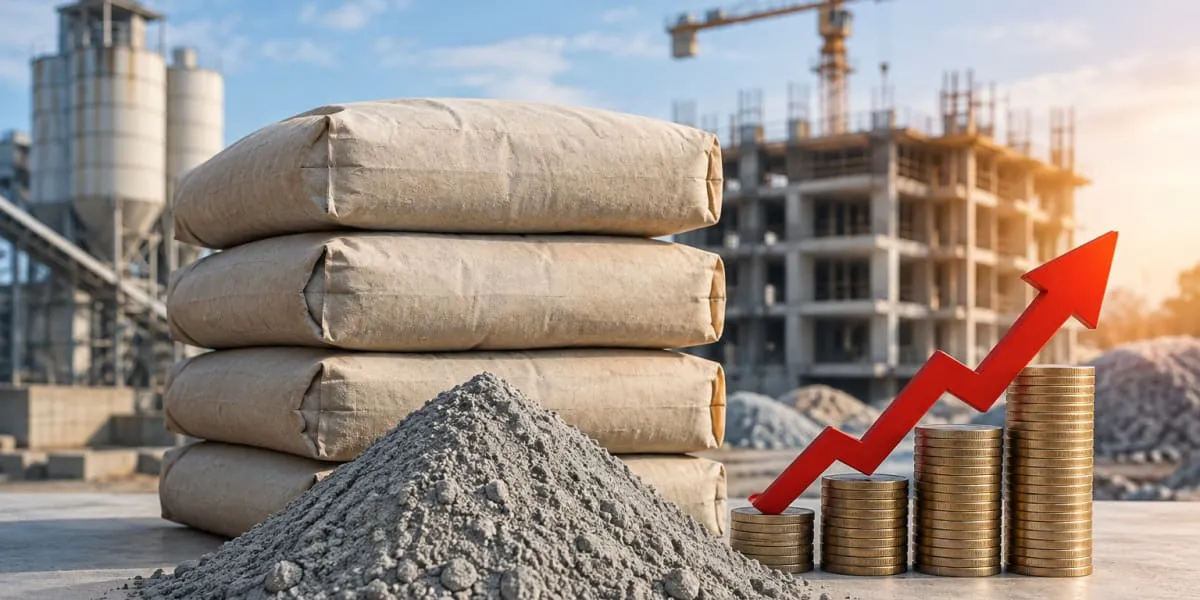
Channel checks show cement demand remained healthy with volume growth estimated at six to seven per cent in July and August 2026. Trade prices were broadly stable while non-trade prices were volatile in the East, and attempted hikes were rolled back amid higher competition. Average fuel costs rose in August by five to nine per cent, lifting spot petcoke and coal prices.

All-India trade price remained flat month on month in August as increased rake supplies and competition offset early increases. Monsoon related demand softness limited sustained hikes and dealers indicated further attempts would depend on demand trends. Combined July and August volumes were estimated at six to seven per cent, supported by infrastructure spending while retail housing remained weather sensitive.

In the South, a Rs20 a bag hike in August did not hold and prices stayed flat month on month, while dealers planned Rs25 to Rs30 a bag from fifth September 2026 but with uncertain sustainability. In the East, trade prices were unchanged and non-trade prices corrected by Rs15 to Rs20 a bag amid weak construction in West Bengal, Jharkhand and Odisha.

The West remained most resilient on pricing and demand despite attempted hikes of Rs10 to Rs15 a bag, and Gujarat saw relatively better volumes in August. North and Central markets kept prices range bound as players focused on ramping up utilisation of new capacity, with schemes of up to Rs2 to Rs3 a bag used to meet month-end targets. Overall construction activity improved as the monsoon eased, aiding a pickup in several states.

Fuel cost pressures persisted, with South African coal at USD114 a t and petcoke around USD146 to USD147 a t in August, while spot imported petcoke and coal were higher. Imported coal consumption cost stood at Rs2.07 per Kcal and petcoke at USD2.11 per Kcal. Analysts estimate the all-India trade spread to decline by Rs90 to Rs100 a t quarter on quarter, weighing on near-term profitability and they prefer UltraTech Cement (UTCEM), JK Cement (JKCE) and Grasim Industries (GRASIM).

Continue Reading

Concrete

Aditya Birla Group Launches Ultravolt Wires And Cables Business

UltraTech extends building solutions into electrical wiring

Published

on

By

Shares


Aditya Birla Group has entered the wires and cables market through Ultravolt, extending UltraTech’s move from building materials into building solutions. The shift builds on UltraTech Building Solutions, a multi-category platform that already addresses customers across different stages of construction and extends beyond cement into ready-mix concrete, waterproofing, tile-fixing solutions and mortars.

The company intends to enter with scale, seeking presence across 100,000 retailers in more than 500 districts and availability through 5,000 plus UltraTech Building Solutions (UBS) outlets. The portfolio spans house wires, light-duty cables, communication cables, solar cables and low-tension and industrial cables to meet changing electrical requirements driven by solar installations, communications infrastructure and industrial automation.

An upstream advantage begins in the Group’s metals ecosystem, with conductor quality central to product performance. Ultravolt wires will use TruePure Copper, defined as 99.97 per cent pure electrolytic-grade annealed copper sourced from Hindalco, providing greater control over raw material quality and provenance and supporting electrical performance, safety and durability.

The business also targets the electrician community as a decisive influence on product choice and installation quality. The Wires and Cables Business has launched a Skill India Electrician Training Programme in partnership with the Electronics Sector Skills Council of India that aims to train and certify more than 40,000 electricians across India over the next year, focusing on safe wiring practices, correct installation and advanced wire technologies and offering Skill India-aligned certification and identification credentials.

The move combines market opportunity, UltraTech’s construction ecosystem, manufacturing capability and Group-level resources. A large Gujarat facility, advanced machinery and in-house testing and research and development underpin the product strategy, which is designed for both traditional and emerging applications. The ambition is to build a scaled national brand and become one of the top two players within five years, making the Group an integral participant in modern building infrastructure.

Continue Reading

Concrete

Ramco Cements Mine Restoration Gets Global Biodiversity Certification

Pandalgudi mine restoration receives Advanced Certification from TGBS

Published

on

By

Shares


The ecological restoration of Ramco Cements’ limestone mine at Pandalgudi in Virudhunagar district, Tamil Nadu, has received international recognition with the site being awarded Advanced Certification by The Global Biodiversity Standard (TGBS). The recognition makes Pandalgudi the first site in Peninsular India to receive the certification and places it among globally recognised biodiversity restoration projects.
TGBS, recognised by the International Union for Conservation of Nature (IUCN) and the Convention on Biological Diversity (CBD), assesses biodiversity restoration projects based on scientific evaluation and their contribution to ecosystem recovery and local communities. The certification is supported by more than 250 scientists and academics worldwide.
Spread across over 500 acres of worked-out mine areas, the restoration project includes a certified 234-acre site. Initiated in 2018 with technical support from Auroville Botanical Gardens, the project began plantation activities in 2019 and is expected to be completed by 2027. More than 430,000 native trees and shrubs belonging to 150 ecologically significant species have been planted at the site.
The restored mine, which was once a barren landscape with limited biodiversity, has recorded over 72 bird species and 53 butterfly species. The project has also captured an estimated 10,000 tonnes of carbon dioxide over the past seven years, supporting broader sustainability and carbon reduction goals.
Opened officially in 2022, the site has attracted more than 13,000 visitors through educational programmes for schools, colleges and training institutions. The restoration initiative has also contributed to the development of the Rajapalayam Masterplan and supported Tamil Nadu’s carbon neutrality ambitions.
Commenting on the achievement, Mr P. R. Venketrama Raja, Chairman, Ramco Group, said the company aims for the Pandalgudi restoration project to serve as an inspiration and blueprint for the mining industry in India. Dr David Bartholomew, CEO, The Global Biodiversity Standard, highlighted the project’s long-term commitment to biodiversity recovery and independent assessment of ecological outcomes.
The certification reinforces Ramco Cements’ focus on sustainable mining practices and ecological restoration as part of its commitment towards a carbon-neutral future.

Continue Reading

Video Thumbnail

    SIGN-UP FOR OUR GENERAL NEWSLETTER

    Trending News