Connect with us

Concrete

Fuller Technologies QCX® Lab Automation Systems

Published

on

Shares

Rizwan Sabjan, Head of Sales & Proposals, and Ramakrishna Nuti, Global Sales Manager -Automation Technologies, Fuller Technologies Cement India, discuss cement laboratory automation.

India’s cement industry is on a strong growth path, driven by infrastructure projects and urban housing demand, with the market expected to grow at over 10 per cent CAGR through 2030. Over the next five years, the sector will reshape the nation by powering mega-corridors, smart cities, and expanding urban centers, while adopting green cement and alternative fuels and waste-heat recovery systems to cut emissions.
The cement manufacturing sector faces mounting pressure from rising demand for high-quality cement products and increasingly stringent environmental regulations. To remain competitive, organisations must enhance productivity, ensure regulatory compliance, and reduce operational costs, all without compromising product quality. These challenges are further intensified by skills shortages, stricter safety requirements, and the need to manage more complex and demanding operating conditions.

The Challenges of Going Green
The cement manufacturing process has evolved significantly as the industry strives to improve cost efficiency and environmental performance. The growing use of alternative fuels and supplementary cementitious materials introduces variability that directly impacts product quality, requiring continuous monitoring and adjustment through precise, agile quality control systems. At the same time, increasing market demand for specialised products places greater emphasis on maintaining tight process control across all stages of production.
To fully capitalise on these opportunities, quality control systems must respond rapidly and effectively to changing conditions. Their ability to deliver timely, accurate insights is critical, often determining whether a plant can maintain competitiveness or risks losing market share.

Automated Laboratory Solutions
Fortunately, the capability of quality control systems has grown immensely in recent years. Where previously plants relied on the skills of their laboratory team, today automated laboratory solutions can achieve optimum consistency in representative sampling, better solid sample preparation and accurate analysis through fast, automated systems. As one can see below there has been tremendous growth in QCX/RoboLabs® in recent years.
Fuller has been a pioneer in this field. With our Lab Automation Solution, cement plants can say goodbye to inconsistencies in quality and excess operational costs, such as a daily variation in power and fuel consumption. They are no longer held back by the skills shortage, or unable to take on the challenge of greener production for fear of undermining quality.
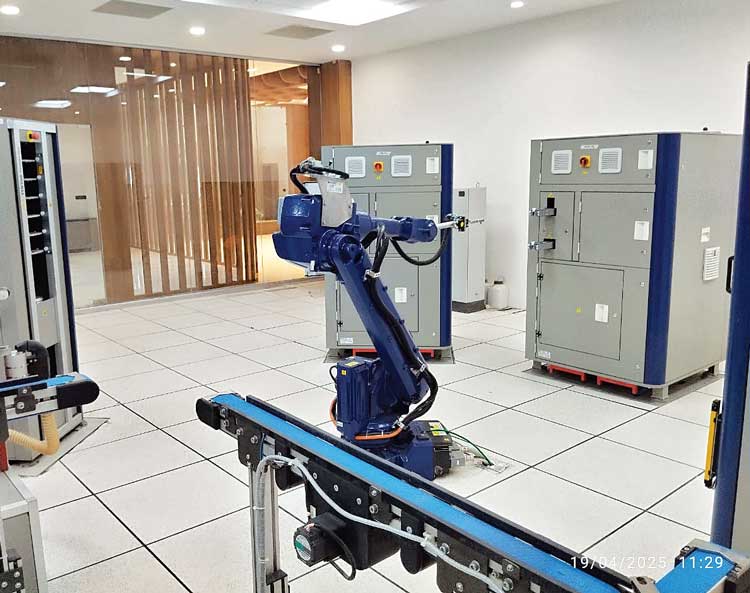
QCX/RoboLab® is a quantum leap in quality control for the cement industry, delivering consistency throughout quality control operations.
The QCX/RoboLab® laboratory concept, which utilises an industrial robot for sample handling allows for very flexible laboratory layouts and a high sample throughput.
Lab Automation speeds up every aspect of quality control operations, from sampling / sample collection to accurate pellet preparation for analysis, and especially when it comes to taking control actions to achieve a desired target with QCX/BlendExpert™ (Raw Mix Control). Plus, by eliminating the potential for manual errors, precision is significantly increased. And the laboratory becomes a much safer environment, with fewer operators and a far reduced risk to health and safety. The advanced, user-friendly software can be tailored to your specific cement production needs, including special fuels, and supports continuous 24/7 operations.

Benefits of QCX® Lab Automation System
Enhance quality control

Achieve consistent, reliable results through automated sampling, preparation, and analysis—eliminating human errors and variability.
Reduce fuel and energy consumption Improve raw material consistency to optimise preheater and kiln performance, leading to lower fuel usage and energy costs.
Ensure a safe and healthy work environment
Minimise exposure to hazardous tasks by automating processes and maintaining clean, dust-free laboratory and sample preparation areas.
Strengthen competitive advantage
Deliver superior product quality by leveraging best-in-class technology and advanced process control systems.
Extend equipment lifespan
Stabilise operations to reduce mechanical stress and wear, increasing the durability and reliability of plant machinery.
Simplify compliance and management
Meet quality standards with ease while supporting continuous improvement through automated reporting and data-driven insights.

Productivity Quality Savings Safety
Fast and accurate results with consistency in operational behavior 24/7/365 Uniformity in quality control with sound chemistry that doesn’t compromise on safety Reduced number of unplanned stoppages with precise chemistry recipe  2 × 350 TPH

Continue Reading

Concrete

Dhanekula Institute Signs MoU with Adani Cement

Agreement to expand internships, industrial visits and practical learning

Published

on

By

Shares


The Department of Civil Engineering at Dhanekula Institute of Engineering & Technology, Ganguru, organised an industrial interaction programme under the Adani FutureX Programme on Thursday. The programme focused on strengthening engagement between the institute and the cement industry while giving students greater exposure to professional practices.

Yedukondalu, technical head for Andhra Pradesh and Telangana at Adani Cement, delivered a technical lecture on concrete as a man-made material. The session covered the importance of concrete in construction, its properties and applications, and its significance in modern infrastructure development.

The lecture also addressed the role of quality cement and suitable concrete technology in supporting durable and sustainable construction. The discussion connected classroom learning with the technical considerations involved in infrastructure projects and construction practices.

A key part of the programme was the signing of a memorandum of understanding (MoU) between the Department of Civil Engineering and Adani Cement under the Adani FutureX Partnership Agreement. The agreement is intended to strengthen industry-academia collaboration through opportunities for student internships and industrial visits.

The initiative is expected to provide students with practical exposure, improve their understanding of industrial practices and help bridge the gap between theoretical knowledge and real-world applications. Dhanekula Institute Chairman Dhanekula Ravindranath Tagore, Secretary Dhanekula Venkata Bhavani Prasad and Director DKRK Ravi Prasad supported the initiative, with the institute leadership highlighting the importance of industry-institution interaction in enhancing students’ technical employability.

Continue Reading

Concrete

JK Lakshmi Cement Begins Rs. 110 bn Assam Plant Project

Project Kamakshi will produce 2.5 mn t of cement annually by FY2029.

Published

on

By

Shares


JK Lakshmi Cement has laid the foundation stone for Project Kamakshi, its first integrated cement manufacturing facility in Assam, marking the company’s entry into Northeast India. The groundbreaking ceremony took place at Umrangso village in Dima Hasao district in the presence of Assam Chief Minister Himanta Biswa Sarma.

The project involves an investment of Rs. 110 bn, including the mining lease. It will have annual cement production capacity of 2.5 mn t and a 1 mn t clinkerisation unit, with completion scheduled for FY2029.

The facility is expected to create more than 2,000 jobs and will primarily serve the growing Northeast market. It will also include dedicated railway sidings for transporting raw materials and finished cement, supporting supply chain reliability and regional distribution.

Chairperson and Managing Director Vinita Singhania said the project represented the beginning of a long-term relationship with Assam and the wider Northeast. She said the plant would help provide locally produced cement, employment and dependable supplies as the region’s infrastructure development accelerated, while enabling the company to grow alongside the communities it serves.

The investment supports JK Lakshmi Cement’s strategy of expanding into high-growth markets beyond its established presence in Northern, Western and Eastern India. The company expects the project to contribute to regional economic development and infrastructure growth while pursuing its long-term objective of achieving net-zero emissions by 2047.

Continue Reading

Concrete

Kshatriya Engineering College Signs MoU with Adani Cement

Agreement to provide students with industrial exposure and training

Published

on

By

Shares


The civil engineering department of Kshatriya Engineering College in Nizamabad has signed a memorandum of understanding (MoU) with Adani Cement to provide students with industry-oriented training and practical exposure. The agreement is intended to connect classroom learning with workplace requirements in the construction sector.

Under the partnership, students will receive opportunities to take part in industrial visits and internships. The arrangement will also include guest lectures by industry experts and guidance on live projects, allowing students to gain first-hand understanding of industry practices and emerging construction technologies.

College secretary and correspondent Aljapur Devender said the initiative was designed to bridge the gap between academic instruction and industry expectations. He said the collaboration would help students develop practical skills and improve their employment prospects after completing their studies.

Principal Dr Katakam Srinivas said exposure to industrial practices was important for civil engineering students and would complement their academic learning. He said the MoU would support the development of their technical knowledge and confidence through greater familiarity with professional work environments.

Administrative officer B. Narender said the collaboration would familiarise students with modern construction technologies, quality standards and project management practices. Civil engineering department head N. Deepika said the agreement would help students understand recent developments in the construction sector and prepare for professional careers. The college said the partnership would give learners a broader view of the processes and standards followed in the industry, while helping them relate their academic studies to practical project requirements.

Continue Reading

Video Thumbnail
▶

    SIGN-UP FOR OUR GENERAL NEWSLETTER

    Trending News

    SUBSCRIBE TO THE NEWSLETTER


    Don't miss out on valuable insights and opportunities to connect with like minded professionals.


      This will close in 0 seconds