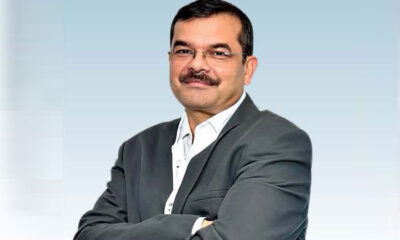
Vimal Choudhary, President and Logistics Head – HeidelbergCement India, discusses how bulk distribution impacts cost and the measures his company is taking to ensure smooth operations of their distribution channels.
What is the volume of production in your cement plants and how much of it goes in bulk distribution?
Currently, HeidelbergCement India produces about 9MT cement pan-India. Our production is divided in two parts, central India and south India producing 4.8 MT and 4.2 MT respectively.
23 per cent produced in the south is transported through bulk. In central India, we do not transport on a bulk basis.
Which is the most suitable mode of transport for carrying large quantities of cement and why?
Depending on the distance, we choose the most viable mode of transport for cement. Preference is always based on that. For shorter distances, roadways are considered as it takes less time to reach the customer, handling is less and cost is less. If cement needs to be sent to a longer distance, then railways is preferred as it would allow a much larger quantity to be transported in one go.
Earlier there were concessions allotted to cement manufacturers for transporting cement through the railways, however, those have been withdrawn now. However, what we choose as a mode of transport is not only based on cost, it is also dependent on the service to the customer.
By road, the end product directly reaches the customer. The bag quality remains good with the least amount of deterioration to the bag. But in case of rail, the material goes through material handlings like from factory to railway platform, platform to cargo containers. It is then loaded into smaller trucks at the destination and then reaches the customer. In some cases, it goes to the warehouse, then railways, then customers. This amount of bag handling hampers the bag quality. When the distance to be covered is beyond 300 km, then we consider rail transport as it also presents a large cost advantage.
What are the various advantages attached to bulk distribution of cement?
There are various advantages attached to bulk distribution of cement.
Foremost advantage in transporting cement by bulk is to the environment. In this transportation, we end up using a smaller number of plastic bags which would otherwise be used in smaller quantities of transport. Along with that, dust emission is also very low as compared to loading and unloading of smaller quantities.
A major advantage of transporting cement in bulk is the saving of bag cost. It costs less than transporting smaller quantities and that is why it is widely considered.
A technical advantage is experienced during monsoon. Due to the high humidity levels and moisture, cement usually gets hydrated, which is a loss for us. However, in bulk transportation there is no hydration as the bulkers are air-tight.
Smaller quantities bagged cement present a large chance of adulteration, however, that is not possible in case of bulk transportation. Once the bulker is locked, it is unlocked only at the destination upon reaching the customer.
How does distribution or transportation of cement in bulk impact the end user cost of the product?
In case of bulk, we save a certain amount on the bag cost, but pay a higher amount in freight cost. Example, the cost of a bulker is higher than the bulk trucks. More or less, the cost almost balances itself. Ultimately, the customer gets to witness only a minor difference in their cost. However, bulk buyers get good discounts from us as they pick up large quantities from us.
This cost and demand are different from market to market.
What are the major challenges or gaps faced by your organisation in the bulk distribution domain?
One of the major challenges that we face with bulk cement is consistency in orders. We cannot transport this bulk of transport to anyone else. There are limited buyers in the market. If the orders are received on a regular basis, our system works smoothly and the customer also keeps receiving their cement load in a timely fashion.
Sometimes in South India, we face detention time for the bulkers. Sometimes when we send our bulker to the customer, their silo may already be full. They then utilise their pre-existing load, empty the silo to accommodate cement from the bulker. This duration accounts as cost to us as it is a detention time for the bulker.
Countering this challenge is dependent on the market because bulk buyers are limited. For example, in Bangalore, we sell 25 per cent cement in bulk and 75 per cent cement in bags. We cannot switch over the customers. Only those in need will purchase or consume the product. This gap can be filled by installing more silos which will create space for some more quantity of cement storage and allow bulkers to be free sooner with a lesser detention time.
There are some organisations that are providing silos to customers to promote purchases in bulk cement. The idea behind this is to work towards reducing carbon emission. And bulk cement is preferred as it is environment friendly.
Taking examples from the mature markets of the western countries, they are all consumers of bulk cement. In India, buyers only from the big cities have bulk purchases, buyers from other cities still prefer purchases in small quantities.
Is there a specific reason why international markets have bulk cement transportation in much larger quantities?
Traditionally people in the international markets prefer a ready mix. In some countries there are laws that do not allow mixing to be done at the site, hence, the consumption of ready mix. These users consume bulk cement. Bag cement is used for smaller repair purposes, but if a larger construction project is happening, bulk ready mix orders are placed.
Explain your organisation’s distribution model.
Our distribution in central India is 55 per cent by rail and 45 per cent by road. In south India, 90 per cent distribution happens by road and 10 per cent by rail.
This difference between the use of rail and road in South India and Central India stem from the difference in the distances. In South India, point A to point B is shorter by road as compared to by rail.
We are operating about 70 warehouses in central India and about 90 warehouses in south India. This helps us provide better services to our customers. As a logistics manager, I will always prefer direct delivery to the customer as it involves the least damage to the product and saving of cost as well. But ultimately, a balance has to be drawn between the cost and the service to the customers and warehouses allow us to do that. Most of these warehouses are
maintained in bigger cities where the entry restrictions are a minimum.
Is the preference of using roadways more than railways also stemming from the road conditions of the country?
The road conditions in India have in recent times become so much better. National Highways are in good condition and provide great connectivity as well. Earlier we used to have smaller trucks – 15 tonnes or 18 tonners, the size of those have increased to become 36 tonners. To take cement to warehouses, we sometimes use 45 tonner trucks also.
Roadways have largely improved their condition as compared to railways. Earlier the industry transported 36 per cent by rail, 62 per cent by road and 2 per cent by sea. Now the rail coefficient has significantly dropped to 25 per cent. Since it is easier to handle the material, organisations are preferring roadways as a medium to transport their product.
At the railway platforms, we have to deal with unions for secondary movements or product handling which is a tricky affair. Roadways take the material to the customers with minimum handling.
How can a curated logistics system help in achieving the sustainability goals for the industry?
Logistics of a cement plant can contribute to the sustainability goals in a couple of ways.
Increasing the transportation by rail will result in a better environment. The carbon emission in railway transportation is much lower compared to roadways. Bulk cement transportation should be increased, as it will largely reduce the use of plastic bags and the dust emission that happens in loading and unloading of smaller packs. From the warehouses, we use trucks that use diesel or other fossil fuel, instead, the organisations must use CNG fitted trucks for shorter delivery distances. This will largely reduce the carbon dioxide emitted and better the environment.
Our organisation is focused on achieving its sustainability goals. We plant trees and also push our transporters to plant trees as well.
What are the key changes the industry is likely to witness in the near future?
With rising competition in the industry, service levels have become very important to the customers. They always chose those that provide materials the fastest. Services for the customers are going to significantly increase and become better in the
near future.
Driver scarcity is also something I can see in the near future for the industry. Currently we also have availability of trucks but a lack of drivers. This is happening mainly because it isn’t a lucrative enough business and requires a much larger labour. This is the reason people aren’t going for truck driver training and are opting for other paying roles. The industry needs to build an incentive plan to attract more drivers for our fleet.
Another change in the future will be reduced lead time and distance from the markets.
Some organisations have started installing grinding units closer to the market to achieve the same.
And more organisations will follow a similar pattern. This will also make material reach much faster to the customers.
–Kanika Mathur

















 Concrete1 month ago
 Concrete4 weeks ago
 Concrete1 month ago
 Concrete3 weeks ago