Connect with us

Concrete

Combating Material Accumulation in Cement Plants

Published

on

Shares

A state-of-the-art cement plant has resolved material accumulation issues in its limestone silo by combining high-efficiency cleaning techniques with powerful, strategically-placed air cannons to prevent further build-up.

The Drake Cement facility to miles north of Paulden, AZ was experiencing clogging issues on a weekly basis, forcing maintenance personnel to spend up to 12 hours to clear the blockage using tools and compressed air. During damp weather, the problem worsened, and at times the large structure would fill in as little as two hours, forcing operators to use CO2 blasting tubes every 15 to 30 minutes.

Technicians from Martin Engineering were able to clear the blockage on a short-notice visit, and then revised the site’s air cannon system to prevent the issue from recurring.

Drastic Measures
A key component of Drake’s dry-process manufacturing is efficient material flow. Excessive rain in the months of January through March caused the limestone being extracted from the nearby quarry to have elevated moisture levels. Not only does the rain cause standing water, but the limestone is also wetter coming out of the ground.

Little of that water is lost in the crushing process, and dry material can absorb moisture as it is reduced in size. So in the winter months, by the time the material lands in the 536-tonne (486 metric tonne) limestone silo, it is nearly saturated. In prior years, the silo had not experienced a single flow disruption, nor had it required cleaning due to the aid of two Martin? XHV air cannons. Adequate in previous years to keep material flowing at required volumes through all seasons, the air cannons were unable to prevent clogging at such high moisture levels.

"This plant is one of the most advanced operations of its kind, with advanced operating and pollution controls found in only a few other facilities in the world," explained Jose Venegas, Maintenance Manager, Drake Cement. "I had a Martin representative coming out to look at another part of the plant, but when the silo clogged, that took immediate priority. The problem had become disruptive, expensive and hazardous. We needed it solved once and for all."

Limestone Snowballs
When Martin Engineering’s National Business Development Manager Doug Brown arrived at the plant, he found a silo so compactly clogged that it had halted the entire production process. "Inspecting the silo for a solution, we realized that the limestone could be packed like snowballs, dense enough to stick to the wall when thrown," said Brown, adding "This demonstrated just how serious the problem was. We luckily had a silo cleaning crew that had just finished a job in Tucson, AZ, so they were quickly dispatched north to the plant."

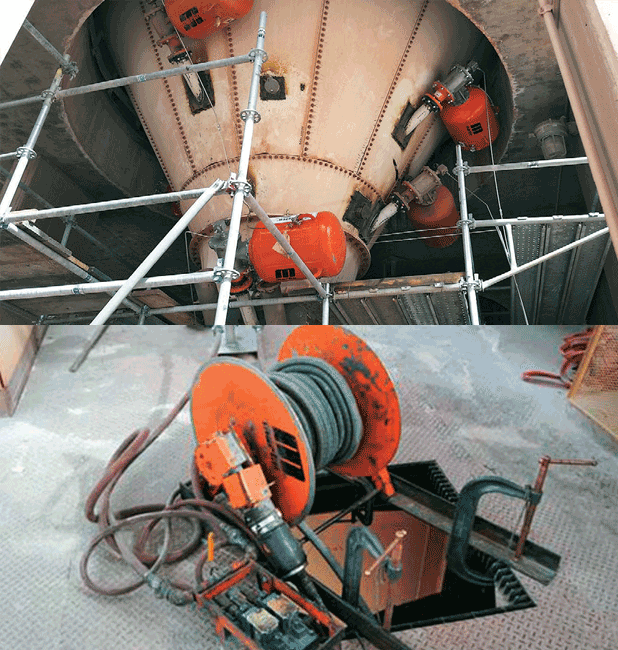
The experienced two-man crew immediately set up a Martin? Heavy Duty Whip. Powered by compressed air, the device can be equipped with a variety of flails and cutting edges to knock down accumulated material without damaging the silo’s walls or support structure. Requiring no confined space entry, the device was set above the manhole opening at the top of the vessel and maneuvered by remote control. "Working together with the electrical and maintenance departments, we were able to continue operations during the cleaning process," Venegas said. "This really helped us avoid what could have been some costly downtime."

Long Term Prevention
Once the silo had been completely evacuated, Brown – a flow aid specialist – realized that the ongoing problem could be remedied by utilising Drake’s current stockpile of air cannons. Using an innovative placement strategy, Brown was certain that the cannons could safely prevent buildup and promote efficient high-volume material flow, no matter how moist or dense the limestone.

Rather than the two cannons at the bottom of the limestone silo firing across the cargo flow, five cannons were strategically placed around the vessel. Three 70-litre Martin? Tornado Air Cannons were placed on the lower incline of the cone at a 30? downward angle against the 60? slope in the 6 and 12 o’clock positions (one side of the silo was inaccessible). In the 3 o’clock position, one air cannon was situated at the 2-foot – wide shaft, and another was added to the upper silo to aid in loosening material.

Already fitted with 53 XHV and Tornado Air Cannons throughout the plant, a programmable logic control (PLC) system centrally placed in the facility coordinates and monitors the timing and firing sequence of each unit at all locations, including the limestone silo. During the wet winter and monsoon months, the cannons are activated approximately every hour, but throughout the rest of the year the system has a firing sequence of only 4-5 times per day. This pattern can also be manually activated from the weigh feeder, at the solenoid panel or in the control room.

Results Demonstrated
Since installation, plant production has returned to normal levels. Material flow is ongoing, and the silo has not been shut down for cleaning. There has been no unscheduled downtime due to clogging, which has greatly increased production, especially through heavy weather periods. The use of CO2 tubes has been ceased altogether. When a buildup is detected, workers no longer are required to get close to the area to resolve it, increasing plant safety and reducing the number of man-hours required to maintain the silo.

"This equipment upgrade has paid for itself many times over," Venegas said. "We are extremely happy with the results. The service was fast, responsive and well coordinated. During our next scheduled outage, we’re going to have a Martin Engineering team out here to consult on other areas where we might need air cannons, so that we can maximize production. We look forward to an ongoing and productive relationship."


Continue Reading
Click to comment

Leave a Reply

Your email address will not be published. Required fields are marked *

Concrete

Cement Margins to Erode as Energy Costs Rise: CRISIL

CRISIL warns of 150–200 bps margin decline this fiscal

Published

on

By

Shares

Crisil Intelligence (CRISIL) released a report on April 13, 2026, indicating Indian cement manufacturers face margin erosion of 150–200 basis points this fiscal, reducing operating margins to between 16 per cent and 18 per cent. The firm noted that this represents a reversal from the prior year when margins expanded by 260–280 basis points. The analysis attributed the shift to rising input costs despite steady demand.

The report said that power and fuel, which typically account for about 26–28 per cent of production cost, are expected to increase by 10–12 per cent year on year, driven by higher prices for crude oil, petroleum coke and thermal coal. Brent crude was assessed as likely to trade between $82 and $87 per barrel, and industrial diesel prices rose by 25 per cent in March, raising logistics and procurement expenses. Such increases have therefore heightened cost pressures across the value chain.

Producers plan to raise selling prices by one–three per cent, which would put the average retail price of a cement bag at around Rs355–Rs360, according to the report. CRISIL’s director Sehul Bhatt was cited as saying that these hikes will at best offset a four–six per cent rise in production costs, leaving little room for higher profitability. The report added that intense competition and continual capacity additions constrain the extent to which firms can pass on costs.

Demand conditions remain supportive, with CRISIL projecting volume growth of six point five–seven point five per cent this fiscal on the back of accelerated infrastructure projects and steady industrial and commercial consumption. Nonetheless, the pace of recovery is sensitive to developments in West Asia, the speed of government infrastructure execution and monsoon performance. The agency noted that any further escalation in energy prices or delays in project execution would widen margin pressures.

Overall, the sector will continue to grow but with compressed margins as energy cost inflation outpaces the limited ability to raise prices. Investors and policymakers will therefore monitor both input cost trajectories and policy measures aimed at alleviating supply chain constraints.

Continue Reading

Concrete

Haver & Boecker Niagara to showcase solutions at Hillhead

Focus on screening tech, diagnostics and quarrying efficiency

Published

on

By

Shares
Haver & Boecker Niagara will showcase its mineral processing technologies at Hillhead 2026, scheduled from June 23–25 in Buxton, UK.
At Stand PA3, the company will present its end-to-end solutions including screeners, screen media and advanced diagnostics, with a focus on improving efficiency, uptime and throughput for aggregates producers.
Highlighting its screen media portfolio, the company will feature Ty-Wire media with hybrid design offering up to 80 per cent more open area, alongside FLEX-MAT® solutions designed to enhance wear life and throughput while reducing blinding and clogging.
The showcase will also include its PULSE Diagnostics suite, comprising vibration analysis, condition monitoring and impact testing, aimed at assessing equipment health and preventing unplanned downtime.
Commenting on the event, Martin Loughran, Sales Manager, UK & Ireland, said, “Hillhead presents an excellent opportunity for us to demonstrate how we deliver innovative technologies along with long-term service and technical support.”
The company will also highlight its Niagara F-Class vibrating screen, designed to reduce structural vibration and improve operational reliability under demanding conditions.
The participation reflects Haver & Boecker Niagara’s focus on supporting quarrying operations with advanced screening solutions and predictive maintenance technologies.

Continue Reading

Concrete

Siyaram Recycling Secures Rs 21.03 mn Order From Anurag Impex

Domestic Fixed Cost Contract To Be Executed Within Seven Days

Published

on

By

Shares

Siyaram Recycling Industries Limited (Siyaram Recycling) has informed the stock exchange that it has secured a purchase order for brass scrap honey from Anurag Impex. The company submitted the intimation on 10 April 2026 from Jamnagar and requested the filing be taken on record. The filing was made under the provisions of regulation 30 of the SEBI listing regulations and accompanying circular. The intimation referenced the SEBI circular dated 13 July 2023 and included an annexure detailing the terms.

The order carries a fixed cost value of Rs 21.03 million (mn) and is to be executed domestically within seven days. The contract was described as a fixed cost engagement and the customer was identified as Anurag Impex. The announcement specified that the order size contributes a short term consideration to the company. Owing to the brief execution window, logistics and dispatch were expected to be prioritised.

The filing clarified that neither the promoter group nor group companies have any interest in the purchaser and that the transaction does not constitute a related party transaction. Details were provided in an annexure and the document was signed by the managing director, Bhavesh Ramgopal Maheshwari. The company referenced compliance with SEBI disclosure requirements in its notification. The notice indicated that no related party approvals were required owing to the nature of the transaction.

The order is expected to provide a modest near term revenue inflow and to be processed within the stated execution window given the nature of the product and the fixed cost terms. Management indicated the contract will be executed in accordance with standard operational procedures and accounting recognition at completion. The development signals continuing demand in the secondary metals market for brass scrap.

Continue Reading

Video Thumbnail

    SIGN-UP FOR OUR GENERAL NEWSLETTER


    Trending News

    SUBSCRIBE TO THE NEWSLETTER


    Don't miss out on valuable insights and opportunities to connect with like minded professionals.


      This will close in 0 seconds