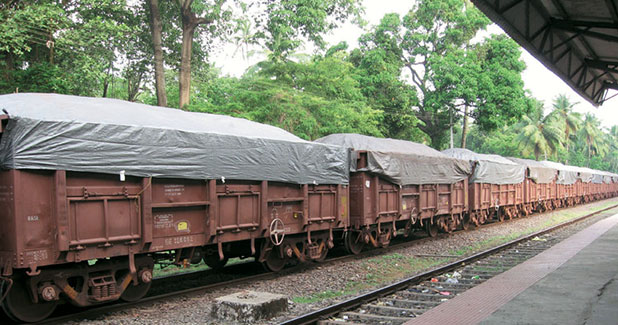
Indian Railways have scripted history by quietly conducting a trial run of the country?s first Dedicated Freight Corridor (DFC) which will come up between two districts in rural Bihar.
The train carried 5,265 tonnes of clinker, an intermediate product for cement manufacturing, loaded on 58 wagons on the 56-km new stretch between Durgawati and Sasaram, the bastion of late Dalit leader Babu Jagjivan Ram.
The trial run brought India a step closer to joining the select club of nations, including the US, China, Australia and South Africa, with operational dedicated freight-specific lines.The double line electrified Durgawati-Sasaram section is being commissioned with an investment of Rs 1,000 crore entirely funded by Indian Railways? equity. The pilot stretch on the eastern arm of the DFC project would divert largely coal freight from the existing rail network. The DFC has eliminated 18 level-crossings on the 56-km stretch by building road over-bridges.
The section is being constructed with an average investment of Rs 20 crore per km. The Dedicated Freight Corridor Company (DFCC), entrusted with the task, is currently building more than 3,350 km of double-track freight-specific lines from Ludhiana in Punjab to Dankuni in West Bengal as the Eastern DFC, and from Dadri in Uttar Pradesh to Jawaharlal Nehru Port Trust (JNPT) in Navi Mumbai as the Western DFC.
The DFCC has acquired more than 89 per cent of the 11,550 hectares of land required for the project and has tied up funding from the World Bank for the Eastern DFC and Japan International Cooperation Agency for the Western DFC.
Contracts worth Rs 24,102 crore were awarded in 2015-16 as against contracts worth Rs 13,000 crore finalised in the previous six years.
?The DFCC has finalised civil contracts for 2,138 km (76 per cent), electrical contracts for 1,786 km (63 per cent) and signalling & telecom contracts for 1,356 km (48 per cent) of the length of the project,? an official said.
The DFCC will purchase 200 locomotives for the western arm of the project from Japan and that order is being finalised at the Board level.
When commissioned, the eastern and the western arms of the DFCC will divert up to 40 per cent of freight traffic from Indian Railways and push the rail?s share of freight from the existing 36 per cent to 45 per cent.
JK Cement stops clinker production from Karnataka plant
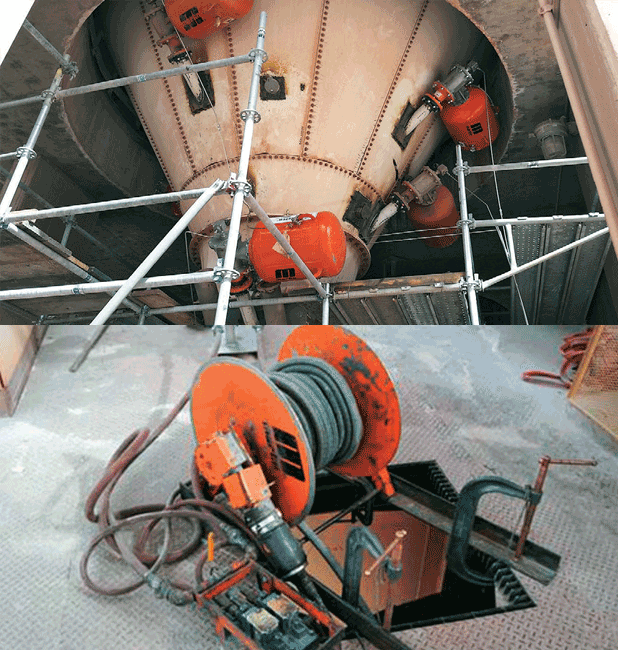
JK Cement has informed stock exchanges that it has stopped clinker production at its Muddapur, Taluka Mudhol, Dist. Baglakot, South site (in Karnataka) on account of cracks being developed in its CF silo. This is the raw meal feeding silo to the kiln and as a measure to avoid collateral damage, the company has stopped kiln production temporarily. No material clinker inventory being currently present, volumes are likely to be impacted for the next 30-40 days. JK Cement dispatches nearly 5,000 tonnes of daily production of cement from this facility. This is the second instance when damage is being observed in a silo at its southern site.
Further, JK Cement has also said that power connectivity has been commissioned at its UAE site. Till date the plant was operating on diesel generating sets.
Cement prices cut in Himachal
Cement producers have decided to cut prices by Rs 10 per bag in Himachal Pradesh with immediate effect, the state government has said.
Cement companies had recently announced a price hike, forcing the state government to intervene in the matter.
State Industries Minister Mukesh Agnihotri asked Principal Secretary R D Dhiman to take up the matter with cement manufacturers.
Consequently, a high-level meeting was held here under the chairmanship of Dhiman. The meeting was attended by Director-Industries Amit Kashyap and representatives of ACC, Gujarat Ambuja and JP Cements.
It was decided in the meeting that all cement producers would slash prices of cement by Rs 10 per bag with immediate effect, an official spokesman said.
It was agreed in the meeting that rates of cement in the bordering areas of Himachal Pradesh would be at par or lower than the rates in the neighbouring states.
Adulterated cement selling racket busted
The Khour police (in Jammu) have busted an illegal cement selling racket by arresting three persons.
As per police sources, a complaint was lodged by Gittan Sharma, son of Daya Ram, a resident of Camp Khour with police station Khour on April 20 regarding illegal trade of cement.
Acting on the complaint, a case was registered at Khour police station and an investigation was started.
During the investigation, the accused disclosed that he along with his associates used to buy inferior quality cement from the mini plants of Kathua, and after procuring original used bags of Ambuja Cement, they used to refill the cement in these branded bags at rented shops and godowns at Rara Ramnagar.
After packing the cement in these ?branded? bags, the accused used to sell the cement bags at Akhnoor and Khour. They were engaged in this business for the last several months.
A total of 445 bags of spurious and substandard cement have been seized by the police.
RMC trucks emit cloud of dust
While citizens across Mumbai have been complaining of worsening air quality, residents of Sion?s Everard Nagar are particularly at risk because of constant movement of trucks from a nearby RMC plant.
The cloud of dust and pollutants that the trucks leave behind has already landed some residents and compelled a senior citizen to relocate to Goa.
?A ready mix truck passes by our society almost every minute. They go to the ACC plant located on KJ Somaiya grounds and use the same service road on the way back. There are two speed breakers on the stretch and every time a truck stops, it releases some dust and cement that enters our homes,? said Saraswathi Sundareswaran, who has been leading the society?s fight against the polluting vehicles.
Saraswathi has taken up the issue with the BMC, police, Maharashtra Pollution Control Board (MPCB), ACC Limited, and KJ Somaiya, but RMC trucks continue to ply on the service road.
?An MPCB official came to our society a few weeks ago. He just stood near the gate and asked us, ?Where is the cement? I don?t see anything?,? she said.
The in-charge at the ACC concrete batching plant said the company had deployed five men to clean the road regularly.?We use water to clean the road to ensure the dust does not rise. Lately, there has been a water shortage in the city, so it has been difficult to wash the road,? said Rohan from the plant.
According to one of the five workers, around five to six sacks of cement is collected from the service road. V Rangnathan, secretary of KJ Somaiya, said he had held several meetings with residents to try and solve the problem.
ASTM award goes to BASF?s Goodwin
ASTM International?s Committee on Concrete and Concrete Aggregates (C09) has presented its top annual award – the Award of Merit – to Fred Goodwin of BASF Construction Chemicals in Beachwood, Ohio, U.S.A. The prestigious award, which includes the accompanying title of Fellow, is ASTM?s highest recognition for individual contributions to developing standards.
The committee honored Goodwin for his dedicated work to develop standards in a number of areas, including hydraulic cement grouts, packaged dry combined materials, and polymer modified concrete and mortars. He has been a member of ASTM since 1991 and received the Award of Appreciation from the same group in 2011.
Goodwin is head of the BASF Construction Chemicals Global Corrosion Competency Center, providing technical expertise and driving research and development on grouts, adhesives, concrete materials, and more. He previously served as a principal scientist with Degussa Construction Chemicals, a technology manager with ChemRex, a plant chemist with Mapei Corporation, and a chief chemist for River Cement Company.
Restart of RMC units in Mumbai
In the last week of April 2016, the Member-Secretary of the Maharashtra Pollution Control Board has given permission to restart the closed Ready Mixed Plants in Mumbai on certain conditions. The conditions laid down are for arresting the emission of dust from these RMC plants either during the movement of trucks or while transferring materials like sand, aggregates etc. All the conditions have to be complied by 30th June 2016. Out of 12 plants closed, 3 are still waiting to restart. This is a big relief to RMC operators in Mumbai.