Connect with us

Concrete

Combating Material Accumulation in Cement Plants

Published

on

Shares

A state-of-the-art cement plant has resolved material accumulation issues in its limestone silo by combining high-efficiency cleaning techniques with powerful, strategically-placed air cannons to prevent further build-up.

The Drake Cement facility to miles north of Paulden, AZ was experiencing clogging issues on a weekly basis, forcing maintenance personnel to spend up to 12 hours to clear the blockage using tools and compressed air. During damp weather, the problem worsened, and at times the large structure would fill in as little as two hours, forcing operators to use CO2 blasting tubes every 15 to 30 minutes.

Technicians from Martin Engineering were able to clear the blockage on a short-notice visit, and then revised the site’s air cannon system to prevent the issue from recurring.

Drastic Measures
A key component of Drake’s dry-process manufacturing is efficient material flow. Excessive rain in the months of January through March caused the limestone being extracted from the nearby quarry to have elevated moisture levels. Not only does the rain cause standing water, but the limestone is also wetter coming out of the ground.

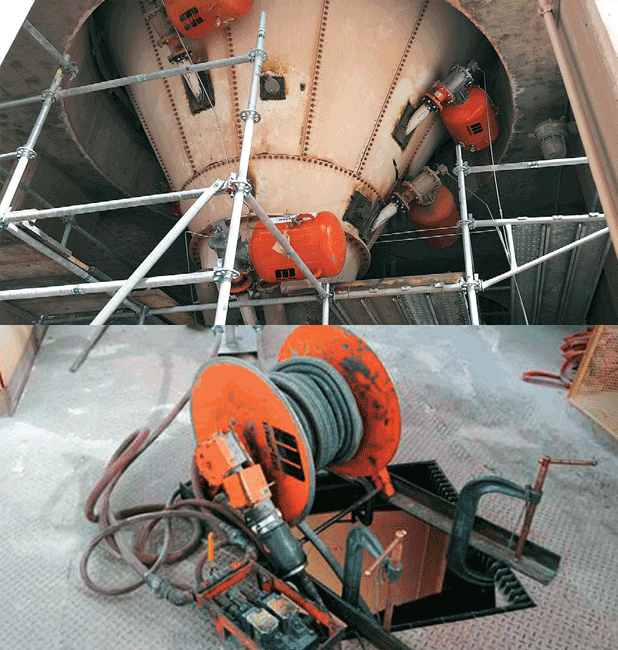
Little of that water is lost in the crushing process, and dry material can absorb moisture as it is reduced in size. So in the winter months, by the time the material lands in the 536-tonne (486 metric tonne) limestone silo, it is nearly saturated. In prior years, the silo had not experienced a single flow disruption, nor had it required cleaning due to the aid of two Martin? XHV air cannons. Adequate in previous years to keep material flowing at required volumes through all seasons, the air cannons were unable to prevent clogging at such high moisture levels.

"This plant is one of the most advanced operations of its kind, with advanced operating and pollution controls found in only a few other facilities in the world," explained Jose Venegas, Maintenance Manager, Drake Cement. "I had a Martin representative coming out to look at another part of the plant, but when the silo clogged, that took immediate priority. The problem had become disruptive, expensive and hazardous. We needed it solved once and for all."

Limestone Snowballs
When Martin Engineering’s National Business Development Manager Doug Brown arrived at the plant, he found a silo so compactly clogged that it had halted the entire production process. "Inspecting the silo for a solution, we realized that the limestone could be packed like snowballs, dense enough to stick to the wall when thrown," said Brown, adding "This demonstrated just how serious the problem was. We luckily had a silo cleaning crew that had just finished a job in Tucson, AZ, so they were quickly dispatched north to the plant."

The experienced two-man crew immediately set up a Martin? Heavy Duty Whip. Powered by compressed air, the device can be equipped with a variety of flails and cutting edges to knock down accumulated material without damaging the silo’s walls or support structure. Requiring no confined space entry, the device was set above the manhole opening at the top of the vessel and maneuvered by remote control. "Working together with the electrical and maintenance departments, we were able to continue operations during the cleaning process," Venegas said. "This really helped us avoid what could have been some costly downtime."

Long Term Prevention
Once the silo had been completely evacuated, Brown – a flow aid specialist – realized that the ongoing problem could be remedied by utilising Drake’s current stockpile of air cannons. Using an innovative placement strategy, Brown was certain that the cannons could safely prevent buildup and promote efficient high-volume material flow, no matter how moist or dense the limestone.

Rather than the two cannons at the bottom of the limestone silo firing across the cargo flow, five cannons were strategically placed around the vessel. Three 70-litre Martin? Tornado Air Cannons were placed on the lower incline of the cone at a 30? downward angle against the 60? slope in the 6 and 12 o’clock positions (one side of the silo was inaccessible). In the 3 o’clock position, one air cannon was situated at the 2-foot – wide shaft, and another was added to the upper silo to aid in loosening material.

Already fitted with 53 XHV and Tornado Air Cannons throughout the plant, a programmable logic control (PLC) system centrally placed in the facility coordinates and monitors the timing and firing sequence of each unit at all locations, including the limestone silo. During the wet winter and monsoon months, the cannons are activated approximately every hour, but throughout the rest of the year the system has a firing sequence of only 4-5 times per day. This pattern can also be manually activated from the weigh feeder, at the solenoid panel or in the control room.

Results Demonstrated
Since installation, plant production has returned to normal levels. Material flow is ongoing, and the silo has not been shut down for cleaning. There has been no unscheduled downtime due to clogging, which has greatly increased production, especially through heavy weather periods. The use of CO2 tubes has been ceased altogether. When a buildup is detected, workers no longer are required to get close to the area to resolve it, increasing plant safety and reducing the number of man-hours required to maintain the silo.

"This equipment upgrade has paid for itself many times over," Venegas said. "We are extremely happy with the results. The service was fast, responsive and well coordinated. During our next scheduled outage, we’re going to have a Martin Engineering team out here to consult on other areas where we might need air cannons, so that we can maximize production. We look forward to an ongoing and productive relationship."


Continue Reading
Click to comment

Leave a Reply

Your email address will not be published. Required fields are marked *

Concrete

30-Day Traffic Diversion In Place For CC Road Works In Madhapur

Diversions in place from May 16 for cement concrete road works

Published

on

By

Shares

The Cyberabad Traffic Police issued a traffic advisory as road works begin for the laying of a cement concrete (CC) road from Jaya Shankar Statue to RRR Restaurant at Parvathnagar in Madhapur limits. The advisory indicated that traffic diversions will be in place for 30 days from May 16 to ensure the smooth flow of vehicles and to minimise congestion on the affected stretch. The measure aims to balance uninterrupted construction activity with the movement needs of commuters.

Traffic moving from Toddy Compound towards Parvathnagar village will be diverted at Parvathnagar junction towards Sunnam Cheruvu and the 100 feet road. Local motorists and public transport operators have been advised to follow the diversionary route as directed by traffic personnel on duty. Alternate routes and signage have been planned to mitigate delays and to manage peak hour congestion.

Police officials said the diversion had been planned to facilitate uninterrupted road works while maintaining traffic movement in the area. Commuters were urged to plan their travel accordingly and to cooperate with traffic staff managing the stretch. Authorities indicated that enforcement of diversions would be active and that violations could attract penalties.

The 30 day schedule is intended to allow contractors to complete the laying and curing phases with minimal interruption to vehicular flow. Residents and businesses in adjacent localities have been advised to factor the diversion into deliveries and travel plans. The traffic police promised continuous monitoring of the works and the operational diversions and emphasised that temporary inconvenience was necessary for longer term improvement of the road network. Traffic personnel will be stationed at key junctions and additional signage and temporary markings will be displayed to guide motorists and pedestrians through the revised alignments while public transport services will follow the diversion where feasible and operators have been asked to adjust timetables to minimise disruption.

Continue Reading

Concrete

HeidelbergCement India Receives Consent For Khandwa Grinding Unit

Consent granted by Madhya Pradesh Pollution Control Board

Published

on

By

Shares

HeidelbergCement India (HeidelbergCement India) has received regulatory consent to establish a cement blending and grinding unit at Village Dongaliya, Tehsil Punasa, District Khandwa in Madhya Pradesh. The consent was granted by the Madhya Pradesh Pollution Control Board under the Water (Prevention & Control of Pollution) Act, 1974 and the Air (Prevention & Control of Pollution) Act, 1981 and is dated 17 May 2026. The company disclosed the development in a filing made under Regulation 30 of the SEBI (Listing Obligations and Disclosure Requirements) Regulations, 2015.

The project plan envisages procurement of long term availability of fly ash and the allotment of land on lease for setting up the unit. The proposed facility is described as a blending and grinding installation which will process cementitious materials sourced from nearby operations and suppliers. Company filings state the measures required to secure raw material logistics and statutory compliance before commencing construction.

The addition of a grinding unit in Khandwa is intended to strengthen regional supply and improve logistical efficiency by reducing haulage distances for finished product. The unit is expected to complement existing capacities in central India and to offer flexibility in product mix through blending operations. The reliance on fly ash as a supplementary cementitious material will necessitate long term supply agreements with thermal power producers and coordination with waste utilisation policies.

The disclosure to the regulator and to the stock exchanges follows standard corporate governance practice and aims to keep investors apprised of capital expenditure initiatives. The company indicated that subsequent permits and clearances would be sought in accordance with applicable environmental and land use rules. The project is presented as part of HeidelbergCement India’s broader strategy to optimise capacity distribution and to respond to regional demand dynamics.

Continue Reading

Concrete

PROMECON introduces infrared-based tertiary air measurement system for cement kilns

Published

on

By

Shares

The new solution promisescontinuous, real-time tertiary air flow measurement in cement plant operations.

PROMECON GmbH has launched the McON IR Compact, an infrared-based measuring system designed to deliver continuous, real-time tertiary air flow measurement in cement plant operations. The system addresses the longstanding process control challenge of accurate tertiary air monitoring under extreme kiln conditions. It uses patented infrared time-of-flight measurement technology that operates without calibration or maintenance intervention.

Precise tertiary air measurement is a critical requirement for stable rotary kiln operation. The McON IR Compact is engineered to function reliably at temperatures up to 1,200°C and in the presence of abrasive clinker dust. Its vector-based digital measurement architecture ensures that readings remain unaffected by swirl, dust deposits or drift. Due to these conditions conventional measurement systems in pyroprocess environments are often compromised.

The system is fully non-intrusive and requires no K-factors, recalibration or periodic readjustment, enabling years of uninterrupted operation. This design directly supports plant availability and reduces the maintenance overhead typically associated with process instrumentation in high-temperature zones.

PROMECON has deployed the McON IR Compact at multiple cement facilities, including Warta Cement in Poland. Plant operators report that the system has aided in identifying blockages, optimising purging cycles for gas burners, and supplying accurate flow data for AI-based process optimisation programmes. The practical outcomes include more stable kiln operation, improved process control, and earlier detection of process disturbances.

On the energy side, real-time tertiary air data enables reduction in induced draft fan load and helps flatten process oscillations across the pyroprocess. This translates to lower fuel and energy consumption, fewer unplanned shutdowns, and a measurable reduction in NOx peaks. This directly reflects on the downstream cost implications for plants operating SCR or SNCR systems for emissions compliance.

Continue Reading

Video Thumbnail
â–

    SIGN-UP FOR OUR GENERAL NEWSLETTER


    Trending News

    SUBSCRIBE TO THE NEWSLETTER


    Don't miss out on valuable insights and opportunities to connect with like minded professionals.


      This will close in 0 seconds