Dr SB Hegde, Former President – Manufacturing (Cement Industry); Professor, Department of Civil Engineering, Jain College of Engineering and Technology, Hubballi, India, and Visiting Professor, Pennsylvania State University, USA, discusses breakthroughs in materials, energy and digital systems.
Cement—second only to water in global consumption—supports every major infrastructure programme but contributes 7 per cent to 8 per cent of global CO2. India, the world’s second-largest producer, is projected to reach 441.9 Mt by 2025, while global production stabilises near 4.1 Bt. The industry must now combine growth with carbon discipline. Breakthroughs in materials, energy systems, digital intelligence, and carbon management are redefining competitiveness from ‘volume and cost’ to ‘efficiency and sustainability.’
Industry statuses
Global cement output has stabilised at ~4.1 billion tonnes, while India’s production continues to rise, driven by housing and infrastructure growth. This shift positions India as a key driver of global demand but also heightens pressure to improve energy efficiency and cut emissions. The gap between average and best-practice performance (Table 1a) highlights major scope for cost-effective decarbonisation.
Efficient plants already prove that emission control and profitability align.
Sustainable Innovations in Production
1. Low-Carbon Cement Technologies
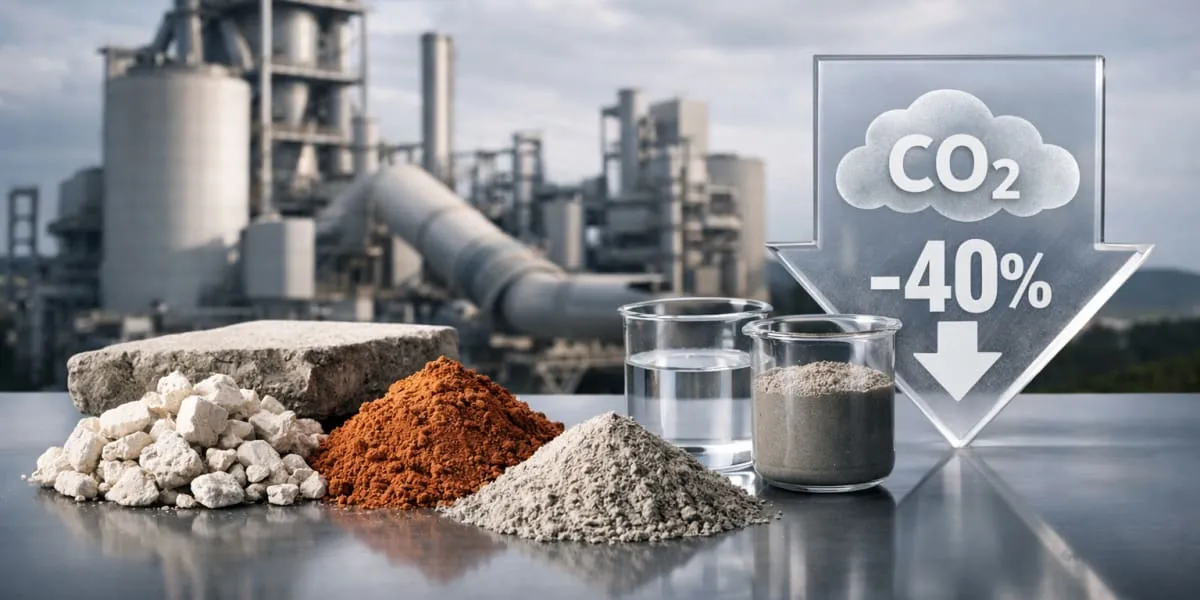
Replacing clinker with SCMs—fly ash, slag, calcined clay, limestone— can cut emissions 30 per cent to 70 per cent. LC3 formulations show strong strength and durability when kaolinite content and calcination are well controlled.
2. Clinker Substitution and Electrochemical Processes
• Clinker substitution remains the fastest reduction route.
• Electrochemical cement eliminates kiln CO2 by using low-temperature electrolysis.
Figure 2: Bar chart of CO2 reduction potential (SCMs, AFR, WHR, CCUS, Digital)
3. Carbon Capture, Utilisation and Storage (CCUS)
CCUS targets calcination CO2 (~60 per cent of total). Plant 1 has characterised flue gas; Plant 2 reserved space for modular capture; Plant 3 studies CO2 utilisation. Full deployment could cut emissions ˜ 50 per cent.
4, Alternative Fuels & Waste Heat Recovery (WHR)
Each 10 per cent AFR substitution saves ˜ 25 kg CO2/t clinker. WHR can meet 30 per cent to 35 per cent of power needs if maintained efficiently.
5, Materials-Science Frontiers
Recent advances in clinker chemistry are enabling deeper CO2 reduction. Belite–Ye’elimite–Ferrite (BYF) clinkers operate at firing temperatures nearly 150°C lower than ordinary Portland clinker, reducing process emissions by about 30 per cent.
Calcium Sulphoaluminate (CSA) cements provide rapid early strength with lower energy input. Nano- and graphene-enhanced binders improve strength-to-carbon ratios, while alkali-activated materials (AAMs) and geopolymers utilise fly ash and slag, cutting both emissions and waste. These advances mark a decisive shift toward low-clinker, high-performance systems.
Digital innovations and industry 4.0
The cement industry is rapidly embracing Industry 4.0 technologies to achieve precision, stability, and predictive control in operations. Artificial intelligence (AI), the Industrial Internet of Things (IIoT), and digital twins are transforming kiln, mill, and logistics management by reducing process variability and energy consumption. These tools enable real-time monitoring, data-driven decision-making and improved plant reliability. The following tables highlight the current level of digital adoption and its quantifiable impact across modern cement plants. AI, IoT and digital twins are reducing energy waste and variance across plants.
Circular economies and resource looping
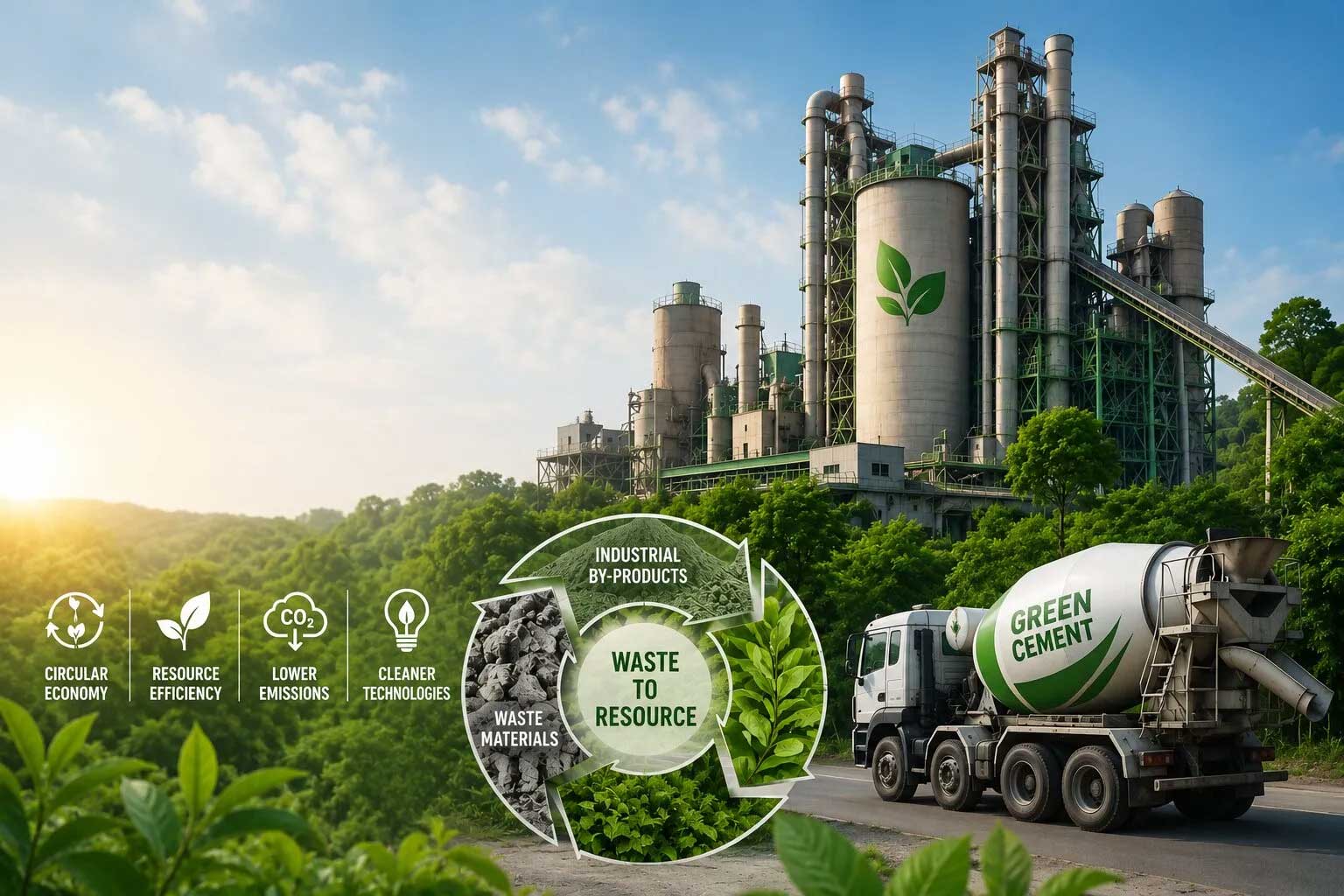
The cement industry is increasingly adopting circular economy principles to close material and carbon loops. Co-processing of municipal and industrial wastes as alternative fuels and raw materials reduces both emissions and landfill burdens. Recycling construction and demolition waste (CDW)as a partial raw feed, and promoting recarbonation of concrete at end of life, further enhance carbon recovery. These initiatives make cement plants integral to sustainable waste management and resource efficiency.
Cement plants are evolving into resource recovery centres:
• Co-processing municipal and industrial wastes as fuel or raw feed.
• Recycling CDW as raw meal additive or aggregate.
• Recarbonation of concrete absorbs ˜ 150 kg CO2/t over life.
Decarbonisation pathways and innovation roadmap
The cement industry’s path to net zero requires a phased and coordinated innovation roadmap. In the near term (2025–2030), emphasis must be on energy efficiency, clinker substitution, AFR, WHR, and digital optimisation, which are already proven and cost-effective. The next decade (2030–2040) will see wider adoption of electrification and carbon capture technologies, supported by renewable energy and green hydrogen. By 2040–2050, advanced low-carbon clinkers, carbon-negative binders, and circular material use will dominate, enabling deep decarbonisation. Together, these phases form a realistic pathway to cut CO2 emissions by over 70 per cent while ensuring competitiveness and resilience.
Learning from practice
• Plant 1 implemented multi-source SCMs and advanced QC, cutting emissions by >70 kg/t.
• Plant 2 achieved stable kiln operation with 25 per cent AFR.
• Plant 3 combined WHR and AI controls to self-generate 30 per cent power.
• Plant 4 pre-engineered for future CCUS and CO2 offtake agreements.
Lesson: Innovation succeeds when technology is paired with discipline, cross-functional coordination, and long-term planning.
Innovation enablers: market, finance and policy
Market Signals. Public and private projects are specifying low-carbon materials, pushing plants to expand SCM and AFR capacity. Financing Models. AFR, WHR and digital projects suit traditional project finance. Emerging tech like CCUS needs blended finance (carbon credits + green bonds + grants). ESG-linked loans reward verified CO2 reduction with lower interest rates. Regulatory Ecosystem. Updated standards for high SCM blends, fast-track permits for AFR/WHR, and EPD-based procurement create a virtuous cycle between policy and market.
Policy and regulatory levers for acceleration
India’s leadership in low-carbon cement depends on pragmatic steps:
1. Raise blending limits to 65 per cent to 70 per cent where performance permits.
2. Streamline approvals for AFR and WHR projects.
3. Adopt green procurement with EPD requirements.
4. Provide carbon credits and tax rebates for early CCUS and LC3 plants.
5. Implement national MRV protocols aligned with global benchmarks.
Such policies offer predictability and move innovation from pilot to mainstream.
Sequencing the transition (2025–2050)
• Phase 1 (2025–2030): Deploy SCMs, AFR, WHR and digital optimisation — low-risk, high-impact.
• Phase 2 (2030–2040): Scale CCUS and partial electrification as costs drop.
• Phase 3 (2040–2050): Adopt new clinker chemistries and full carbon capture networks.
This phasing lets plants build skills and capital progressively while meeting net-zero goals.
Conclusion
Cement’s future depends on how fast the sector moves from clinker-intensive processes to circular low-carbon systems. Every path count: lower clinker factor, energy efficiency, AFR, digital control, and CCUS. India possesses the scale, technical talent and market momentum to lead this transformation. With consistent policy support and industry discipline, specific CO2 can fall below 300 kg/t cement by 2050—making the nation a benchmark for sustainable cement production.
References
1. International Energy Agency (IEA). (2023). Cement – Tracking Industry 2023. Paris: IEA.
2. Global Cement and Concrete Association (GCCA). (2024). Cement Industry Net Zero Progress Report 2024/25. London: GCCA.
3. Scrivener, K. L., Martirena, F., Bishnoi, S., & Maity, S. (2018). Calcined clay limestone cements (LC³). Cement and Concrete Research, 114, 49–56.
4. Gartner, E., & Sui, T. (2018). Alternative cement clinkers. Cement and Concrete Research, 114, 27–39.
5. Bosoaga, A., Masek, O., & Oakey, J. E. (2009). CO2 capture technologies for cement industry. Energy Procedia, 1(1), 133–140.
6. Miller, S. A., John, V. M., Pacca, S. A., & Horvath, A. (2018). Carbon dioxide reduction potential in the global cement industry by 2050. Cement and Concrete Research, 114, 115–124.
7. Roussanaly, S., Berstad, D., Husebye, J., & Jakobsen, J. (2021). Towards large-scale CO2 transport and storage networks in Europe: A cost and carbon perspective. International Journal of Greenhouse Gas Control, 105, 103239.
8. Nobre, A. V., Scholes, O., & Butler, I. (2022). Industry 4.0 in cement manufacturing: A review of technologies, applications, and benefits. Journal of Cleaner Production, 359, 132043.
9. Lehne, J., & Preston, F. (2018). Making Concrete Change: Innovation in Low-Carbon Cement and Concrete. London: Chatham House.
10. Reddy, D. V., & Kumar, M. S. (2023). Circular economy pathways for sustainable cement and concrete in India. Resources, Conservation & Recycling Advances, 18, 200164.
About the author:
Dr SB Hegde, Global Industry Expert is a Professor at the Department of Civil Engineering, Jain College of Engineering and Technology, Hubballi, India and Visting Professor, Pennsylvania State University, United States.