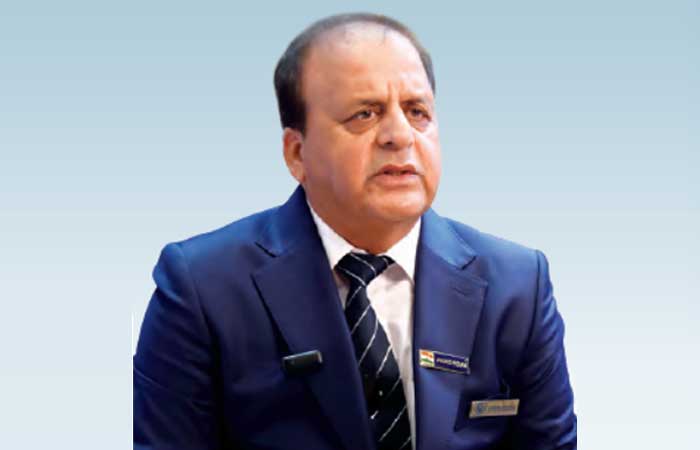
Pradip Kalra, CEO, Stotz Gears, discusses the role of innovation in making the Indian cement machinery industry self-reliant and globally competitive.
With an unwavering focus on quality and precision, Stotz Gears has been empowering India’s cement sector with world-class girth gears, kiln shells and tyres. In this candid conversation, Pradip Kalra, CEO, Stotz Gears, explains how engineering excellence and sustainability go hand in hand, and his pioneering contribution towards import substitution in critical cement plant components.
Tell us about your journey in the engineering industry and your association with the cement sector.
My journey in the engineering industry began from humble beginnings, with practically no infrastructure in place. With consistent hard work, dedication and a deep commitment to transform industry standards—especially in terms of cost efficiency and quality—I was able to carve a niche in the manufacturing and supply of critical components to the Indian cement industry.
Today, I find a sense of satisfaction in having initiated and contributed to the manufacturing of vital cement plant components such as girth gears, union assemblies, tyres, support rollers, trunnions, mill heads, kiln shells and mill shells. We have maintained a consistent track record—since 2004, everything we have manufactured and supplied continues to perform reliably, with zero failures. That long-term dependability is a testament to our commitment to quality and precision.
How did you begin with the manufacturing of girth gears, and how has their relevance grown in India?
I started out by manufacturing small gears for modest-scale industries, such as oil mills and small cement plants. But I always dreamed bigger.
I often asked myself: why not manufacture larger gears? That dream became a target, and I pursued it relentlessly.
In 1986, I travelled to Germany and purchased advanced machinery that allowed us to produce girth gears that could match, or even surpass, international standards. Before this, India had to rely heavily on imports from France, Germany, and the USA for such components. By investing in the right machinery and tools—specifically German ones—we raised our quality standards and gradually achieved parity
with global manufacturers. We also invested in
skill development.
The knowledge I gained was shared with our engineers and workers, and that collective learning laid the foundation for quality manufacturing in India. I am proud to say that this initiative has helped India move towards the vision of Atmanirbhar Bharat, championed by our Honourable Prime Minister.
How did your company begin manufacturing tyres, and how did that lead to applications in cement?
Tyres, like girth gears, are cast products, and they require a similar level of metallurgical and engineering expertise. Over time, the quality
and technology of casting in India improved significantly. We didn’t work in isolation—we actively encouraged and guided our casting partners to innovate and meet international standards. We passed on knowledge, provided feedback and set high expectations.
The result was a win-win: the casting industry evolved and we were able to manufacture tyres of international-grade quality domestically. This directly benefited the cement sector, which depends on the reliability and durability of such components.
How are kiln shells serving the cement industry, and how do you ensure their precision and performance?
Kiln shells, like other critical cement plant components, are manufactured in accordance with international quality standards. These standards are set by OEMs and well-known across the cement industry. I believe the foundation of delivering high-quality products lies in honesty—honesty towards quality standards, material procurement, and the will to achieve excellence. Personally, I have always repeated to myself: I must achieve it, I must achieve it. That self-motivation and conviction have taken me a long way.
Every kiln shell we produce reflects that commitment. We source certified raw materials, maintain stringent manufacturing controls, and ensure precision across every stage. The final product not only meets OEM specifications but also earns the long-term trust of our clients.
Could you elaborate on any sustainability practices you follow in your company?
Absolutely. First and foremost, our industry is not a major polluter. The only minimal emission we produce is a small amount of smoke during heavy gear cutting operations. Even this is addressed responsibly—we have installed smoke arrestors in our facility roofs, which capture the smoke and discharge it safely via high-speed fans. This ensures that no harmful emissions reach the areas where people live or work.
Additionally, we manage our oil usage sustainably. Used industrial oils are collected and sold to licensed refineries, where they are reprocessed and reused. We do not discharge any waste oils or chemicals into drains or public waterways.
Beyond that, we also make a conscious effort to maintain greenery around our plant. Every year, we plant numerous trees, maintain flower beds and promote green spaces around our premises to enhance biodiversity and environmental balance.
What are some of the challenges you face in your line of work, and how do you address them?
Challenges are constant, especially in engineering and manufacturing. One of the biggest challenges is the increasing demand for precision and reliability from cement plants. Every year, the expectations rise. Clients demand tighter tolerances, better materials and longer-lasting components—even if the products we supplied years ago are still running without a single complaint.
To address this, we continuously work to improve. We tighten our precision parameters, upgrade our machinery and metrology equipment and invest in employee training. We impose strict quality control standards at every level—from raw material inspection to final testing. This proactive approach helps us meet evolving demands and deliver even better results.
What are your thoughts on the Net Zero mission and how do you see the journey evolving for the cement sector?
That’s an important question. Although I am not a cement plant operator or technical head, I have been closely observing the sustainability trends over the past few years. In fact, I have been attending conferences to better understand the Net Zero mission. Pollution is everyone’s concern—not just the plant owners. I am genuinely proud of how far the Indian cement industry has come in the last decade. Initially, we were focused on increasing production. Then we moved to improve quality. Later, the focus shifted to logistics and transport. And now, we are tackling emissions.
It is a remarkable progression, and the fact that Indian cement companies are now talking about and achieving targets for zero emissions is something to truly admire. We are not just following global trends—we are matching, and in some cases, even leading. My heartfelt compliments to all stakeholders in the cement industry—whether it is plant operators, general managers or company owners.