

Concrete
Gypsum is used in cement to avoid flash-set


Pradeep Kumar Chouhan – General Manager (QC and Environment), Udaipur Cement Works, sheds light on the role of gypsum and its manufacturing process.
Explain the role of gypsum in the cement manufacturing process.
Gypsum plays an important role in controlling the rate of hardening of the cement. Since it delays the settling of cement, it allows a longer working time, transporting, and placing. If gypsum is not added with a clinker during the cement manufacturing process, then the cement produced will immediately be set in addition to water and masons will not find time to work with it.
Gypsum is colourless, transparent, and naturally occurring in crystalline form as a mineral. It is widely used in our day-to-day life. It is a primary ingredient of toothpaste, used as a colour additive for drugs and cosmetics, as a food additive, plaster for orthopaedic use etc.
Generally, gypsum occurs in nature called mineral gypsum. Another variety of gypsum produced during production of common salt in coastal regions, particularly in Gujarat and Tamil Nadu, is called marine gypsum. Phosphoric Acid plants are important sources of by-product Phosphogypsum. Nowadays, chemical gypsum or synthetic gypsum (SynGyp) are also widely utilised as an alternative source of mineral gypsum for manufacturing of cement. The chemical gypsum or synthetic gypsum are produced from dyes and chemical industries and during flue gas desulphurisation (FGD) for abatement of SO2 pollution from sources like power plant for sulphur dioxide controlling system as an additional pollution control device.
Gypsum (CaSO4.2H2O) added with clinker while grinding in the cement mill to produce finished product i.e., cement.
C3A is the phase with the highest hydration speed
3CaO.Al2 O3 + n H2O fast reactions CAH + profuse exothermic heat
C3A + 6H2O▼ C3AH6
This is controlled by gypsum,
C3A + H2O + CaSO4- C4AS3H12 – C4AS3H32
Chemical reaction in the presence of gypsum is given below
3CaO. Al2O3 + 3CaSO4 . 2H2O + nH2O → 3CaO. Al2 O3 . 3CaSO4 . 32H2O
(Ettringite: calcium tri sulpho aluminate hydrate) + moderate exothermic heat
What proportions of gypsums are added in various types of cements produced? Tell us in detail about the composition and percentage.
Gypsum is normally used in various types of cement to maintain the SO3 in cement as per specification of BIS, based on Purity of Gypsum as CaSO4.2H2O its proportion in cement varies in the tune of 4 to 10 per cent. Limit for SO3 per cent in cement is 3.5 per cent, accordingly based on purity of gypsum as CaSO4.2H2O, proportion of gypsum is as follows:
Tell us about the process of obtaining gypsum by your organisation. What are the key resources utilised?
Udaipur Cement Works Limited (UCWL) is uses two types of gypsum i.e., Mineral and Chemical Gypsum for its cement products (i.e. OPC and PPC).
UCWL procures mineral gypsum from Rajasthan State Mines and Minerals Ltd. (RSMML) through road transportation.
Chemical gypsum generated primarily by dyes manufacturing industries using sulphuric acid in the manufacture of dye intermediates. The waste/effluent containing sulphuric acid is neutralised with limestone to produce large quantities of chemical gypsum in these industries. At present, UCWL procures chemical gypsum from Chemical Industries of Gujarat through road transportation.

Tell us about the key technical feasibility factors that make gypsum viable for mixing with cement?
As I mentioned earlier, gypsum is used in cement to avoid flash-set. In other words, gypsum delays the setting of cement. The main purpose of adding gypsum in the cement is to slow down the hydration process of cement once it is mixed with water. The hydration process starts when water is added into cement. Water reacts with C3A and hardens. This happens in a very short time, which doesn’t allow cement for transporting, mixing, and placing with construction building material and other useful materials. In presence of gypsum in the cement and water is added to it, reaction with C3A particles takes place to form ettringite (calcium tri sulpho aluminate hydrate). This ettringite is initially formed as very fine-grained crystals, which form a coating on the surface of the C3A particles. These crystals are too small to bridge the gaps between the particles of cement. Therefore, the cement mix remains plastic and workable. This is an important role of gypsum for strength, composition and workability of concrete. The gypsum retards the process of hydration, so it is termed as retarding agent of cement.
Clinker, which has all cementitious properties, after mixing of water it gets set quickly without gypsum. To avoid the quick set and give a workability time gypsum is mixed with clinker in the tune of 4 to 9 per cent (based on the purity of gypsum as CaSO4.2H2O). Limit of BIS for initial setting time is above 30 minutes and final setting is less than 600 minutes. Normally, cement is produced having a setting time between 60 to 150 minutes. We can say gypsum is not only a retarding agent of cement but also provides strength and hardness to cement.
What is the preparation or processing required to make gypsum ready to mix with the clinker?
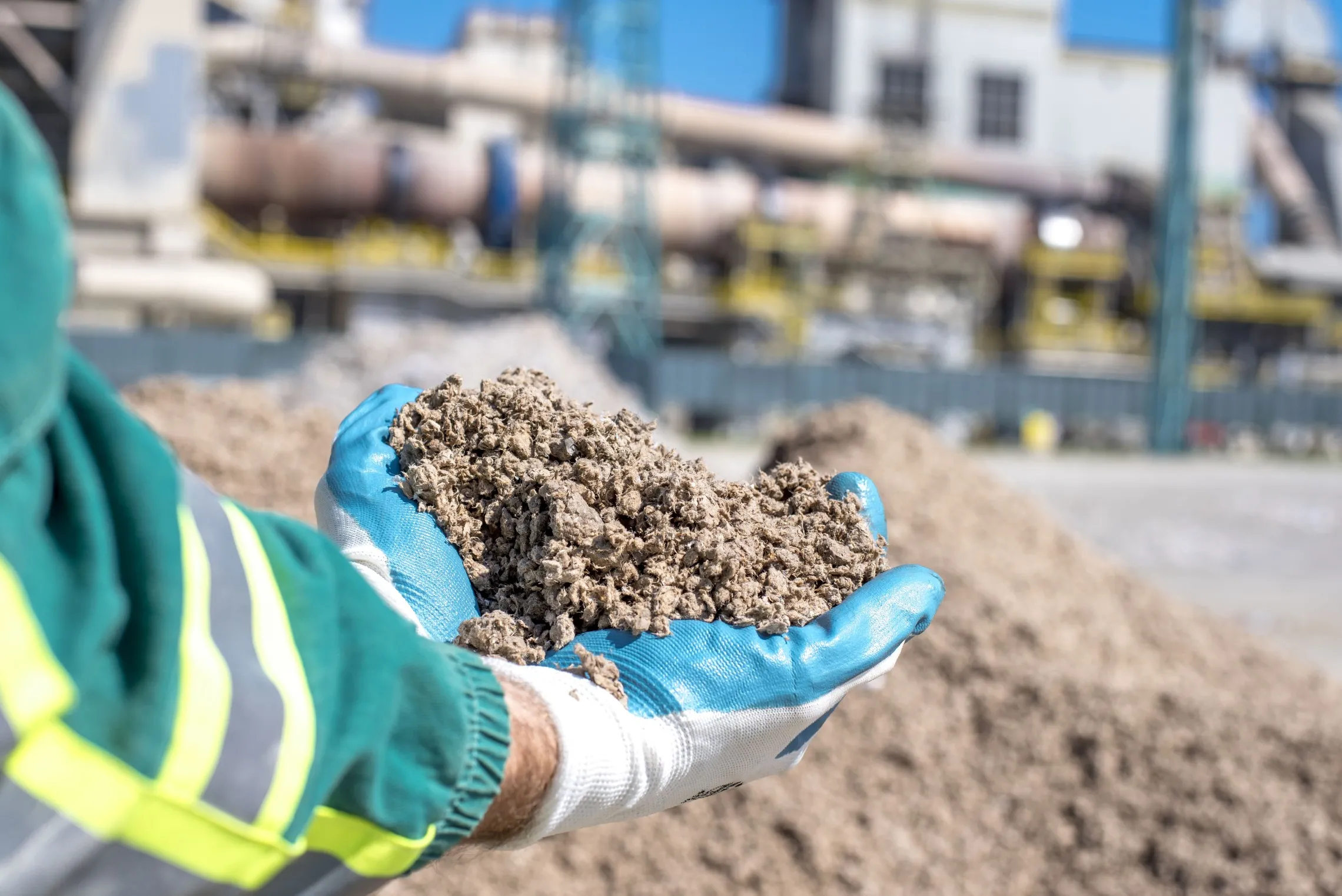
Gypsum is added to the clinker just before the final grinding to make it into the finished product i.e., cement. Gypsum is a hygroscopic material and is sticky in nature. Its composition and physical characteristics vary from region to region in case of mineral gypsum and purity or quality matters for chemical or synthetic gypsum.
Since, gypsum is used as one of the prime materials in cement and due to its hygroscopic nature, it requires proper cover shed to avoid direct sunlight and moisture. Moisture control is one of the complex handling issues for storage of gypsum and to retain its quality. Therefore, gypsum stockpiles should be stored in a building or a storage in a cover shed which is preferably dry, rain proof and moisture proof.
Due to sticky nature, further procedures of handling, loading, conveying and feeding into cement mills require precautions and robust systems to ease this material flow and feed into cement mills for mixing with clinker. There are, however, alternative sources of gypsum available which may be able to partly substitute natural gypsum. Synthetic gypsum can be produced by using limestone powder with sulphuric acid. For making gypsum limestone to be ground at the fineness of 100 – 200 mm.
Dilute sulphuric acid to be added to the limestone powder as per molar ratio of calcium and sulphate to produce CaSO4.2HO. Gases generated during treatment to be handled by suitable pollution control equipment. Produced gypsum is required to be sun dried till moisture is reduced to the level of 10 to 15 per cent. Solar drying method for removal of moisture is one of the best available, less complex, and economical technologies for drying gypsum where solar radiation is high.

How does automation help in obtaining this mineral and increasing productivity
of the unit?
Any kind of possible automation in the manufacturing process will help increase productivity and sustain business. Right now, UCWL does not have any processing unit for manufacturing gypsum.
To bring down moisture in mineral/chemical/synthetic gypsum at desired level, solar drying method can be adopted. If the solar drying system is controlled with a Programmable Logic Controller (PLC) to check and control the indoor temperature and humidity, lower energy cost and higher material drying performance can be obtained through automation.
However, automation of gypsum manufacturing processes helps to increase productivity and availability. During the synthetic gypsum manufacturing, dosing of sulphuric acid with automation will help to maintain the pH of the mix. Mixing and treatment time regulation is required and can be controlled through automation. Fineness of limestone powder can also be controlled for treatment with sulphuric acid.
What are the sustainability measures taken by your organisation in obtaining and processing the desired quality of gypsum?
UCWL started trials of various industrial waste to use as a set retarder for replacement of gypsum. Our organisation is a pioneer in the utilisation of Jarosite in its cement manufacturing process as a partial substitute of gypsum. JK Lakshmi Cement (JKLC) Group’s research and development department is also working on making gypsum from Limestone rejected through screen during the crushing
of limestone.
Does your organisation recycle gypsum? Tell us more about the process.
Since, once gypsum is added to cement it cannot be recycled, however at UCWL, we are using various materials as a set retarder to replace mineral gypsum.
Other industrial wastes like chemical gypsum are used to the tune of 40 to 60 per cent of the total gypsum in place of mineral or marine gypsum. As I said, for the first time in India, UCWL started use of Jarosite (an industrial waste from the zinc industry’s smelting process) as a part replacement of mineral gypsum. Presently 10 per cent of mineral gypsum is replaced by use of Jarosite.
What are the major challenges faced in handling and obtaining gypsum for the manufacturing process?
The cement industry is a major user of gypsum. India’s domestic resources of gypsum are large enough to meet increased demand. Rajasthan has one of the richest sources of mineral gypsum however, it is a limited natural resource in view of increasing demand of the cement industry as a whole. It is also used for the manufacturing of value-added products like POP. Cement industry is also looking for other alternatives i.e., chemical gypsum, POP waste and industrial waste. Consumption and demand of gypsum will also increase by rapid growth of the cement industry, which leads to increased dependence upon alternatives of mineral gypsum viz. synthetic and chemical gypsum to meet cement demand.
There are two ways to obtain gypsum either from natural resources i.e., mineral gypsum and to some extent marine gypsum or chemical or synthetic gypsum generated from dyes and chemical industries and through flue gas desulphurisation (FGD) process.
To obtain mineral gypsum state-of-the-art technology needs to be adopted for the exploitation of deep-seated gypsum. Synthetic gypsum can be manufactured as per specific requirement and quality depends upon purity of lime.
Major challenges during the manufacturing process of Synthetic Gypsum (SynGyp) are as follows.
a) Availability of sulphuric acid, price variation of sulphuric acid as its availability depends on other industries production and consumption. Sulphuric acid is majorly used by fertiliser manufacturing units, hence, during crop seasons availability of sulfuric acid affects badly.
b) Quality of lime w.r.t. purity
c) Maintenance of Process is comparatively higher.
d) Drying of produced gypsum to get desired level of moisture.
e) Safety measures are required due to the use of sulphuric acid.
Nowadays, FGD generated gypsum is getting more attention among industries. High market demand for FGD gypsum is expected to encourage companies to install FGD systems in their power plants. Research shows that more than 85 per cent of FGD systems installed across the globe are wet systems. Rise of the construction industry and agricultural sector is expected to create opportunities for FGD manufacturers over the coming years, which will aid the expansion of synthetic gypsum market size as well.
Through manufacturing of synthetic gypsum, industry can reduce overall environmental impacts and their carbon footprint. This is a win-win situation for both generators as well as users of the synthetic gypsum (SynGyp). SynGyp is the best sustainable alternative for the environment through conservation of mineral gypsum natural deposits.
-Kanika Mathur












JSW Cement Commissions 1 MTPA Unit in Rajasthan

Wonder Cement appoints Mahesh Singh as VP Corporate Brand Communication

JSW Cement commissions additional 1 MTPA grinding unit in Rajasthan

JSW Cement Boards Approve Proposed Shiva Cement Merger

JSW Cement commissions additional 1 MTPA grinding unit at Nagaur
JSW Cement Commissions 1 MTPA Unit in Rajasthan
Wonder Cement appoints Mahesh Singh as VP Corporate Brand Communication
JSW Cement commissions additional 1 MTPA grinding unit in Rajasthan
JSW Cement Boards Approve Proposed Shiva Cement Merger







