

Concrete
The Power of Gypsum

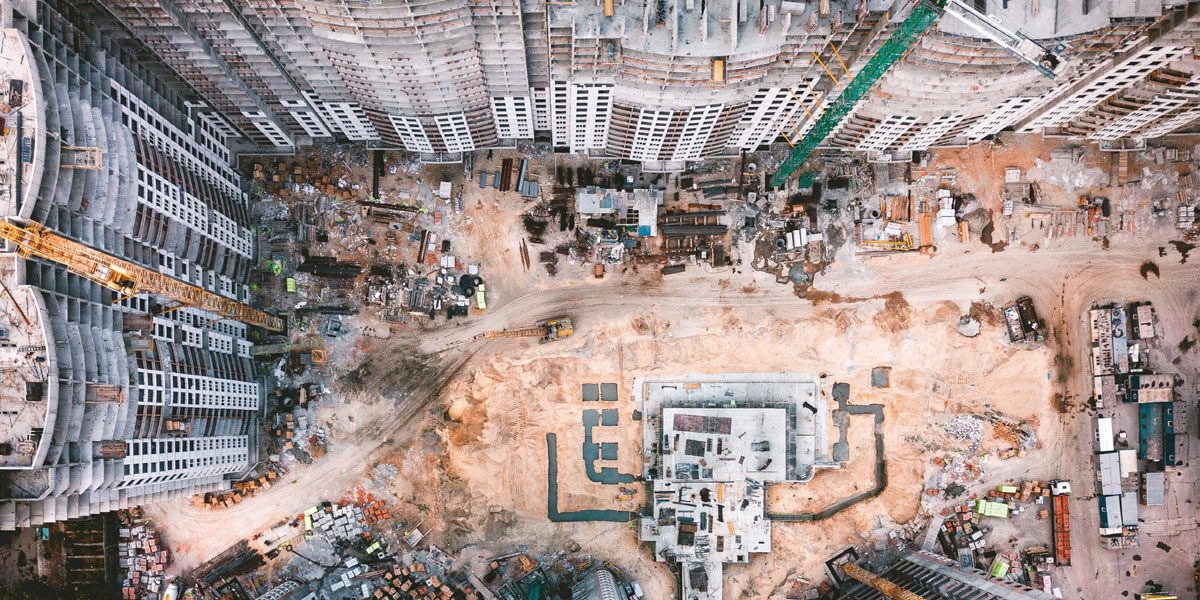
Gypsum is indispensable to cement as it regulates the setting time of cement and impacts its strength. We look at the various aspects of sourcing and processing of gypsum that makes this retarding agent of cement an important component in the manufacturing process while being a sustainable ingredient.
Gypsum is a soft sulphate mineral composed of calcium sulphate dihydrate, with the chemical formula CaSO4•2H2O. It is moderately water-soluble and, in contrast to most other salts, it exhibits retrograde solubility, becoming less soluble at higher temperatures. When gypsum is heated in air it loses water and converts first to calcium sulphate hemihydrate, (bassanite, often simply called ‘plaster’) and, if heated further, to anhydrous calcium sulphate (anhydrite).
Gypsum occurs in nature as a flattened, and transparent, cleavable mass called selenite. It is a common mineral with thick and extensive evaporite beds in association with sedimentary rocks. It is deposited from lake and sea water, as well as in hot springs, from volcanic vapours, and sulphate solutions in veins. Pure gypsum is white, but other substances found as impurities may give a wide range of colours to local deposits.
Calcined gypsum is produced when dihydrate gypsum is fired at the temperature of 800 to 1100°C. At this time, a little calcium sulphate is decomposed to generate new phase CaO, which gives calcined gypsum certain hydrating ability. The condensation speed of calcined gypsum is slow. The amount of water demanded in standard consistency is about 25 per cent to 30 per cent of its own weight. According to Statista reports, India produced nearly 1.5 million metric tons of gypsum in 2021. The total global production of gypsum from mines in 2021 amounted to an estimated 150 million metric tons. The investment value in the cement and gypsum sector in India
for fiscal year 2020 amounted to about 82.6 billion Indian rupees.
The Indian Mineral Yearbook 2020 states that as per NMI database, based on UNFC system, the total reserves/resources of mineral gypsum in India have been estimated at 1,330 million tonnes of which 37 million tonnes have been placed under ‘Reserves’ and 1,293 million tonnes under ‘Remaining Resources’ category.
The demand of cement as a commodity is increasing with the growth of the nation and consequently it shall increase the demand of gypsum as well. The Indian Mineral Yearbook 2020 predicts that India’s domestic resources of gypsum are large enough to meet increased demand. However, with renewed focus on improving the economy and upscaling industrial developments as India lays greater emphasis on creation of infrastructure it will also incline dependence on imports and synthetic gypsum to meet cement demand. Further, as per the report, steps would be necessary to find suitable mining technology to exploit deep seated gypsum resources in Rajasthan and other states. A state-of-the-art technology needs to be adopted for the exploitation of this deep-seated gypsum.
Role of Gypsum in Cement
Gypsum is a mineral and is hydrated calcium sulphate in chemical form. It plays a very important role in controlling the rate of hardening of the cement, and thus, it is often termed as a retarding agent of cement. It is mainly used for regulating the setting time of cement and is an indispensable component. Cement, fertiliser (ammonium sulphate) and plaster of Paris are the three important industries in which gypsum is utilised.

is added to clinker at a level of about 5 per cent.
When water is added to cement, it starts reacting with the C3A and hardens. The time taken in this process is very less, which doesn’t allow time for transporting, mixing and placing. Therefore, gypsum is added to cement to slow down the hydration process. The reaction process of the mix with C3A particles takes place to form ettringite. This ettringite is initially formed as very fine-grained crystals, which form a coating on the surface of the C3A particles. These crystals are too small to bridge the gaps between the particles of cement. The cement mix therefore remains plastic and workable. The time allowed for mixing, transporting and placing plays an important role in strength, composition and workability of concrete. As gypsum retards the process of hydration, it is termed as retarding agent of cement.
It is observed that the optimum addition of gypsum will also enhance the hydration of alite (C3S) leading to increased early strength and reduced shrinkage. Thus, gypsum has a dual role, it helps to retard the setting of cement thus, providing working time/application time for cement on the other hand it also enhances hydration of C3S content due to which it contributes to increased compressive strengths at early ages.
The optimum quantity of gypsum (percentage SO3) would depend mainly on:
• C3A content and its reactivity (clinker )
• Fineness and particle size distribution of the cement
• Alkali content and presence of soluble sulphate
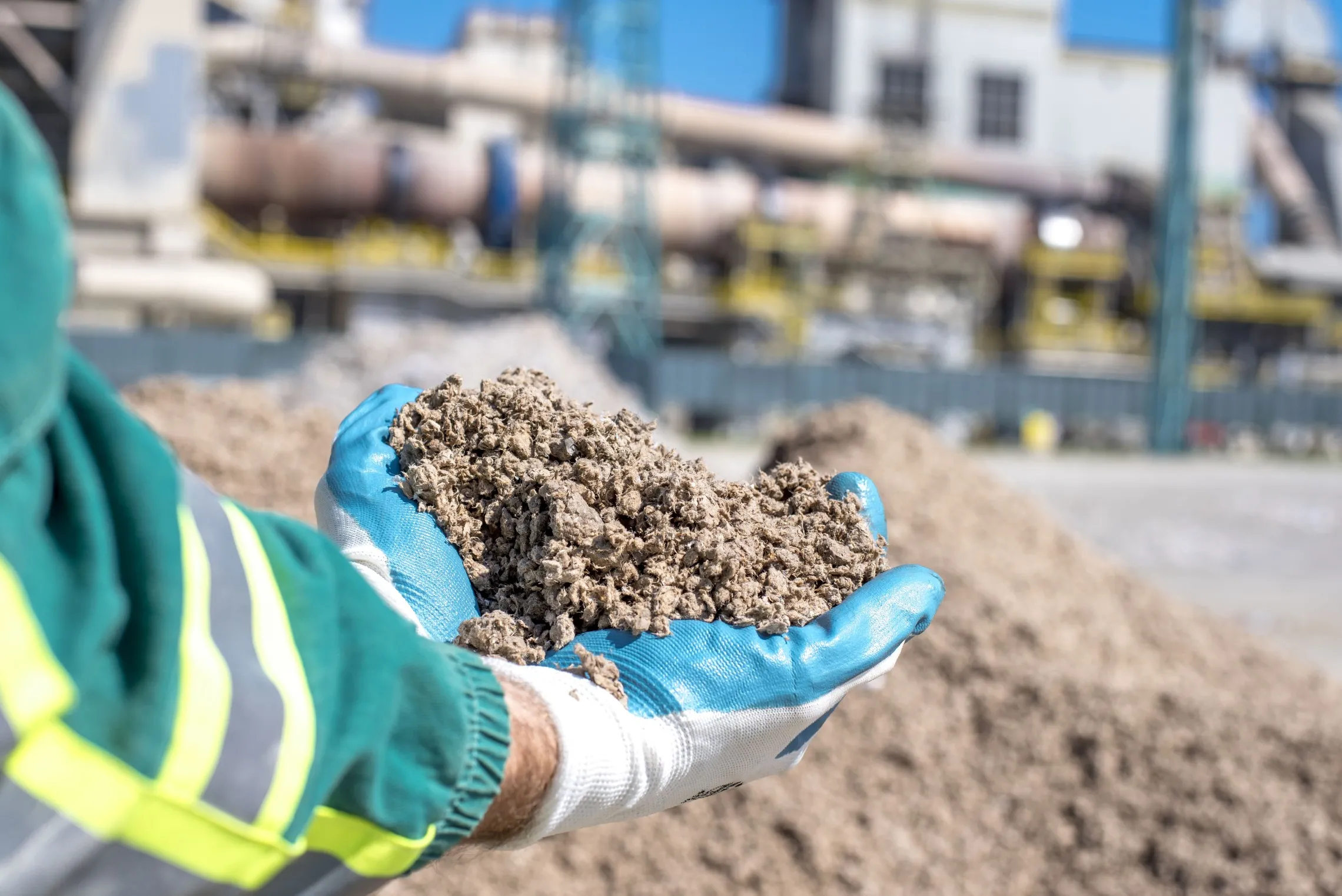
Pradeep Kumar Chouhan – General Manager (QC and Environment), Udaipur Cement Works, says, “Since, gypsum is used as one of the prime materials in cement and due to its hygroscopic nature, it requires proper cover shed to avoid direct sunlight and moisture. Moisture control is one of the complex handling issues for storage of gypsum and to retain its quality. Therefore, gypsum stockpiles should be stored in a building or a storage in a cover
shed, which is preferably dry, rain proof and moisture proof.”

“Due to sticky nature, further procedures of handling, loading, conveying and feeding into cement mills require precautions and robust systems to ease this material flow and feed into cement mills for mixing with clinker. There are, however, alternative sources of gypsum available which may be able to partly substitute natural gypsum. Synthetic gypsum can be produced by using limestone powder with sulphuric acid. To make gypsum, limestone to be ground at the fineness of 100 – 200 mm,” he adds.
The optimum gypsum usage in cement is a function of type of milling system as well as of the type of cement (OPC, PPC and PSC). The optimisation should always be carried out in the plant grinding system as the optimum gypsum is also a function of particle size distribution of the cements. While the lower threshold limit of the gypsum is governed by the necessity to avoid a quick set, the upper limit is governed by the considerations of maximising the early strengths and avoiding undesirable expansion in the hardened mortar/ concrete. The sulphate content in the cement may be added in the form of the:
• Gypsum – calcium sulphate dihydrate CaSO4 2H2O
• Plaster of Paris calcium sulphate hemihydrate CaSO4 0.5H2O and / or
• Anhydrite calcium sulphate anhydrite CaSO4 0 – 0.5H2O
Because of the differences in solubility between hemihydrates (highly soluble), gypsum (moderately) and anhydrite-I (highly soluble) and anhydrite-II (poorly soluble), the nature of the sulphate-bearing compound added to the clinker during cement grinding is of significant importance.
Sustainability in Gypsum
In India, gypsum mining is mainly carried out in the state of Rajasthan, which contributes about 99 per cent of the total production; the remaining 1 per cent is contributed by Jammu and Kashmir and Gujarat. Used in both plasterboard and cement, gypsum is a key component of the construction industry. One of the key benefits of gypsum is sustainability, and the industry is increasingly being obliged to recycle gypsum due to closures in landfills and higher costs of tipping. Gypsum offers many advantages as a building material because of the performance of its properties. Prefabricated products (dry wallboards, ceiling panels, flooring panels) form fire-resistant interiors. Gypsum products are nontoxic and are highly soundproof, heat-insulating materials. Gypsum blocks and panels are used in partitions and internal walls instead of ceramic bricks, cellular concrete blocks and other relevant products. Gypsum can be a substitute for lime and cement in interior plasters.

Gypsum/anhydrite are produced from open-cast mines or underground mines using pillar and stall mining methods that give extraction rates of up to 75 per cent. Gypsum deposits are abundant and widespread, allowing for the use of locally mined gypsum in most regions and avoiding transport costs. Many modern plants are built next to coal-fired power stations that make gypsum as a by-product, and depending on the quality of the raw mineral, gypsum-mining operations can be rehabilitated easily. A by-product or synthetic, gypsum is viewed as environmentally friendly because it incorporates sulphur removed during flue gas desulphurisation (FGD) at coal-fired power plants and other industrial sites.
“As part of our sustainability goals we have taken significant measures to replace natural or mineral gypsum with industrial waste. All our manufacturing units are utilising available industrial waste such as chemical gypsum, anhydrite gypsum, FGD, synthetic gypsum etc.,” says Prakhar Shrivastava, Corporate Quality, JK Cement Limited.
“Blending of mineral gypsum with industrial waste as an economical and sustainable solution to replace natural minerals. Promoting a circular economy is our key pillar of the Sustainability journey to reduce the environmental impact of our product by replacing natural resource consumption with industrial wastes which in turn has reduced our dependency on natural resources and is economical as well. It benefits our business, society and the environment by eliminating waste and decoupling our growth from the consumption of natural resources,” he adds.
Recycling plays a big role in making Gypsum a sustainable material. Plaster that has been formed into a wall is essentially the same material that was dug out of the ground, just reconstituted, and that crushing and reconstitution can be repeated endlessly. Gypsum from gypsum boards and other products can usually be directly recycled in a plaster or plasterboard plant. Physically, gypsum is infinitely recyclable; however, the recycling process requires additional energy. Gypsum wastes, mostly from pure gypsum, can be used in construction, agriculture and other industrial areas. This infinite recyclability of gypsum drastically reduces waste, landfills, energy consumption as well as prevent the natural reserves from depleting.
Gypsum, while not a raw material in the kiln feed, is used in Portland cement to regulate sets and is added to clinker at a level of about 5 per cent. It is an integral part of the cement manufacturing process. An addition is calculated to produce the optimum performance from the points of view of strength development and water demand for the cement. It may contain anhydrite, clay, quartz and calcite as impurities, at levels which vary widely with source.
-Kanika Mathur














JSW Cement Commissions 1 MTPA Unit in Rajasthan

Wonder Cement appoints Mahesh Singh as VP Corporate Brand Communication

JSW Cement commissions additional 1 MTPA grinding unit in Rajasthan

JSW Cement Boards Approve Proposed Shiva Cement Merger

JSW Cement commissions additional 1 MTPA grinding unit at Nagaur
JSW Cement Commissions 1 MTPA Unit in Rajasthan
Wonder Cement appoints Mahesh Singh as VP Corporate Brand Communication
JSW Cement commissions additional 1 MTPA grinding unit in Rajasthan
JSW Cement Boards Approve Proposed Shiva Cement Merger





