

Concrete
Commonly used precast shapes

In the olden days, wooden sleepers were used for laying the railway tracks, but due to the depleting wooden resources and increasing concern of the ecological balance, the use of concrete sleepers was started and now it has completely replaced the wooden sleepers. Concrete ties have become more common mainly due to greater economy and better support of the rails under high speed and heavy traffic. Ties are normally laid on top of track ballast, which supports and holds them in place, and provides drainage and flexibility. Heavy crushed stone is the normal material for the ballast, but on lines with lower speeds and weight, sand, gravel and even ash from the fires of coal-fired steam locomotives have been used. Regarding the market potential of the railway sleepers, their demand totally varies with the installation of new railway lines. To link almost every city and town with the other and to avoid the delay of trains because of ??ross??on single lines, number of new tracks is being installed. Tracks on high-density traffic routs with speed exceeding 100 km per hour, are being strengthened and modernised adopting improved methods of track maintenance for safer and comfortable rail travel.
Concrete sleepers can be produced from both new and recycled concrete. A railway sleeper is a rectangular support for the rails in railroad tracks. Generally laid perpendicular to the rails, ties transfer loads to the track ballast and subgrade, hold the rails upright and keep them spaced to the correct gauge. Railway sleepers are traditionally made of wood, but pre-stressed concrete is now also widely used, especially in Europe and Asia. Steel ties are common on secondary lines in the UK plastic composite ties are also employed, although far less than wood or concrete. From the view of region, Asia-Pacific and Europe have a larger sales market share in 2018 which together account for 74.02 per cent, and will witness a stable growth in following years.
The demand for sleepers will go on a lot better aspect in time to return. In the near future, the railways are probable to broaden as a minimum 5,000 to 8,000 km of rail network per year, which is almost 30 to 40 per cent extra than in past, assuming that kilometer of rail would need 1600 sleepers these plans are probable to outcomes in annual demand of about 1.3 crore of sleeper. Present manufacturing cost of monoblock broad gauge pre-stressed concrete sleeper is within the range of Rs 2,200 to Rs 2,500. The cement which is applied for the manufacture of the sleeper is the main raw material.


Cement requirement
The main requirement for railway sleepers is cement. There is a separate specification issued by Ministry of Railways through Research Design and Standards Organisation, Lucknow for the manufacture of concrete sleepers. It is popularly known as IRS T-40 grade of cement. The specification is quite similar to that of Ordinary Portland Cement 53 Grade except few parameters are different taking into account the requirement of manufacturing process of sleepers.
Likewise the cement fineness has to be minimum of 3700 sq. cm per gram. The compressive strength of cement mortar is measured only for the age of 7days and has to be minimum of 375 kg per sq cm. The tri calcium Silicate content (C3S) requirement has to be not less than 45 percent. The other requirements are same as that of 53 Grade of cement. The Indian cement industry is capable of fulfilling the entire requirement of sleeper manufacturing industry locally.

Vulnerability
The average lifespan of a pre stressed concrete sleeper is about 50 years. Over a period of time the pre stressed concrete sleepers have proved its superiority over wooden and steel sleepers. However the fundamental problems in these types of sleepers is vulnerability to chemical attack [DEF(Delayed Ettringite Formation), AAR(Alkali-Aggregate Reaction) and many others] and low impact resistance. It can be minimised by changing cement with Industrial waste cementitious materials, which will give extremely good engineering properties like protection against chemical degradation.
Railway produces around 1.3 crore (2019) sleepers each year and if they use industrial waste in concrete for sleepers, it’s going to reduce the value of manufacturing of each sleeper by approximately Rs 30, with the intention to imply a typical value saving of Rs 30 to 35 crore in keeping with annum for India Railways.
But critics have been quick to point out that the weight and bulk of concrete sleepers is a significant disadvantage when it comes to the cost ??both in time and money ??of initial installation and later repairs.

Spun pipes
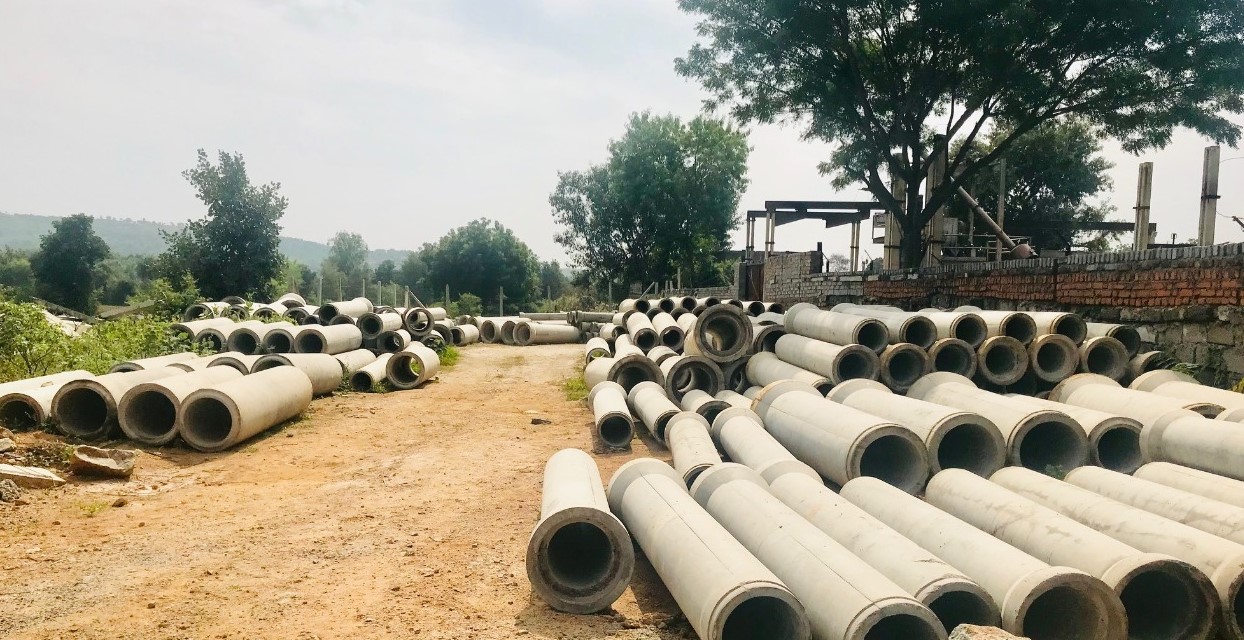
The other major consumed pre cast item is spun/hume pipes. It is produced in a small scale industry (SSI) and has a very wide market. The technology used is pretty old and has not changed much but the use of these pipes is very extensive. Only SSI units can manufacture the RCC (reinforced cement concrete) pipes up to 100 cm diameter. Such pipes are classified into two groups as pressurized and non-pressurised. Cement, coarse and fine aggregate, sand, and mild and HT steel rods are used for the manufacture of such pipes. These are mostly manufactured in two lengths such as 1.8 m and 2.8 m with varying diameters from 10 cm to 100 cm. The RCC pipes are used for irrigation, culverts construction, sewerage, and drainage purposes for smooth transportation of effluents and to avoid seepage. The main raw materials used are cement, sand, aggregates, M.S. reinforcement rod and wire etc.
Manufacturing process
A mixture with raw materials such as cement, sand, and stone chips in 1:2.5:2.5 ratios are prepared with the help of power operated cement concrete mixture. Steel rod with reinforcement case is made in accordance with the dimensions of the pipe in a reinforcement making/winding machine. This case is then placed inside the pipe mold. The mold is mounted horizontally on the runners of the pipe molding machine. The mold is then rotated at a slow speed. Concrete mixture is fed into the rotating molds through its open ends at both sides.
When the mold is filled with required quantity of the mixture to obtain requisite thickness, the speed of the rotation of the mold is increased and kept at a fixed speed for few minutes depending upon the pipe diameter, length, etc. the inside diameter of the green pipe in the rotating mold is then finished for smoothness with the help of wooden reaper and to remove excess water. Thereafter neat cement is sprinkled inside the pipe to obtain a well-polished surface and to reduce friction coefficient at the time of its setting. The mold is taken out from the machine by the system and left in curing bay for the initial setting. On the following day, the molds are removed and the pipe is passed on to the curing tank and allowed to remain in the water for 15 days and then taken out for inspection and quality test. The finished product is then stocked in the yard for disposal. The pipes so manufactured are tested as per the specifications IS 458:1971 drawn by the Bureau of Indian Standards for ensuring the quality of the product.
Source: A research paper by Prof. Suresh Kumar.A and Dr.Muthukannan M. published by in International Journal of Recent Technology and Engineering (IJRTE), December 2019.














JSW Cement Commissions 1 MTPA Unit in Rajasthan

Wonder Cement appoints Mahesh Singh as VP Corporate Brand Communication

JSW Cement commissions additional 1 MTPA grinding unit in Rajasthan

JSW Cement Boards Approve Proposed Shiva Cement Merger

JSW Cement commissions additional 1 MTPA grinding unit at Nagaur
JSW Cement Commissions 1 MTPA Unit in Rajasthan
Wonder Cement appoints Mahesh Singh as VP Corporate Brand Communication
JSW Cement commissions additional 1 MTPA grinding unit in Rajasthan
JSW Cement Boards Approve Proposed Shiva Cement Merger







