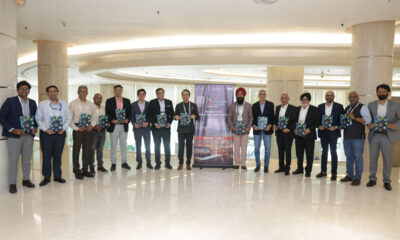
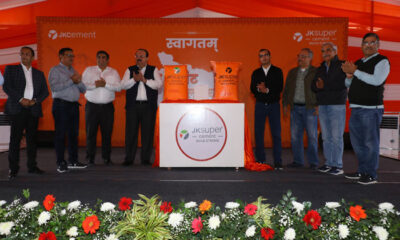
Strengthening its value-added portfolio, Prism Johnson Limited introduces ‘Prism Chakachak’ Gypsum Plaster under Prism Cement. The launch expands its integrated building materials offering while leveraging a strong 2,400-dealer distribution network
Mumbai, February 27, 2026: Prism Johnson Limited (BSE: 500338 | NSE: PRSMJOHNSN), amongst India’s leading integrated building materials companies, has introduced ‘Prism Chakachak’ Gypsum Plaster under its cement division, Prism Cement. This addition reinforces the Company’s strategy of expanding its value-added construction materials portfolio while leveraging its existing distribution network.

Part of the Premix Walling Range, Prism Chakachak Gypsum Plaster is a lightweight, quick-setting material designed to deliver smooth, paint-ready wall and ceiling finishes. It requires no water curing, reduces construction time and labor requirement, and offers low shrinkage with minimal cracks. Naturally fire-resistant and eco-friendly, the product provides good thermal and acoustic insulation while adding minimal load to structures.
The Company’s cement business, Prism Cement, has a strong presence in Central India, including key markets such as Uttar Pradesh, Madhya Pradesh and Bihar, supported by a dealer network of ~ 2,400 dealers. The product will be made available across the Company’s operating regions through this established distribution network.
Prism Johnson Limited offers a diversified portfolio of building materials spanning cement, tiles, bathware, ready-mix concrete, construction chemicals and others. The addition of gypsum plaster further strengthens the Company’s integrated product basket, enabling customers to access a wider range of construction and interior solutions under one roof.

UltraTech Cement reported record financial performance for Q4 and FY26, supported by strong volumes, higher profitability and improved cost efficiency. Consolidated net sales for Q4 FY26 rose 12 per cent year-on-year to Rs 254.67 billion, while PBIDT increased 20 per cent to Rs 56.88 billion. PAT, excluding exceptional items, grew 21 per cent to Rs 30.11 billion.
For FY26, consolidated net sales stood at Rs 873.84 billion, up 17 per cent from Rs 749.36 billion in FY25. PBIDT rose 32 per cent to Rs 175.98 billion, while PAT increased 36 per cent to Rs 83.05 billion, crossing the Rs 80 billion mark for the first time.
India grey cement volumes reached 42.41 million tonnes in Q4 FY26, up 9.3 per cent year-on-year, with capacity utilisation at 89 per cent. Full-year India grey cement volumes stood at 145 million tonnes. Energy costs declined 3 per cent, aided by a higher green power mix of 43 per cent in Q4.
The company’s domestic grey cement capacity has crossed 200 MTPA, reaching 200.1 MTPA, while global capacity stands at 205.5 MTPA. UltraTech also recommended a special dividend of Rs 2.40 billion per share value basis equivalent to Rs 240.
India’s pace of infrastructure development is pushing the construction sector to work at a significantly higher scale than previously. Tight deadlines necessitate eliminating concreting delays, especially in large and mega projects, which, in turn, imply installing the right batching plant and ensuring batching is efficient. CW explores these steps as well as the gaps in India’s batching plant market.
Choose well
Large-scale infrastructure and building projects typically involve concrete consumption exceeding 30,000-50,000 cum per annum or demand continuous, high-volume pours within compressed timelines, according to Rahul R Wadhai, DGM – Quality, Tata Projects.
Considering the daily need for concrete, “large-scale concreting involves pouring more than 1,000–2,000 cum per day while mega projects involve more than 3,000 cum per day,” says Satish R Vachhani, Advanced Concrete & Construction Consultant…
The Andhra Pradesh government will allow private firms that require more than 300 megawatt (MW) of power to apply for distribution licences, making the state the first to extend such licences beyond the power sector. The policy targets information technology, pharmaceuticals, steel and data centres and aims to reduce reliance on state utilities as demand rises for artificial intelligence infrastructure.
Approved applicants will be able to procure electricity directly from generators through power purchase agreements, a change officials said will create more competitive tariffs and reduce supply risk. Licence holders will use the Andhra Pradesh Transmission Company (APTRANSCO) network on payment of charges and will not need a separate distribution network initially.
Licences will be granted under the Electricity Act, 2003 framework, with the Central and State electricity regulators retaining authority over terms and approvals. The recent Electricity (Amendment) Bill, 2025 sought to lower entry barriers, enable network sharing and encourage competition, while the state commission will set floor and ceiling tariffs where multiple discoms operate.
Industry players and original equipment manufacturers welcomed the policy, saying competitive supply is vital for large data centre investments. Major projects and partnerships such as those involving Adani and Google, Brookfield and Reliance, and Meta and Sify Technologies are expected to benefit as capacity expands in the state.
Analysts noted India’s data centre capacity is forecast to reach 10 gigawatts (GW) by 2030 and cited International Energy Agency estimates that global data centre electricity consumption could approach 945 terawatt hours by the same year. A one GW data centre needs an equivalent power allocation and one point five times the water, which authorities equated to 150 billion litres (150 bn litres).
Advisers warned that distribution licences will require close regulation and monitoring to prevent misuse and to ensure tariffs and supply obligations are met. Officials said the policy aims to balance investor requirements with regulatory oversight and could serve as a model for other states.