Concrete
Cementing new identity
Published
6 years agoon
By
admin
Large cement companies cracked the code and invested heavily in high visibility ATL (above the line) advertising, says Sandip Ranjan Ghose of Birla Corporation.
The advertisement of an iconic tea brand features a shop-owner trying to sell a packet of ordinary tea to a customer- saying "Chai toh chai hi hota hain".. The lady refuses to take it, explaining why she preferred only that particular brand. Cement marketing used to be similar with little differentiation between the offerings by manufacturers.
There was another reason for the late marketing evolution of the cement industry. As long as cement was under the control regime customers had little choice. They had to pretty much settle only for what was available.
At best, there were some perceived differences, determined largely by visual attributes such as colour and fineness. These, at times, resulted in the products of certain plants commanding a marginal premium over others. Because of this, the name of the plant where the cement was produced became the brand rather than the company that owned it. So, the trade would refer to it as Jamul, Satna, Maihar, Kota, etc. depending on the source of supply.
Thus, there was little incentive for cement-makers to invest in marketing. All brands of cement were generically positioned in terms of strength. Rarely did the communication extend to technical parameters such as setting time, workability and other BIS standards. Therefore, it is not surprising that the sales teams of cement companies were referred to as marketing. A practice that has not entirely disappeared since not all companies have a separate dedicated brand marketing vertical.
Life began to change in the 90s after decontrol – when, with a surge in capacities, the industry saw cycles of supply-demand imbalance and, consequently, the impact of real competition in the market. The first serious attempt at brand building was probably by Gujarat Ambuja, which came to challenge the dominant player in its home turf.
The advent of multinationals and the ensuing spree of consolidation, most notably Grasim’s merger with L&T cements, permanently changed the rules of the game. Soon, cement companies became one of the biggest advertisers on television and dominated the outdoor space, covering practically every inch of exposed wall in the countryside.
What makes India different from many other countries is the route-to-market. With a very high component of retail customers – the Individual Home Builder (IHB) segment – bulk of cement sales, including supplies to small or medium-size builders and contractors, happen in bags through the trade network. RMC, still is at a nascent stage and only large sites, can handle bulk deliveries. Thus, it is essentially a B2C business – in which dealers and stockists are the first level of customers.
Large companies cracked the code and invested heavily in high visibility ATL (above the line) advertising. Television commercials-especially cricket sponsorship-pleased the channel partners and wall paintings helped raise TOMA (top of mind awareness) with rural consumers. However, marketers soon realised they were missing a vital link in the chain – the influencers, comprising Masons, Engineers and Contractors.
This led to a renewed emphasis on influencer contact programmes through BTL (Below the Line) marketing activities. From simple gratification schemes, market leaders started developing more sophisticated technical selling competencies.
Separate Technical Services or Customer Service Teams were formed with the mandate for customer conversion through on-site demonstration. So, cement marketing drew from both pure play consumer and industrial product categories to developing a unique marketing mix, that is a combination of B2B and B2C businesses. The large players were naturally the early adapters as they jostled for space at the premium end of the market. This saw a burst of creativity but without any significant product innovation.
The first major disruption came with the introduction of laminated bags – pioneered by the erstwhile Lafarge for its Concreto brand of slag cement. The "tamper proof" packaging provided the consumer with a "reason to believe" the superior quality claim, addressing two common concerns of moisture absorption and pilferage. On the back of this innovation and smart celebrity advertising, Lafarge was able to establish itself over peers in its core markets.
However, not everyone was impressed. Traditional companies thought the extravagance of MNCs and large Indian conglomerates were wasteful. Much like the "tea-seller" they saw little point in branding a commodity. The old guard preferred to remain "price-takers" (and, in some cases, "cost warriors") and not spend resources for the race for price leadership.
This diametrically opposite strategies of two sets of players had an interesting impact on the market structure, polarising it into two distinct segments of premium and discount brands that came to be popularly known as "A" and "B" Group. The price gap between these was accentuated during 2010-2011 when the industry saw one of the steepest declines in demand growth. Since then, the twain has not met though, as we shall see later, there has been some cross currents between them.
The sustained investment in brand building had a positive fall out for the industry. Years of commoditisation of the product had led to very low consumer engagement with the category. But, with increasing visibility, thanks to the rural penetration of satellite television and high viewership of sports (primarily cricket) and news channels (rise in political awareness and high stake elections), consumer involvement with cement palpably increased.
This shift in consumer mindset coincided with the rise of aspirational middle class in "Bharat" comprising tier 2 and 3 cities, small towns and "urban" areas. This was in sync with trends in related products for construction and home-building, such as paint, tiles, sanitaryware and toilet fittings. The sentiment of "you build a home only once" resonated with "new India"more than ever before.
During the last decade, if one were to analyse, cement price increased marginally in real terms. However, the cost push on Fuel, Power and Logistics was relentless. This put margins of cement companies under pressure. This could only be partially insulated by tax incentives for new units and reducing lead to market by setting up grinding units closer to cementitious sources and consumption centre. But, manufacturers realised that the cushion will not last for ever. Salvation in the longer run, therefore, lies in improving realisation while ruthlessly pursuing cost reduction. Thus was born the new cult of "Premiumisation" in cement industry. Companies in the so-called"B" segment jumped on to the premium bandwagon by launching brands in paper (LPP) bags. Group A leaders launched"super-premium" variants with special attributes. While everyone was nibbling at different ends of the pie – a clear strategy was not in sight.
MP Birla case study
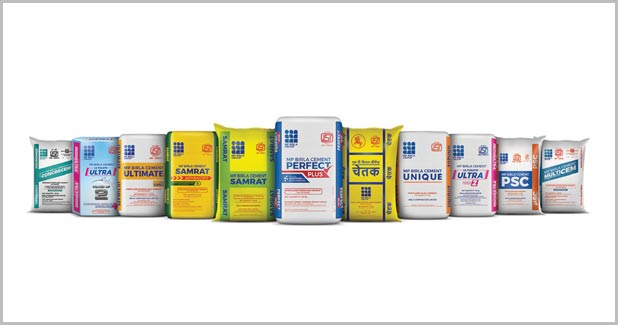
Sometimes, necessity is the mother of virtue. Birla Corporation faced a unique challenge. Due to historical legacy, it had inherited a slew of regional brands across the geographies where it was present. While Birla Chetak, often called Ghoda Chhap Cement by consumers, was its dominant brand in Rajasthan and North India, Birla Samrat (popularly referred to as Satna Cement) was its flagship in Central India. In the East, it had a niche premium slag cement, Birla Unique.
This put serious impediments in developing an unified brand strategy for the Company. There was considerable confusion in brand recognition among consumers and the trade due to the presence of several cement brands with the "Birla" suffix in the same markets. To resolve that it was imperative to have a common brand identity. Also, without a sizeable national presence it was not possible to provide adequate ATL support to each of the brands.
Merging the brands was not an option " because that would destroy the strong regional equity of each brand. Therefore, a mega brand transition like what UltraTech undertook after its acquisition of L&T’s Cement Division was neither advisable nor viable given Birla Corporation’s size and scale of operations.
The problem was compounded – when Birla Corporation acquired the Cement Business of the Reliance ADAG group in 2016. The Business Transfer Agreement provided a very short window for using the Reliance brand name. So, a quick name-change was almost a condition precedent of the deal. This posed several challenges on the marketing front. Though Reliance Cement had a very short life-span it had established its own brand salience. Reliance Group insignia gave it a special halo that could not be easily substituted in the trade and consumer mind-space.
At the same time, any value destruction of the brand would jeopardise the financials of the deal. However, the marketing team saw this as an opportunity to create a brand architecture for the group under a new MP Birla franchise. The strategy was based on segmentation of the market both in terms of price-points and geographies. Reliance Cement brand morphed into MP Birla Perfect Plus and became the group’s flagship premium cement brand across all markets.
The seamless brand transition ensured business continuity with minimum disruption in the trade channel, which helped the company scale-up and consolidate within a short time. Since then, MP Birla Perfect Plus has been extended into new geographies, increasing its share in the premium cement segment. Now, nearly 40 per cent of MP Birla Cement’s trade sales come from the premium segment " one of the highest among its peer group.
The Brand Architecture is founded upon the strong pillars of the regional Heritage Brands (Chetak and Samrat), flanked by Super-Premium and niche offerings. To have a common pan-India offering for the non-trade and Institutional customers and preserve the sanctity of trade (B2C) segment – MP Birla Cement has two special brands Multicem (blended cement) and Concrecem (OPC).
Albeit a very evolved architecture – it has probably yielded results with MP Birla Cement’s high share of trade sales (81.61 per cent) and blended cement (92.5 per cent) in the portfolio, during April to December/FY20.
The future of Cement Marketing, like almost every other category, is clearly Digital. We already find companies investing heavily in Data Analytics, CRM and Loyalty programmes for trade and Influencers and preparing for e-selling. The consumer today is more aware, tech savvy and looks for the best while building his dream house. The key would be to provide segmented solutions.
The future clearly belongs to brands offering segmented solutions to customers. Those who understand and connect with the consumers best will ultimately win the game.
ABOUT THE AUTHOR: Sandip Ranjan Ghose is the Chief Operating Officer of Birla Corporation (MP Birla Group). He has worked in senior leadership roles at Hindustan Unilever, ABP Group, HT Media and Lafarge. He is an ICF – PCC Leadership Coach. Ghose is a popular blogger, op-ed columnist and social-media influencer.
Concrete
Merlin Prime Spaces Acquires 13,185 Sq M Land Parcel In Pune
Rs 273 crore purchase broadens the developer’s Pune presence
Published
11 hours agoon
March 6, 2026By
admin
Merlin Prime Spaces (MPS) has acquired a 13,185 sq m land parcel in Pune for Rs 273 crore, marking a notable expansion of its footprint in the city.
The transaction value converts to Rs 2,730 mn or Rs 2.73 bn.
The parcel is located in a strategic area of Pune and the firm described the acquisition as aligned with its growth objectives.
The deal follows recent activity in the region and will be watched by investors and developers.
MPS said the acquisition will support its planned development pipeline and enable delivery of commercial and residential space to meet local demand.
The company expects the site to provide flexibility in product design and phased development to respond to market conditions.
The move reflects an emphasis on land ownership in key suburban markets.
The emphasis on land acquisition reflects a strategy to secure inventory ahead of demand cycles.
The purchase follows a period of sustained investor interest in Pune real estate, driven by expanding office ecosystems and residential demand from professionals.
MPS will integrate the new holding into its existing portfolio and plans to engage with local authorities and stakeholders to progress approvals and infrastructure readiness.
No financial partners were disclosed in the announcement.
The firm indicated that timelines will depend on approvals and prevailing market conditions.
Analysts note that strategic land acquisitions at scale can help developers manage costs and timelines while preserving optionality for future projects.
MPS will now hold an enlarged land bank in the region as it pursues growth, and the acquisition underlines continued corporate appetite for measured expansion in second tier cities.
The company intends to move forward with detailed planning in the coming months.
Stakeholders will assess how the site is positioned relative to existing infrastructure and connectivity.
Concrete
Adani Cement and Naredco Partner to Promote Sustainable Construction
Collaboration to focus on skills, technology and greener practices
Published
11 hours agoon
March 6, 2026By
admin
Adani Cement has entered a strategic partnership with the National Real Estate Development Council (Naredco) to support India’s construction needs with a focus on sustainability, workforce capability and modern building technologies. The collaboration brings together Adani Cement’s building materials portfolio, research and development strengths and technical expertise with Naredco’s nationwide network of more than 15,000 member organisations. The agreement aims to address evolving demand across housing, commercial and infrastructure sectors.
Under the partnership, the organisations will roll out skill development and certification programmes for masons, contractors and site supervisors, with training to emphasise contemporary construction techniques, safety practices and quality standards. The programmes are intended to improve project execution and on-site efficiency and to raise labour productivity through standardised competencies. Emphasis will be placed on practical training and certification pathways that can be scaled across regions.
The alliance will function as a platform for knowledge sharing and technology exchange, facilitating access to advanced concrete solutions, innovative construction practices and modern materials. The effort is intended to enhance structural durability, execution quality and environmental responsibility across developments while promoting adoption of low-carbon technologies and green cement alternatives. Companies expect these measures to contribute to longer term resilience of built assets.
Senior executives conveyed that the partnership reflects a shared commitment to strengthening quality and sustainability in construction and that closer engagement with developers will help integrate advanced materials and technical support throughout the project lifecycle. Leadership noted the need for responsible construction practices as urbanisation accelerates and indicated that the association should encourage wider adoption of green building norms and collaboration within the real estate and construction ecosystem.
The organisations said they will also explore integrated building solutions, including ready-mix concrete offerings, while supporting initiatives aligned with affordable and inclusive housing. The partnership will progress through engagements, conferences and joint training programmes targeting rapidly urbanising cities and growth centres where demand for efficient and environmentally responsible construction grows. Naredco, established under the aegis of the Ministry of Housing and Urban Affairs, will leverage its policy and advocacy role to support implementation.
Operational excellence in cement is no longer about producing more—it is about producing smarter, cleaner and more reliably, where cost per tonne meets carbon per tonne.
Operational excellence in cement has moved far beyond the old pursuit of ‘more tonne’. The new benchmark is smarter, cleaner, more reliable production—delivered with discipline across process, people and data. In an industry where energy can account for nearly 30 per cent of manufacturing cost, even marginal gains translate into meaningful value. As Dr SB Hegde, Professor, Jain College of Engineering & Technology, Hubli and Visiting Professor, Pennsylvania State University, USA, puts it, “Operational excellence… is no longer about producing more. It is about producing smarter, cleaner, more reliably, and more sustainably.” The shift is structural: carbon per tonne will increasingly matter as much as cost per tonne, and competitiveness will be defined by the ability to stabilise operations while steadily lowering emissions.
From control rooms to command centres
The modern cement plant is no longer a handful of loops watched by a few operators. Control rooms have evolved from a few hundred signals to thousands—today, up to 25,000 signals can compete for attention. Dr Rizwan Sabjan, Head – Global Sales and Proposals, Process Control and Optimization, Fuller Technologies, frames the core problem plainly: plants have added WHRS circuits, alternative fuels, higher line capacities and tighter quality expectations, but human attention remains finite. “It is very impossible for an operator to operate the plant with so many things being added,” he says. “We need somebody who can operate 24×7… without any tiredness, without any distraction… The software can do that for us better.”
This is where advanced process control shifts from ‘automation spend’ to a financial lever. Dr Hegde underlines the logic: “Automation is not a technology expense. It is a financial strategy.” In large kilns, a one per cent improvement is not incremental—it is compounding.
Stability is the new productivity
At the heart of operational excellence lies stability. Not because stability is comfortable, but because it is profitable—and increasingly, low-carbon. When setpoints drift and operators chase variability, costs hide in refractory damage, thermal shocks, stop-start losses and quality swings. Dr Sabjan argues that algorithmic control can absorb process disturbances faster than any operator, acting as ‘a co-pilot or an autopilot’, making changes ‘as quick as possible’ rather than waiting for manual intervention. The result is not just fuel saving—it is steadier operation that extends refractory life and reduces avoidable downtime.
The pay-off can be seen through the lens of variability: manual operation often amplifies swings, while closed-loop optimisation tightens control. As Dr Sabjan notes, “It’s not only about savings… there are many indirect benefits, like increasing the refractory life, because we are avoiding the thermal shocks.”
Quality control
If stability is the base, quality is the multiplier. A high-capacity plant can dispatch enormous volumes daily, and quality cannot be a periodic check—it must be continuous. Yet, as Dr Sabjan points out, the biggest error is not in analysis equipment but upstream: “80 per cent of the error is happening at the sampling level.” If sampling is inconsistent, even the best XRF and XRD become expensive spectators.
Automation closes the loop by standardising sample collection, transport, preparation, analysis and corrective action. “We do invest a lot of money on analytical equipment like XRD and XRF, but if it is not put on the closed loop then there’s no use of it,” he says, because results become person-dependent and slow.
Raju Ramachandran, Chief Manufacturing Officer (East), Nuvoco Vistas Corp, reinforces the operational impact from the plant floor: “There’s a stark difference in what a RoboLab does… ensuring that the consistent quality is there… starts right from the sample collection.” For him, automation is not about removing people; it is about making outcomes repeatable.
Human-centric automation
One of the biggest barriers to performance is not hardware—it is fear. Dr Sabjan describes a persistent concern that digital tools exist to replace operators. “That’s not the way,” he says. “The technology is here to help operator… not to replace them… but to complement them.” The plants that realise this early tend to sustain performance because adoption becomes collaborative rather than forced.
Dr Hegde adds an important caveat: tools can mislead without competence. “If you don’t have the knowledge about the data… this will mislead you… it is like… using ChatGPT… it may tell the garbage.” His point is not anti-technology; it is pro-capability. Operational excellence now requires multidisciplinary teams—process, chemistry, physics, automation and reliability—working as one.
GS Daga, Managing Director, SecMec Consultants, takes the argument further, warning that the technology curve can outpace human readiness: “Our technology movement AI will move fast, and our people will be lagging behind.” For him, the industry’s most urgent intervention is systematic skilling—paired with the environment to apply those skills. Without that, even high-end systems remain underutilised.
Digital energy management
Digital optimisation is no longer confined to pilots; its impact is increasingly quantifiable. Raghu Vokuda, Chief Digital Officer, JSW Cement, describes the outcomes in practical terms: reductions in specific power consumption ‘close to 3 per cent to 7 per cent’, improvements in process stability ‘10 per cent to 20 per cent’, and thermal energy reductions ‘2–5 per cent’. He also highlights value beyond the process line—demand optimisation through forecasting models can reduce peak charges, and optimisation of WHRS can deliver ‘1 per cent to 3 per cent’ efficiency gains.
What matters is the operating approach. Rather than patchwork point solutions, he advocates blueprinting a model digital plant across pillars—maintenance, quality, energy, process, people, safety and sustainability—and then scaling. The difference is governance: defined ownership of data, harmonised OT–IT integration, and dashboards designed for each decision layer—from shopfloor to plant head to network leadership.
Predictive maintenance
Reliability has become a boardroom priority because the cost of failure is blunt and immediate. Dr Hegde captures it crisply: “One day of kiln stoppage can cost several crores.” Predictive maintenance and condition monitoring change reliability from reaction to anticipation—provided plants invest in the right sensors and a holistic architecture.
Dr Sabjan stresses the need for ‘extra investment’ where existing instrumentation is insufficient—kiln shell monitoring, refractory monitoring and other critical measurements. The goal is early warning: “How to have those pre-warnings… where the failures are going to come… and then ensure that the plant availability is high, the downtime is low.”
Ramachandran adds that IoT sensors are increasingly enabling early intervention—temperature rise in bearings, vibration patterns, motor and gearbox signals—moving from prediction to prescription. The operational advantage is not only fewer failures, but planned shutdowns: “Once the shutdown is planned in advance… you have lesser… unpredictable downtimes… and overall… you gain on the productivity.”
Alternative fuels and raw materials
As decarbonisation tightens, AFR becomes central—but scaling it is not simply a procurement decision. Vimal Kumar Jain, Technical Director, Heidelberg Cement, frames AFR as a structured programme built on three foundations: strong pre-processing infrastructure, consistent AFR quality, and a stable pyro process. “Only with the fundamentals in place can AFR be scaled safely—without compromising clinker quality or production stability.”
He also flags a ground reality: India’s AFR streams are often seasonal and variable. “In one season to another season, there is major change… high variation in the quality,” he says, making preprocessing capacity and quality discipline mandatory.
Ramachandran argues the sector also needs ecosystem support: a framework for AFR preprocessing ‘hand-in-hand’ between government and private players, so fuels arrive in forms that can be used efficiently and consistently.
Design and execution discipline
Operational excellence is increasingly determined upstream—by the choices made in concept, layout, technology selection, operability and maintainability. Jain puts it unambiguously: “Long term performance is largely decided before the plant is commissioned.” A disciplined design avoids bottlenecks that are expensive to fix later; disciplined execution ensures safe, smooth start-up with fewer issues.
He highlights an often-missed factor: continuity between project and operations teams. “When knowledge transfer is strong and ownership carries beyond commissioning, the plant stabilises much faster… and lifecycle costs reduce significantly.”
What will define the next decade
Across the value chain, the future benchmark is clear: carbon intensity. “Carbon per ton will matter as much as cost per ton,” says Dr Hegde. Vokuda echoes it: the industry will shift from optimising cost per tonne to carbon per ton.
The pathway, however, is practical rather than idealistic—low-clinker and blended cements, higher thermal substitution, renewable power integration, WHRS scaling and tighter energy efficiency. Jain argues for policy realism: if blended cement can meet quality, why it shall not be allowed more widely, particularly in government projects, and why supplementary materials cannot be used more ambitiously where performance is proven.
At the same time, the sector must prepare for CCUS without waiting for it. Jain calls for CCUS readiness—designing plants so capture can be added later without disruptive retrofits—while acknowledging that large-scale rollout may take time as costs remain high.
Ultimately, operational excellence will belong to plants that integrate—not isolate—the levers: process stability, quality automation, structured AFR, predictive reliability, disciplined execution, secure digitalisation and continuous learning. As Dr Sabjan notes, success will not come from one department owning the change: “Everybody has to own it… then only… the results could be wonderful.”
And as Daga reminds the industry, the future will reward those who keep their feet on the ground while adopting the new: “I don’t buy technology for the sake of technology. It has to make a commercial sense.” In the next decade, that commercial sense will be written in two numbers—cost per tonne and carbon per tonne—delivered through stable, skilled and digitally disciplined operations.
Merlin Prime Spaces Acquires 13,185 Sq M Land Parcel In Pune
Adani Cement and Naredco Partner to Promote Sustainable Construction
Operational Excellence Redefined!
World Cement Association Annual Conference 2026 in Bangkok
Assam Chief Minister Opens Star Cement Plant In Cachar
Merlin Prime Spaces Acquires 13,185 Sq M Land Parcel In Pune
Adani Cement and Naredco Partner to Promote Sustainable Construction
Operational Excellence Redefined!
World Cement Association Annual Conference 2026 in Bangkok
Assam Chief Minister Opens Star Cement Plant In Cachar
Trending News
-
Economy & Market4 weeks agoFORNNAX Appoints Dieter Jerschl as Sales Partner for Central Europe
-
Concrete2 weeks agoRefractory demands in our kiln have changed
-
Concrete2 weeks agoDigital supply chain visibility is critical
-
Concrete2 weeks agoOur strategy is to establish reliable local partnerships