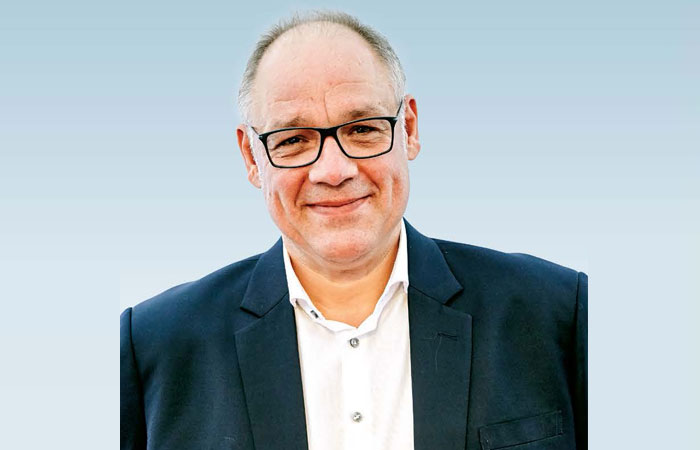
Frank Ormeloh, Business Unit Manager – Cement, HAVER & BOECKER, defines the correlation between innovation, material science and digital intelligence, resulting in sustainable process engineering that link productivity with responsibility.
Innovators are continuously pushing into new frontiers in cement manufacturing, for better efficiency and sustainability. In this conversation, Frank Ormeloh, Business Unit Manager – Cement, HAVER & BOECKER, brings forth the company’s philosophy, which is rooted in flow optimisation across every stage—from packing
to filtration—blending engineering precision with digital foresight.
How does your motto ‘Perfect Flow’ translate into breakthrough solutions for cement plants?
Since the inception of business, the measure of success has been the profit a company generates. The dictionary defines profit as ‘the ratio of pecuniary gain compared to the amount of capital invested.’ At HAVER & BOECKER, we believe that the key to maximising this ratio lies in perfecting the quality of a company’s flow, both in terms of product and process. We are convinced that a single ‘perfect flow’ — applicable to any and every product or process — does not exist. Instead, we’re driven to identify this ideal for each product, customer and operation. In essence, at HAVER & BOECKER, we are a family of flow designers and engineers. The foundation for this is our premium technologies, which can be combined to form complete systems of flow. From processing and materials handling to mixing, packing and filling to palletising, loading and automating, HAVER & BOECKER can partner with you in all aspects of your business. With W.S. Tyler, IBAU Hamburg, The Portland Company and, of course, HAVER & BOECKER itself, we have assembled a brand powerhouse to ensure that you will not make any compromises when it comes to your ‘perfect flow.’
Which module from the QUAT²RO® suite has had the biggest impact in cement operations?
QUAT²RO® Connect System has the biggest and most immediate impact on cement producers. This comprehensive analysis tool offers a secure, flexible and scalable approach to optimise your production processes. QUAT²RO® Connect provides you with a clear overview of your entire production line’s performance, enabling you to maximise machine productivity, identify bottlenecks and implement continuous improvements.
By centrally collecting machine data from all your production sites and saving it to the cloud, you have access to relevant information anytime and anywhere. This forms the basis for advanced applications such as the ‘Q-Dashboard’ for customisable real-time alerts of machine events and ‘Q-Insights’ for analysing downtime and production metrics. QUAT²RO® Connect can be upgraded by
the QUAT²RO® AI (Artificial Intelligence) Product Suite.
How is your PROcheck life-cycle approach helping plants continuously innovate and upgrade?
If ‘Perfect Flow is the destination, then PROcheck is the road to get there. Maximising profits is only possible if you look after your packing process throughout its entire lifecycle. The key ingredients are your product, the bag you wish to pack in, and the packing technology. Mastering the product, bag and technology is the basis of our expertise and the starting point for achieving perfect flow. With our PROcheck lifecycle approach, we accompany you on the way to your goal. PROcheck includes: diagnostics, equipment, consumables, original parts, rebuilds and upgrades, service, plants and systems and process engineering.
With PROcheck, we show you how you can sustainably maximise your productivity and results over the entire life cycle of your plants, systems and machines. If you do that, you will get as close to ‘Perfect Flow’ as possible.
In retrofits or modernisation of old plants, which HAVER & BOECKER innovations offer the most value today?
The answer depends on the producer’s specific situation. If the desire is to maximise the efficiency of the entire packing and logistics operations, then HAVER & BOECKER offers the Plant Optimisation Plan (POP). POP involves HAVER & BOECKER’s system specialists inspecting your entire line — from product storage and handling to packing and bag transport to palletising and loading, as well as surrounding equipment and environmental factors in the plant. We look behind the scenes at every individual machine to assess how the packing system integrates into the overall process. Our system specialists provide a detailed report to customers with a current operation overview, areas of improvement and recommendations, classified by level of urgency.
If the end goal is automation, we suggest an upgrade in robotics using the AMICUS® technology. The AMICUS® DEPAL Edition eliminates the need for operators to feed packing machines with empty bag bundles. This allows producers to redesign their intralogistical processes. The AMICUS® can be configured to palletise and depalletise full bags, providing 24/7 functionality and ensuring maximum uptime for the line.
If the producer is looking to reduce material waste through clean, weight-accurate filling technology, and increase efficient material recirculation using return screws and ideal protection of the filled product, there are upgrade options specific to these goals. Innovative solutions for clean filling in the HAVER & BOECKER product range include the patented ROTO-LOCK® dosing unit, ROTO-FEED® silo filling system and SEAL® technology, which welds filled bags shut using ultrasonics.
How are you combining wire mesh / filter media innovations with plant-level process engineering to push boundaries?
Every cement plant requires water. We also understand what bigger role cement plants play in India to support local municipalities. Wastewater treatment plants (WWTPs) face significant pressure to upgrade their facilities due to population growth, industrial expansion and tightening regulations. Building a new plant, or upgrading an existing one, is not done overnight. The need for more capacity is urgent.
To not just talk about sustainability, but to create it, we have invested in a startup company called Renasys. Renasys is truly pushing boundaries in making clean water more affordable. At the inception of our cooperation with Renasys, HAVER & BOECKER’s Wire Weaving Division provided 3D woven filtration medium — our RPD HIFLO — for their water filtration systems, which outperform conventional systems in both durability and precision. Together, this technology makes an impact very quickly, reducing the use of chemicals in wastewater treatment by up to 95 per cent.
Economically, municipalities seldom have the funds needed to build new plants or upgrade current plants with expensive equipment. That’s why the Renasys model is leasing-based. Wastewater operations only pay for the water that the system cleans,
leading to the end goal of transforming wastewater management worldwide.
What role does AI / computer vision play in your diagnostics, e.g. in your QUAT²RO® ‘Valve Check / Bag Check /Seal Check’ solutions?
All four of the new QUAT²RO® AI products use high-definition cameras and self-programmed algorithms to create fully automated monitoring for the packing line.
• QUAT²RO® BAGcheck uses image recognition to verify that the correct bags are placed into closed, automated packing machines, like our INTEGRA® IV series. If the system flags a bag as the incorrect type, the packing line stops to allow operators to replace it. This safeguards against the wrong bags being filled with product, ending a longstanding challenge our customers have faced — and one that can be incredibly costly if bags are shipped before the error is caught.
• QUAT²RO® VALVEcheck detects improperly opened bags and drops them to the machine floor for manual rework before grabbing a new one. The elimination of improperly opened bags or T-applications can increase production by an average of 10 per cent.
• QUAT²RO® MATEXcheck — short for material explosion check — monitors the bag being filled and detects possible bursts or leaks. In the case of detection, the camera signals the packing machine to stop the filling process immediately. Compared to standard packing machines that monitor bag filling by weight, MATEXcheck increases operator safety and eliminates cleanup time and product loss.
• QUAT²RO® SEALcheck bookends the packing line by detecting improperly closed bags. Today’s industry standard requires valves to be sealed with ultrasonic sealing technology. However, depending on the bag, the welding unit and the product volume found in the valve,
some seals may not close 100 per cent. SEALcheck monitors every bag on the
conveyor to ensure no bag leaves the facility improperly closed. When an issue with the seal is detected, the bag is diverted off the line to a separate area.
How do you manage to stay ahead in materials (mesh, filters) innovations while also scaling digital/automation tech?
We achieve this goal through dedicated teams and budgets. We have special woven wire product development teams as well as an extremely focused AI/digital product team. These experts develop solutions independently but come together regularly for knowledge exchange. We call these gatherings HAVERTHONS. In these dedicated meetings, innovation is created in short periods of time.
Over the next decade, which radical or disruptive technologies do you see HAVER & BOECKER leading (in cement / bulk materials)?
Well, we don’t want to spoil it too much now, but we can play a bit of buzzword bingo. Our innovation / disruption strategy for the future is based on the following pillars:
• Application expansion: We plan to help cement producers not only pack their existing products but also add to their product portfolio using ingredients, which today they considering as waste.
• Operator focus: Developing new AIR (artificial intelligence and robotics) solutions, we are striving to change the role of the operator within the packing industry. Rather than being a necessary element to complete the value chain, HAVER & BOECKER’s vision of the operator is that she or he becomes the conductor of the complete value stream. This will make their role more exciting and make their job more attractive.
• Packaging revolution: We are developing new types of packaging, including how they interact with the packing machine, which will change the way we think about the packing process. We intend to completely redesign the overall packing process of cement producers by introducing sustainable packaging and new handling technologies, both for empty and full bags.
– Kanika Mathur
















 Concrete3 weeks ago
 Concrete3 weeks ago
 Concrete1 month ago
 Concrete3 weeks ago