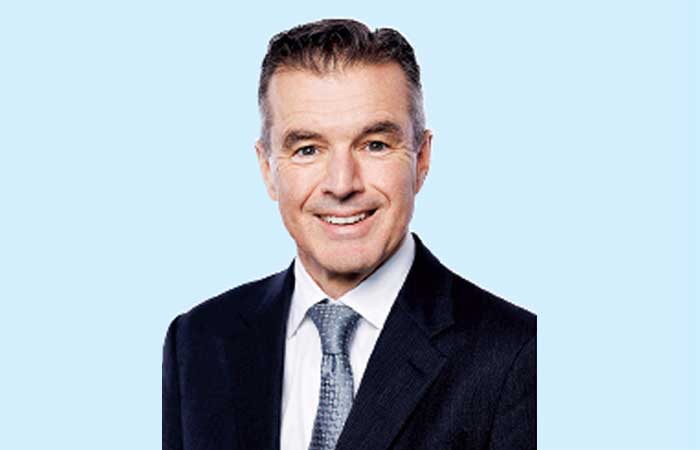
FLSmidth Cement has launched a new website as it is transforming into a leaner pure play company, focussing on what is needed to achieve sustainable growth. In conversation with Christopher Ashworth, the new President of FLSmidth Cement.
“FLSmidth began with a focus on cement, building our first plant back in 1887,” Ashworth began. “Our mining and mineral processing business is a much more recent development in comparison. Over the past few years, the market outlook for these two industries has diverged significantly. We therefore came to the view that keeping them together benefitted neither and so made the decision to go forward on a pure play basis.”
A quick look at the market context for cement and mining makes the case. Demand for metals and minerals is expanding and will continue to do so – in large part due to the green transition. Cement faces a more complex outlook. It undoubtedly remains a critical building material with a key role in delivering both the green transition and sustainable development goals. Yet overall demand is unlikely to grow significantly. The industry must also vastly reduce the around 7 per cent of global CO2 emissions for which it is currently responsible.
Ashworth is not one to be daunted by such challenges, having been instrumental in several transformations over his career, most recently as Managing Director of Eurotherm, a supplier of process automation and power control systems to the glass industry. Here he successfully positioned the company for sustainable growth through the dynamics of green industrial transformation in glass manufacturing.
“FLSmidth made its name as a full flowsheet provider of cement plants,” he continued. “It is a history that we value and will continue to build on. But today’s cement market is a vastly different world with vastly different challenges than what has gone before. It therefore requires a different operating paradigm that moves away from a projects-based approach to focus on specific products and services. The pure play strategy thus frees us to adapt to the specific market challenges facing the cement industry by prioritising the supply of our core solutions to facilitate sustainable growth within the context of the green transition.”
It is a strategy that will play out in three distinct ways. Existing equipment will be upgraded and optimised to raise efficiency, improve productivity, and reduce emissions. “We will bring past installations into the future,” said Ashworth. “Meanwhile, new CAPEX installations will focus on our core line of products and emerging green technologies such as calcined clay and our FUELFLEX® Pyrolyzer. The third element is future facing. Our R&D department will continue to work with external partners to deliver the next generation of
green technologies.”
Greening the existing fleet
We might live in a throwaway society – but a cement plant is anything but that. These are assets that represent significant long-term investments. One of the key challenges when it comes to reducing the cement industry’s carbon footprint is thus what to do with existing plants, many of which have decades of operating life left in them. “These plants want to be green!” said Ashworth. “Our job is thus to support them on that journey with a range of services and upgrades that improve operational performance and reduce environmental footprint.”
A good example of this approach is the FEEDflex™ upgrade for Pfister DRW rotor weighfeeders. By allowing a much lower minimum feed rate (down from 1 tph to just 60 kg/h) of coal through the weighfeeder, with no change to the upper limit, plants can maximise their use of alternative fuels without impacting their fallback ability to use coal when circumstances require.
Our automation and plant control systems also illustrate how technology must evolve, sometimes dramatically, at existing sites. Way back in 1969, we pioneered the use of software to optimise cement production and today continue to introduce the latest functionality as evidenced in our launch of ECS/ProcessExpert® V9.0 advanced process control software. We are committed to invest and advance our technology so that existing installations can also maximise their participation.
“We now have our own digital leadership team free to focus on delivering cement-specific smart and connected services to our clients,” continued Ashworth. “But we are also embracing the latest digital solutions internally to deliver a more efficient manufacturing and supply chain with greater visibility on procurement and operations.”
Beyond equipment and digital solutions, services such as the company’s reliability-centred maintenance (RCM) services play a key role when it comes to achieving the most from existing assets.
CAPEX today for a greener future
Upgrades and services to existing installations only provide part of the cement industry’s decarbonisation journey, however; new CAPEX in the latest green technologies will also be necessary. FLSmidth Cement offers a number of emerging solutions that will help deliver substantial reductions in carbon emissions. Solutions like
our calcined clay technology or the innovative FUELFLEX pyrolyzer, which allows plants to burn up to 100 per cent alternative fuels in the calciner, while also reducing NOx emissions, are two key examples.
“There is growing interest from the industry in these types of innovative technologies,” said Ashworth. “The first FUELFLEX is already operational at the Mannok Cement plant in Ireland, with a second installation expected to come online later in the United States. Furthermore, we are eagerly looking forward to the commissioning of the two calcined clay lines at the Ciment Vicat Xeuilley plant in France and CBI-Ghana, both orders having been announced previously.”
The focus on emerging technologies complements and enhances the company’s core product lines: from its efficient and flexible OK™ vertical roller mills to its industry-leading pyroprocessing equipment and successful Ventomatic® bagging and packaging lines. “The pure play approach is guided by the market and thus prioritises those product lines where we see strong future demand and can offer competitive advantage,” concluded Ashworth. “Importantly, these also tend to be those that have a strong sustainability narrative.”
The focus on core products also resulted in the realisation that some existing product lines would be “better served elsewhere, just as we – as FLSmidth Cement – are served better as a pure play cement company,” explained Ashworth. This has led to the divestment of both Airtech air filtration and MAAG Gears businesses. “Divestment will allow these great businesses to thrive and grow in directions that simply weren’t possible when they were part of our organisation; it also allows us to simplify our business and focus our time and investment on our core priorities.”
Creating the green technologies
The final foundation of the new FLSmidth Cement organisation looks beyond what is possible now to innovate the green technologies of the future. A key part of this will be collaboration with external partners, as is already occurring
with projects such as the DETOCS research consortium. Here FLSmidth Cement is working with a number of academic institutions to use digitalisation and advanced predictive modelling to maximise the use of SCMs in cement. Other current partnerships focus on the development of new SCMs, electric clay calcination, oxyfuel technologies, concrete waste upcycling, and the next-generation FUELFLEX.
“R&D remains an integral part of who we are, FLSmidth Cement,” said Ashworth. “We are committed to delivering the next generation of green cement technologies. We will continue to work both with external research institutions and funding organisations to see these technologies come to commercial realisation.”
It is always about the people
Ashworth saved his final remarks for the heart of any business: the people. “Many organisations going through significant change struggle with enthusiasm. But that does not describe my experience of FLSmidth Cement and that is all down to the quality of people we have here! My job is to nurture that to create a company that remains adaptable and fit for the future of the cement industry. Pure play makes that possible: it provides the best framework for success. But it is the people that will achieve it.”
(Communication by the management of the company)













 Concrete3 weeks ago
 Concrete3 weeks ago
 Concrete4 weeks ago
 Concrete3 weeks ago