Gaurav K Mathur, Director & Chief Executive, Global Technical Services, discusses the importance of lubricants in enhancing productivity of cement plants and in making them more sustainable.
Sustainability means meeting our own needs without compromising the ability of future generations to meet their own needs. In addition to natural resources, we also need social and economic resources. Global warming is the key concern, making sustainability not a choice by a need.
The Paris Climate Conference (COP21) in 2015 sensitised the world towards ecological damage caused due to industrialisation. The Paris Agreement was the first-ever universal, legally binding agreement that was adopted by consensus by all members of the United Nations Framework Convention on Climate Change (UNFCCC). The Paris agreement outlines the global framework to limit global warming well below 2°C. Currently, 197 countries have agreed to work towards reaching net carbon neutrality by 2050.
Sustainability, in the light of the findings of COP21, is now being accepted and implemented by industries globally as social responsibility.
Sustainability for the industrial sector
Sustainable manufacturing plays a vital role in decarbonisation by reducing greenhouse gas (GHG) emissions.
The five highest sectors in which decarbonisation can have the most significant impact account for 51 per cent of energy-related CO2 emissions in the US’ industrial sector (as shown in figure 1). The four key technological pillars can significantly reduce emissions for the five sub-sectors identified above. These crosscutting decarbonisation pillars are:
- Energy efficiency
- Industrial Electrification
- Low-Carbon Fuels, Feedstocks and Energy Sources (LCFFES)
- Carbon Capture, utilisation and storage (CCUS) (as shown in Figure 2)
Why is lubrication key to sustainability?
Based on the statistics, it is observed that the industrial sector accounts for a fair amount of GHG emissions. In most of the cement industries, lubricants are used in large quantities. Lubrication can significantly impact the overall efficiency of a machine, if a proper lubricant is used while performing its function of reducing the coefficient of friction. The lubricant also affects the energy efficiency of the equipment. In most cases, scientifically done lubrication has shown considerably reduced power consumption. As shown in figure 4, industrial energy consumption accounts to 33 per cent, according to the US DOE’s R&D Roadmap.
The cement industry plays a pivotal role in global infrastructure development, providing the foundation for buildings, roads and other critical structures.
Cement manufacturing is energy-intensive and emissions contribute to carbon footprints. In the pursuit of sustainable practices, cement plants are increasingly turning their attention to technology and practices for effective lubrication, as key elements in enhancing operational efficiency while minimising environmental impact.
As global awareness of climate change grows, the cement industry is proactively looking towards adopting technology to decrease their carbon footprint and attention is being given to sustainability to ensure minimal impact to the environment. Efforts and resources are being pledged to optimise every aspect of cement production, including lubrication.
Lubrication and its efficient management in the plant have great potential to help operators reach their sustainability goal and at the same time improve operational excellence.
Energy efficiency and lubrication technology
Evidence of lubricants in use dates back to 1400 BC, when animal fat was being used as lubricant. With advancements in industrialisation, there has been a pressure on delivering higher production and lowering cost of manufacturing. Operational excellence and reliability play a vital role in industry operations.
Lubrication is the fulcrum of mechanical maintenance thus playing a critical role towards sustainable and profitable operation in the limestone quarry or at plants. Traditionally, lubricants have been chosen based on their ability to reduce friction, wear and corrosion. However, the evolving landscape of sustainability demands a more comprehensive approach to lubrication.
Through the careful selection of high-quality lubricants and optimised application practices, friction and wear within machinery are minimised, leading to increased energy efficiency. This results in lower energy consumption, reduced greenhouse gas emissions, and extended equipment lifespan. By incorporating advanced lubrication technologies and practices, cement plants can contribute to the industry’s overall commitment to achieving more sustainable and environmentally friendly manufacturing processes.
Energy-efficient lubricants have been formulated by the lubricant suppliers, typically cost more because they are made of tailored synthesised chemicals rather than straight hydrocarbon base oils. Generally, users are reluctant to purchase more expensive products unless there is demonstrable value.
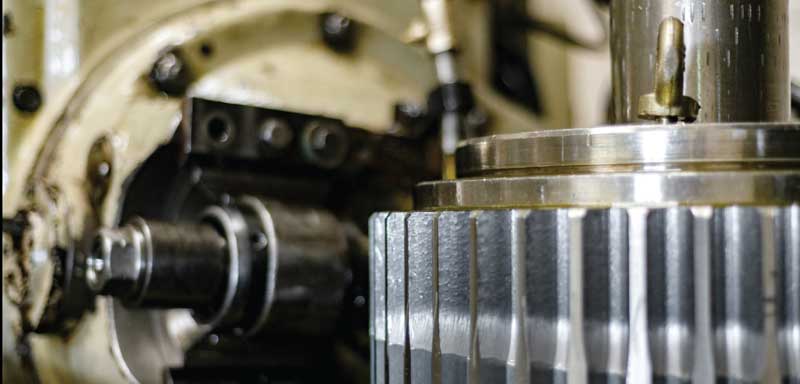
Energy consumption is a significant concern in cement production, with a substantial portion of it attributed to the friction and heat generated by moving components in machinery. Lubrication technology plays a pivotal role in optimising energy efficiency within cement plants. Advanced lubricants with superior friction-reducing properties contribute to lower energy consumption by minimising resistance in moving parts.
Moreover, lubricants can be tailored to specific applications within cement plants, ensuring that each type of machinery receives optimal lubrication for its unique requirements. For example, synthetic lubricants achieve the most impressive energy savings where equipment slides or rolls. This targeted approach not only enhances energy efficiency but also extends the lifespan of critical equipment, reducing the need for frequent replacements and associated
resource consumption.
Oil conservation, waste reduction and recycling
Lubrication is not just about introducing oil in the machine, for a sustainable plant, it is a must to see every point where CO2 emissions are generated for the final introduction of lubricant into the machine. Manufacturing of lubricant, indenting and ordering, logistics, inventory and disposal are some of the points where lubricants through the journey produce carbon emissions, hence it is required to conserve, so every CO2 point can be reduced, if not eliminated. Also lubricants are made from fossil fuels and the environmental impact on the carbon footprints during extraction, refining and usage is well known. Properly formulated and monitored lubricants can extend the life of components, reducing the need for frequent replacements and minimising the generation of waste.
Over the period of their usage inside the machines the lubricants do not die to be condemned or discarded. They generally get contaminated with dirt/water and the chemical additives, which provide additional properties, get used up. Technological advancements have been made in the filtration systems to remove the contaminants completely. Further topping up the relevant additives, which are depleted, can make them functionally as good as new. Additionally, some lubricants are designed for easy recycling, further reducing their environmental impact. The re-refining technology also has made major advancements to recycle the used lubricants to produce base oils or final product, having properties like the original oil. This approach not only enhances the sustainability of operations but also aligns with the principles of the circular economy.
Reducing Environmental Impact
One of the key avenues for driving sustainability is the adoption of environmentally friendly lubricants. Traditional lubricants, often derived from fossil fuels, can contribute to pollution and have adverse effects on the ecosystem. Sustainable lubricants, on the other hand, are formulated with biodegradable and renewable resources, minimising their environmental impact.
Bio-based lubricants, derived from renewable resources such as vegetable oils, present a promising frontier in sustainable lubrication technology for cement plants. These lubricants offer several advantages, including biodegradability, lower toxicity and reduced environmental impact compared to their petroleum-based counterparts. As the technology behind bio-based lubricants continues to advance, cement plants can transition to these greener alternatives, further aligning their operations with sustainable practices.
While the adoption of sustainable lubricants and lubrication technology holds great promise for driving sustainability in cement plants, several challenges and considerations must be addressed. One significant consideration is the compatibility of new lubricants with existing equipment. Cement plants often have long life cycles for their machinery, and transitioning to new lubricants must be carefully planned to avoid transition issues and ensure a seamless integration.
Integrating digitisation technology for sustainability in the cement industry, particularly with a focus on lubrication, presents both challenges and considerations. The cement industry faces hurdles such as significant capital investments for digital technologies, complex integration into existing processes, and the need for cybersecurity measures to protect sensitive data. Workforce training and change management are critical for successful implementation. However, digitisation offers opportunities to enhance energy efficiency through real-time monitoring, optimise maintenance practices and improve asset reliability, adopting digital tools can contribute to sustainability by minimising friction, reducing wear and tear and optimising lubricant usage. Additionally, predictive maintenance supported by digitisation can extend equipment lifespan, reducing the environmental impact associated with frequent lube replacements. The incorporation of lubrication into the wider context of technology and sustainability requires careful consideration of challenges and strategic considerations to achieve a more efficient and environmentally friendly cement production process.
The cement industry’s journey toward sustainability involves a comprehensive approach that extends to every facet of production, including lubrication technology. By embracing sustainable processes, optimising energy efficiency and leveraging advanced lubrication systems, cement plants can significantly reduce their environmental impact while enhancing operational performance, all aspects being
covered by simply implementing Total Lubrication Management (TLM).
Significant efforts are being made by cement industries for being sustainable, TLM is being implemented majorly by cement companies. Two roadblocks to widespread adoption of TLM include the challenge of quantifying measurable improvements and arriving at payback.
Conclusion
The transition to sustainable lubrication practices is a strategic imperative for cement manufacturers seeking to thrive in an era of increasing environmental awareness. As the industry continues to evolve, the integration of TLM plays a pivotal role in shaping a more sustainable future for cement production, where efficiency and environmental stewardship go hand in hand.
Over 50 billion litres of lubricants are sold annually. Approximately half of this volume is formulated into engine oils, and the other half is formulated into industrial lubricants. If only one per cent of the industrial oils doubled their oil drain interval, this would equate to a reduction of over one million metric tonnes of CO2 per year.
This is one of the reasons why Global Technical Services has developed the concept of TLM. Implementation of TLM considers lubricants as an asset and not a consumable. Actively removing contaminants from fresh lubricants and adding in-service lubricants with additive compensation, extends the oil’s life significantly.
Lubricants must be kept clean and free from moisture while maintaining a healthy balance of additives to increase its lifespan. Lubricants must be dealt with the same sensitivity as blood. Thus, implementation of TLM is an important pillar of sustainability, and sustainable manufacturing is not possible without it.
ABOUT THE AUTHOR:
Gaurav K Mathur, CEO, Global Technical Services has over 2 decades of experience in Lubrication, Lubrication Technology, and Oil Analysis. He is actively working with industry on Sustainability via tribology.


















 Concrete1 month ago
 Concrete4 weeks ago
 Concrete1 month ago
 Concrete3 weeks ago