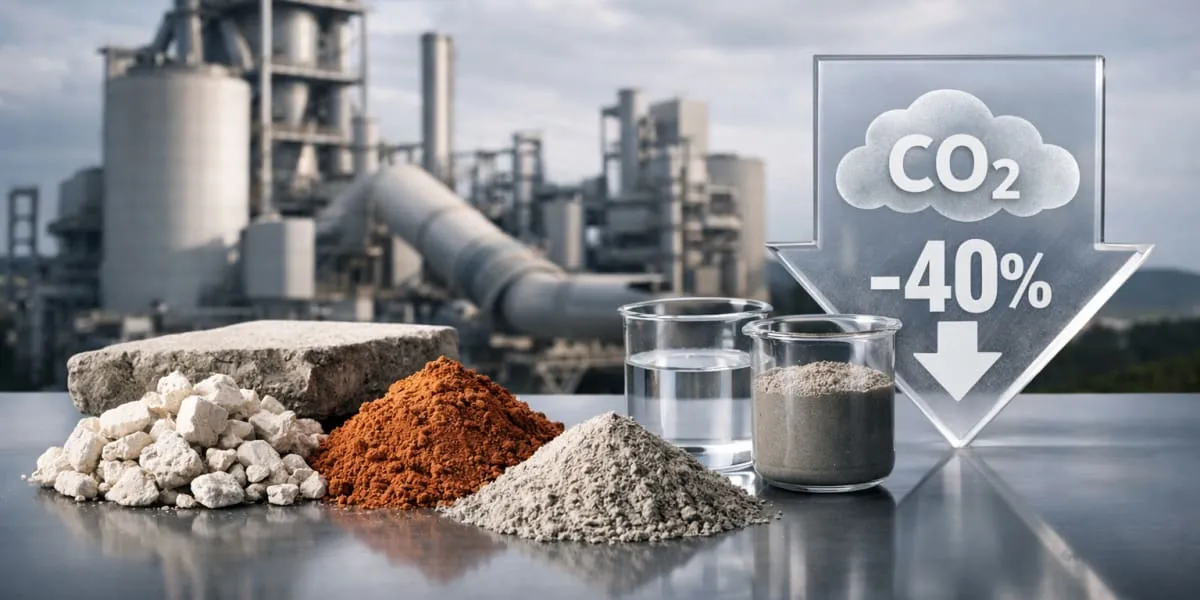
Dr Hitesh Sukhwal, Deputy General Manager (Environment), Udaipur Cement Works, discusses the early adoption of breakthrough technologies that will help the Indian cement industry take faster strides towards its Net Zero target.
Technology is a vital enabler of sustainability. Delivering on the sustainability agenda will be impossible without technology adoption. To make better usage of available resources, technology plays a pivotal role for the best and efficient utilisation of resources. The concept of sustainability has many dimensions. It is a long way journey where initial effort converts into result, later. Many companies (service, manufacturing, etc) are now convinced that the environment-friendly process, product and services will provide them with a less competitive atmosphere from their peers. It has become a priority for every business. Sustainable business demands new technology, process and innovative solutions to manage the available resources.
The cement industry is confronting many challenges due to availability and quality of raw material, geographical location and natural resources, climate linked environmental concerns. Cement is the second most consumed product globally after potable water and it is utilised in almost every built-up structure viz. houses, roads, railways, airport infrastructure, dams, etc. The global economic growth and rapid urbanisation increases demand for cement. The cement industry is an energy intensive and significant contributor to climate change. Cement production contributes greenhouse gases directly / indirectly into the atmosphere through calcination and usage of fossil fuel in an energy form.
Worldwide, the cement industry is the best example for adoption of advanced best technology for energy and operational efficiency among the industry sectors. However, cement industries contribute significantly to carbon dioxide emissions. Decarbonising cement manufacturing will play a vital role for sustaining the cement business. There will be several challenges to decarbonise cement completely in all aspects of production, supply chain and usage.
Sustainability and technological innovation
Cement manufacturing requires a large number of resources – from raw material to finished goods. The cement manufacturing process can be divided into four major processes viz. mining, raw material processing, clinkerisation and finish grinding processing. Cement concrete is the second most consumed product in the world after potable water. With this distinctive manufacturing process and its key ingredients, cement is highly carbon intensive and a source of CO2 emissions. Thus, the cement industry is responsible for around 8 per cent of total global emissions1.
To meet the Government’s plans on development of highways, smart cities, affordable housing and other infrastructure, the projected demand for cement in 2019–2020 is 415 million tonnes, implying installed capacity of at least 460 million tonnes at 90?per cent utilisation. The Indian cement industry is expected to continue its fast-paced growth and attain installed capacity of 850 million ton per annum by 2030 and 1350 million tonnes per annum by 20502.
With the vision 2030, the above industrial growth cannot be realised without considering environmental sustainability. The Indian cement industry has given time, invested in R&D and adopted technological advancement for upgradation of process and pollution control equipment throughout the manufacturing process. At present, almost all cement manufacturing units are having a dry process and in mature stage with existing cement standards for operational parameters, environmental and energy.
The Indian cement industry is among the most energy and carbon-efficient of cement industries globally and has the lowest carbon footprint3. In November 2021, at the Glasgow Climate summit, India announced Net Zero carbon emissions by 2070.
The cement industry has implemented various technological innovations in their mining mineral, process optimisation, energy production and conservation, water management and fuel consumption. However, sustainable cement manufacturing is still the need of the hour as cement production is one of the highest emitting industries.
Decarbonising the cement industry cannot be achieved by a signal solution, instead, every stage in the value chain must reduce its carbon footprint to reach the decarbonisation target. To achieve the necessary carbon reduction target, more innovative solutions viz. new technologies and alternative building materials will be required. Potential strategies for lowering carbon emissions in the cement sector include increasing the energy efficiency of the cement production process, switching to lower carbon fuels, improving material efficiency by reducing the clinker-to-cement ratio and implementing carbon capture and utilisation or sequestration technologies4.
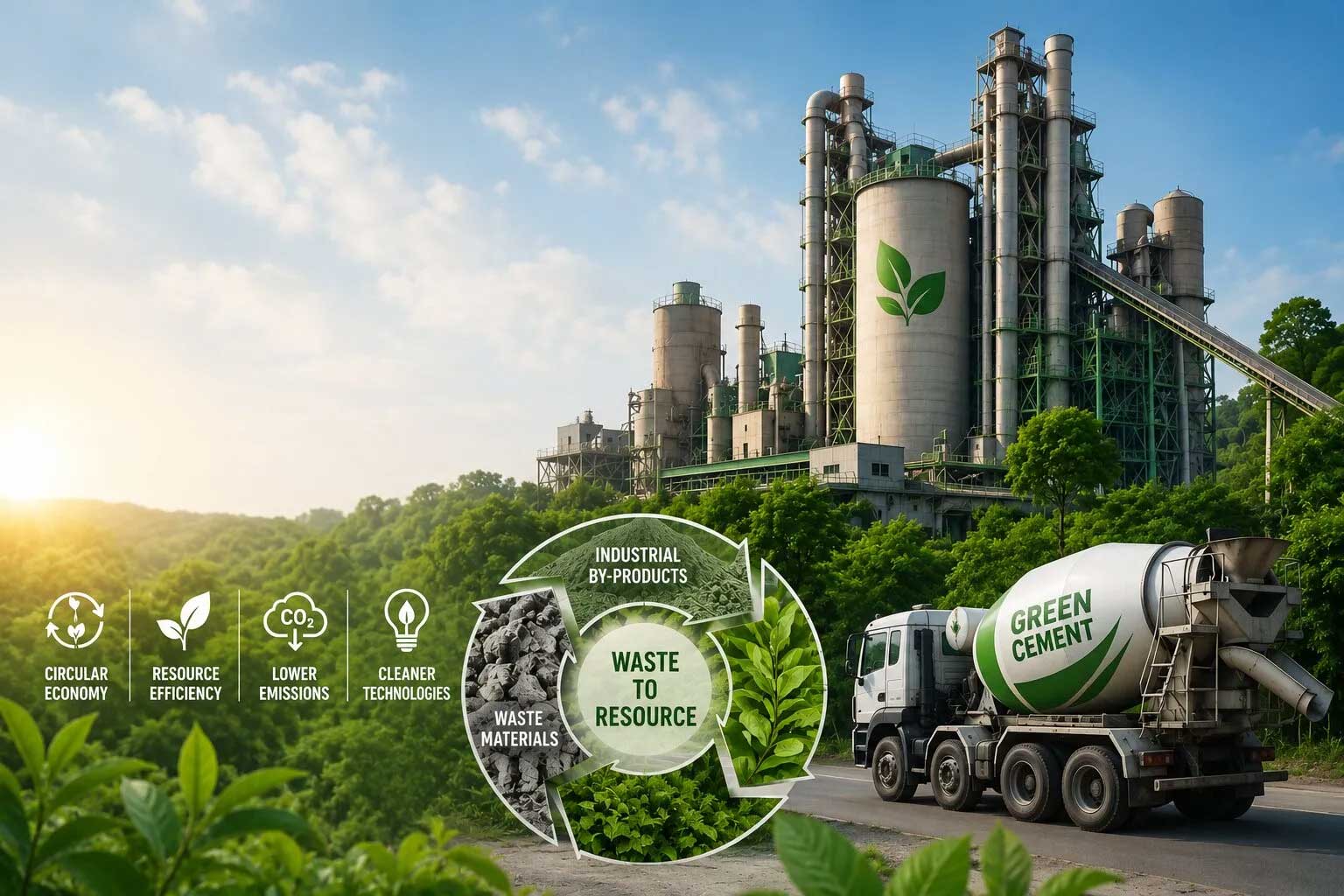
Currently, there are few efforts available and economically viable for the cement industry to develop low emission with a clear technology road map. Efforts are focused primarily on reducing the fossil fuels consumption by using alternative fuels, lowering the clinker to cement ratio, blended cement, renewable energy and clean energy technology such as waste heat recovery and Supplementary Cementitious Materials (SCMs such as fly ash and slag). Each of the above efforts has some benefits as well as limitations to utilise efficiently. In India, fly ash and slag (fossil based) are used widely as SCMs however, these cannot be a long-term solution since supply of both SCMs will decline as blast furnaces and coal-based power plants phase out. Therefore, all potential carbon reduction levers need to be exploited fully across all stages of the cement production process.
Advanced developments
The Indian cement industry has always adopted the best available technology and process setups to become most efficient and sustainable. Indian cement industries are strengthening processes to reduce energy as well as process related carbon emissions through technology advancement, clinker substitution, usage of alternative fuel and raw materials, renewable energy sources such as ground mounted, roof top and floating solar power system, process optimisation, optimise waste heat recovery power generation, etc.
At present, Indian cement industries are focusing on operational efficiency and utilising supplementary cementitious materials. Majority of carbon emission comes from cement production and through the supply chain. Both input of raw material from nearby sources and supply of finished goods contributes emissions in a large amount.
Moreover, the cement industry employed advanced process control systems and automation to optimise production parameters, reducing energy wastage and enhancing overall efficiency. Now, industry has real time monitoring and data analytics for operational parameters, energy consumption patterns to make better decision making to improve efficiency. In the present scenario, Indian cement producers are actively exploring lower-emission technologies like pre-calcining technology and multi-staged pre-calcining processes to effectively reduce CO2 emissions.
Opportunities ahead
Cement concrete can be recycled under certain conditions and the original chemical process cannot be reversed. The industry, with the help of local bodies and competent authorities, can recover useful ingredients from end-of-life cement to reduce the amount of new clinker and hence encourage sustainability through natural resource conservation.
The future challenge is linked with carbon emission from the whole process of cement manufacturing and its branding. At every process of Scope 1, 2 and 3 of greenhouse gas emissions, the cement industry needs to closely watch for checking, verification and monitoring aspects to prepare mitigation plans.
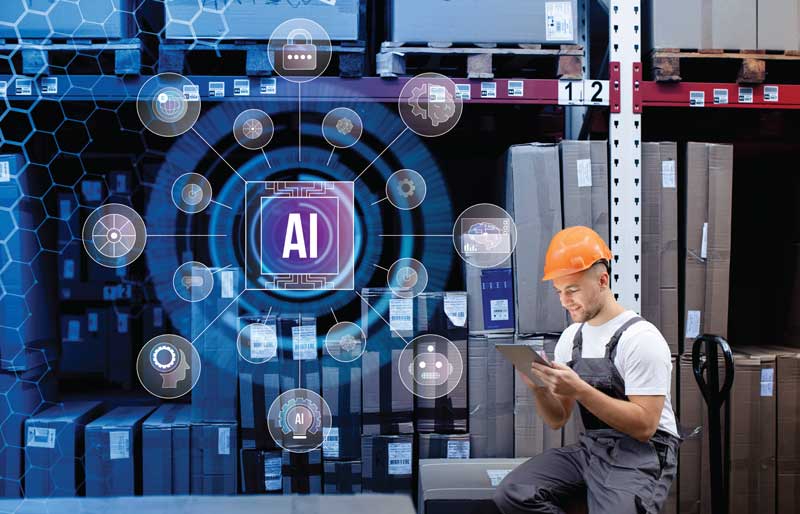
Industrial Internet of Things (IIoT), Artificial Intelligence (AI) and Machine Learning (ML) are some state-of-the-art technologies behind the new revolution in the cement industry. By introducing these powerful techniques, the industry can have a Smart Cement Plant, which can reduce consumption and increase productivity while complying with stringent emission standards. Artificial intelligence (AI) and machine learning (ML) are changing routine practice and process of business. AI is encouraging cement processes in a better way based on data science and analytics. The accuracy of raw mix design, optimise temperature in pyro-process, weighing scale and conveying and feeding of the material, chemical analysis and product design are few of the examples, achievable through adopting AI. Cement industry can use AI tools to optimise the usage of machines like mill, pre-heater, kiln and cooler to automate monitoring and control.
As cement industries are going towards a more sustainable future, implementation of AI and automation can play a critical role in transforming cement manufacturing processes with significant reduction of carbon emissions through real time monitoring. AI systems and ML can reduce risk of accidents, sudden breakdown of machines, and improve quality products with less carbon emission. AI provides benefits in terms of equipment reliability, availability, efficiency and monitoring.
Breakthrough technology like Carbon Capture Utilisation or Storage (CCUS) may become the best technology to minimise carbon emissions at source only. This can help industries to reduce their carbon footprint. The technology exists to clean up the carbon intensive sector, but it remains expensive. This is an urgent requirement to develop a financial tool, R&D and policy to make it economically viable.
In coming years, CCUS and SCMs (clinker substitution) may impact the decarbonisation roadmap but both key technologies require R&D to implement and make it commercially viable. Besides, use of electrical vehicles, green fuels like CNG, LNG etc. in supply chain, nature-based solutions like afforestation and soil carbon sequestration/sink will also be helpful for the sustainability of cement business. The low carbon journey in India will generate opportunities for new jobs and green growth of industry.
References:
https://www.sustainablefitch.com/corporate-finance/challenges-ahead-for-cement-industry-transition-plans-11-04-2023
https://www.zkg.de/en/artikel/zkg_The_Indian_cement_sector_technological_status_and_prospects-2467959.html
RBI recommends technology for India’s cement industry to reduce carbon emissions
https://www.cisl.cam.ac.uk/files/sectoral_case_study_cement.pdf
https://www3.weforum.org/docs/WEF_Surfacing_Supply_of_Near_Zero_Emissions_Fuels_and_Materials_in_India_2023.pdf
ABOUT THE AUTHOR:
Dr Hitesh Sukhwal is the Deputy General Manager – Environment at Udaipur Cement Works. He is a passionate professional about sustainability in the cement industry.