

Economy & Market
Basic Bricks: Nuances of Technical Suitability

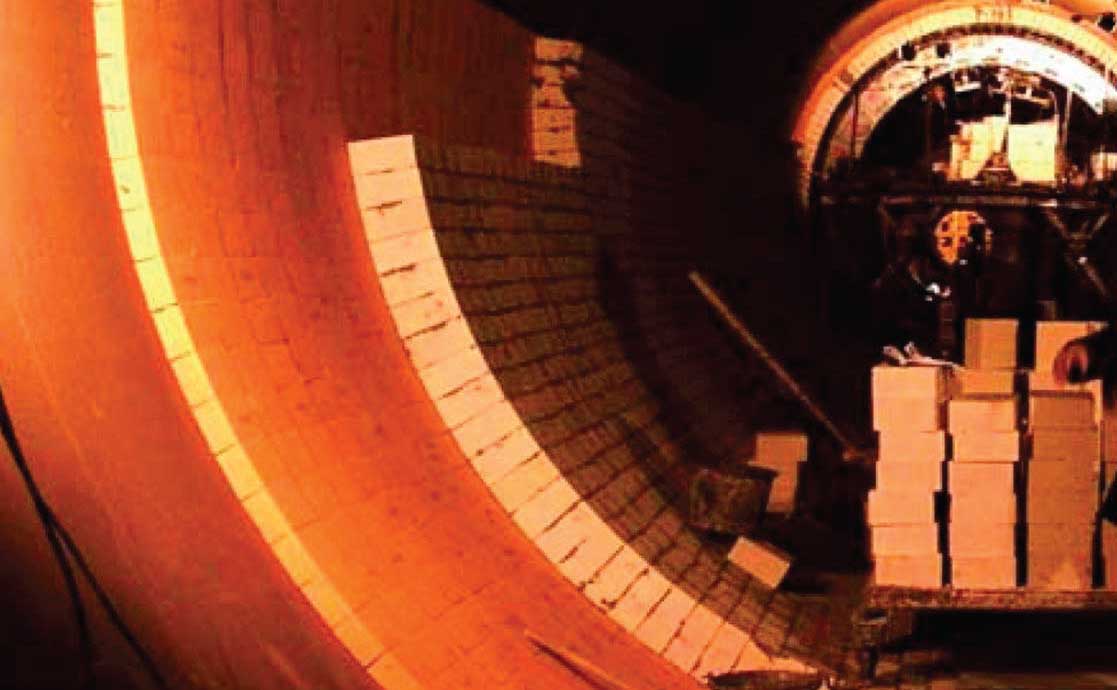
ICR attempts to understand the raw meal parameters, maintenance challenges and supplier selection criteria in the Basic Bricks for kiln refractories for cement
Magnesite (or Basic Bricks) is based on magnesium oxide (MgO) and calcium oxide (CaO). The designation magnesia or magnesite brick, is used for bricks with MgO content above 80 per cent.
These are the bricks that are suited for the most temperature sensitive zones of the cement kins, where quality and performance are the two most important elements as breakdowns from refractory failures could be a very costly affair amounting to millions of dollars of losses.
Kilns today have shorter lengths without loss of production capacity. Many producers use the kiln to burn waste materials – a good source of low-cost energy. Widespread use of alternative fuel causes problems for the refractories that are used. Hightemperature areas, usually lined with basic bricks, require higher refractoriness, alkali, and thermal shock resistance, and better resistance to clinker liquid phase corrosion.
Understanding the various parameters
The various sections of the kiln, starting with the Inlet Cones, where the most important considerations are alkali-resistance, have different critical elements for the right type of refractory material. Raw meal can quickly deteriorate refractories that are not resistant, and temperature fluctuations can cause condensation of alkaline vapours in the refractory lining as in the Inlet Cones.
The Safety Zone has to contend with a number of things. The primary criteria here are alkali- and abrasion-resistance. Brick lining should have a progressively increasing refractoriness and alumina content. Low thermal conductivity is good if the reaction occurring is still endothermic, but insulation benefits should be weighed against the risk of alkaline attack and thermal overload.
Thereafter, the transition zones have to deal with many variables. When liquid phase begins to appear in the raw meal, the kiln lining becomes more vulnerable. This occurs in the upper transition zone.
The more variables that occur, the greater is the need for the correct magnesia-based refractories.
Variables include variations in oxygen potential, caused by use of multiple fuels. After several redox cycles, some brick qualities may become weak and friable. Operation with an unstable coating – caused by a variety of factors. Brick becomes exposed to infiltration by the clinker liquid phase. Direct action of alkali chlorides and sulphates, a result of using several waste fuels. Brick may subsequently cap.
Build-up of abnormal rings, resulting from unbalanced sulphate modulus. Kiln shell corrosion, caused by sulphate and chloride diffusion through the refractory, can result from the burning of some waste fuels. The burning zone factors are paramount to the optimal functioning of the burning zone. First, and most manageable from the technical viewpoint, is the question of combustion engineering – the achievement of proper flame pattern, heat and combustion. The variables here are plenty.
linings and steel segments. Thermal shock and axial
expansion often accelerate refractory wear
Large fluctuations in raw meal parameters and poorly modularised clinker can result in liquid phase segregation, which reduces the thickness and stability of the coating. The use of high-sulphur fuels, combined with poor combustion engineering, can lead to a higher sulphate compound volatilisation and ring formation build-ups. A number of factors can cause coating to disappear completely, with a resulting tendency for the brick to become weak and friable due to thermomechanical fatigue. Some of these factors increase the risk of corrosion of the bricks’ MgO-Al2O3 spinel.
Maintenance and supplier selection
The cooling zones, especially the discharge zone, are often severely stressed. Abrasive clinker outfall can cause wear on both refractory linings and steel segments, and thermal shock and axial expansion often accelerate refractory wear.
The heating up curves for temperature rise is also a very important criteria, which needs to be maintained as follows:
After shutdowns, during which the burning zone does not cool below 300oC.
After repairs, comprising up to 30 lin m of kiln lining.For new plants with an average capacity of 2000 t/day. In the case of larger plants, the heating-up time should be increased by 10 to 20 per cent.Following are the types of basic bricks that fend off the most temperature sensitive and wear/ tear zone:
Magnesia Alumina Spinel Brick: It is made primarily of magnesia grain and synthetic spinel and produced under high temperature firing. It is the most mature and economical widely used transition zone brick. It features good resistance to thermal shock, thermal load, chemical corrosion, overheat damage, oxidation reduction, high temperature mechanical flexibility and abrasion. It can be used at the transition zone of cement rotary kiln and lime kiln.
Magnesia Hercynite Brick: It is made primarily of magnesia and hercynite and produced under high temperature firing. They have the properties of good clinker coating, sound thermal shock resistance, good heat load fatigue resistance, excellent high temperature mechanical flexibility and good wear resistance. They can be used at the burning zone and transition zone at the same time, especially best performed at kiln tire areas.
Magnesia Galaxite Brick: It is primarily made of magnesia and complex spinel, with addition of Manganese compound, which is produced under high temperature firing. Compared with magnesia alumina spinel and magnesia hercynite, it has better resistance to thermal shock, abrasion, corrosion and high temperature mechanical flexibility and kiln coating property. It can be used at burning and transition zones at the same time. It has practical significance for customers to optimise refractory configuration, reduce inventory and facilitate management.
Magnesia Chromite Spinel Brick: It is primarily made of magnesia and chrome ore under high temperature burning. It has the excellent properties of clinker coating, resistance to thermal shock, thermal load fatigue and chemical corrosion. It was also good in resistance to oxidation reduction. The magchrome brick was the most widely used once, which is a mature and economical product for rotary kiln burning zone and transition zone.
Supplier selection is the most important part of the activity in engineering and sourcing and good suppliers stay with the cement plants for long as rarely would one change from the original installation to a new type of bricks from a new supplier. But progress in India on the supplier front has shown some interesting challenges around cost and the choice for low-cost suppliers even in the basic bricks category has remained strong contenders. No wonder the OEMs have to find solutions to the cost effectiveness together with high quality, high yield, low consumption and long-term safe operation if they want to continue with their share of business in the future.















JSW Cement Commissions 1 MTPA Unit in Rajasthan

Wonder Cement appoints Mahesh Singh as VP Corporate Brand Communication

JSW Cement commissions additional 1 MTPA grinding unit in Rajasthan

JSW Cement Boards Approve Proposed Shiva Cement Merger

JSW Cement commissions additional 1 MTPA grinding unit at Nagaur
JSW Cement Commissions 1 MTPA Unit in Rajasthan
Wonder Cement appoints Mahesh Singh as VP Corporate Brand Communication
JSW Cement commissions additional 1 MTPA grinding unit in Rajasthan
JSW Cement Boards Approve Proposed Shiva Cement Merger
JSW Cement commissions additional 1 MTPA grinding unit at Nagaur
-
 Concrete1 month ago
Aditya Birla Group Launches Ultravolt Wires And Cables Business
-

 Concrete4 weeks ago
Cement Demand Strong As Prices Remain Stable
-
 Concrete1 month ago
Ramco Cements Mine Restoration Gets Global Biodiversity Certification
-

 Concrete3 weeks ago
Telangana to Supply Subsidised Cement for Indiramma Houses