The maths is simple: replace 30 per cent of clinker with calcined clay for up to a 40 per cent reduction in CO2 emissions. It’s smart, it’s efficient, and it’s something almost every cement manufacturer could do right now. Steven Miller, Global Process Line Manager at FLSmidth, shares insights on the naturally occurring mineral that is set to accelerate the green transition of cement.
With 7 per cent to 8 per cent of all global carbon emissions coming from cement production, the pressure is rising. Environmental regulations grow progressively more demanding. Financiers shy away from emissions-intensive investments. And around the world, citizens, governments, and a broad range of other organisations are calling for action on climate change. For the cement industry, it’s the perfect storm – and it calls for innovation and ingenuity. Right now, there is no substitution at scale for concrete. But we all know we can’t continue our current practices. To meet our sustainability commitments in line with the Paris Agreement, we need to make some radical shifts. This challenge presents a new opportunity for a centuries-old material combined with 21ˢᵗ century technology.
Step one: Cut the clinker factor
The science of the cement manufacturing process is well known. Reducing energy consumption and switching from fossil fuels to carbon neutral alternative fuels have the capability to cut CO2 emissions by up to ~35 per cent. But the majority of the CO2 coming from the manufacturing process occurs during limestone calcination. In the future, we hope these emissions will be captured before entering the atmosphere, but right now that technology is still some way off widescale availability. Instead, we have a more accessible solution: Cut the clinker factor – i.e. the quantity of clinker used in the cement mix.
For many years, cement manufacturers around the world have been doing just that. Fly ash from coal fired power plants, blast furnace slag from iron and steel manufacturing, and a range of other natural and manmade pozzolans have helped cement manufacturers achieve clinker factors as low as 0.4 for some cement types.
However, these low clinker factors are not possible across the board. They are highly dependent on local availability. And as coal-fired power is phased out and iron and steel producers work to reduce their environmental impact, the availability of these industry by-products will fall away altogether. What we don’t want is to see the clinker factor increasing again, along with emissions.
Fortunately, we have an alternative. A widely available, naturally-occurring mineral can be activated into a supplementary cementitious material that can replace 30 per cent of clinker and eliminate up to 40 per cent of CO2 emissions.
In some cases, an even higher percentage of clinker replacement is possible. Best of all, the technology to incorporate it into your process already exists. It has a low ROI, and it’s actually cheaper to manufacture than clinker. What are we talking about?
Calcined Clay – the future of green cement
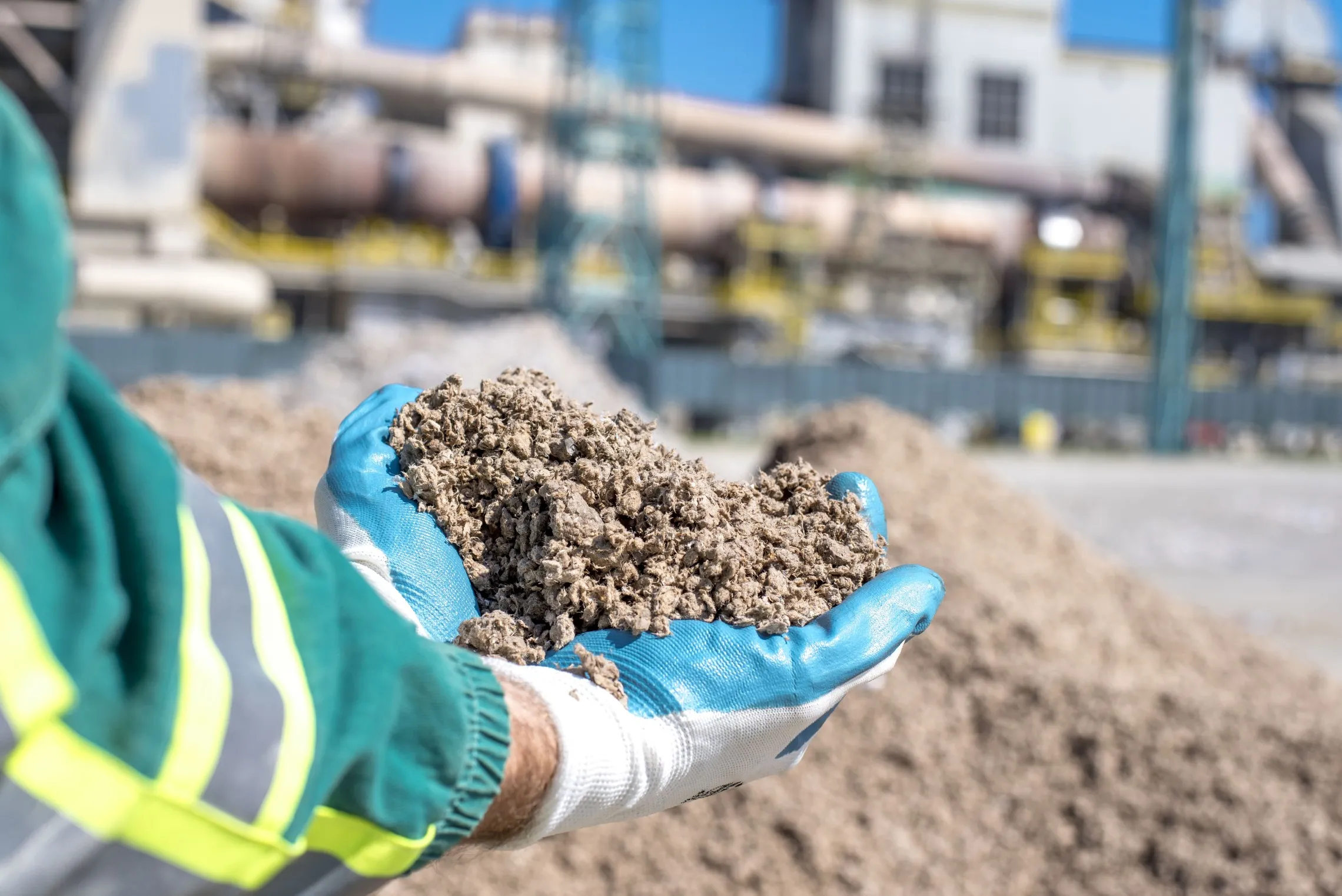
Clay is found almost everywhere in the world, making it a natural solution in regions where a lack of limestone availability drives up the cost of cement. With the right treatment, it makes an excellent replacement for clinker. You may even be able to use some of the equipment you already have on site, further reducing your investment.
The process is simple. We use the best available technologies from the cement and mining industries to optimise clinker substitution while maintaining cement quality.
This begins with our established ET dryer crusher, which is especially designed for materials like clay with up to 40 per cent moisture content. Using waste gases from the preheater, feed material is dried and crushed in one operation, achieving both the required fineness and a free moisture content of just 1 per cent by the time the clay enters the preheater.
From the dryer crusher, the material is fed to the 2-stage preheater/calciner system for calcination. It’s important to note that any fuels you fire in your existing calciner can be used in the clay calciner, including up to 100 per cent waste fuels.
What colour should green cement be?
Perhaps in the future, the natural red colour of calcined clay will be a sign of a green cement. For now, however, our clay calciner includes colour control technology to ensure the final result is traditional cement grey. This will ensure easy adoption by the cement industry’s customers who have had many decades of building grey buildings, bridges and roads – and may need additional time to change their perspective on colour.
The calciner is engineered for consistent clay activation. This ensures you get the uniform product quality that enables you to substitute more clinker in your cement product. After the activated clay has been collected in the bottom stage of the calciner, it is sent to a reducing zone where the colour control process takes place. From there the clay is introduced to a series of cooling cyclones to attain a final product temperature in the range of 100 – 120˚C. Cooling is achieved using fresh air, which is then heated by the cooling clay and recovered for use as combustion air in the calciner. This is significantly more efficient than water cooling and ensures the lowest possible fuel consumption.
Elimi nate f ossil f uels by electrif ying clay calcination To further decarbonise the cement industry, FLSmidth and a series of leading industry experts have formed a new partnership called ECoClayTM.
To reduce CO2 emissions from cement production by up to 50 per cent, the ECoClay partners will develop and commercialise the technology needed to replace fossil fuels in the calcination of clay by fully electrifying the process.
Led by FLSmidth, the global ECoClay partners include US-based industrial heating expert Rondo Energy, cement producers VICAT from France and Colombian Cementos Argos, and the Technical University of Denmark.
Based on the shared research and tests on hightemperature electric heat generation, storage solutions and renewable grid integration, the ECoClay partnership will build a pilot plant at FLSmidth’s R&D Center in Denmark. The consortium will seek to demonstrate how the ECoClay process is superior to the conventional combustion processes, has a smaller physical footprint on site and significantly lower emissions of air pollutants.
According to the project plan, the ECoClay partners expect to be able to commence construction of the first full-scale electric clay calcination installation by the end of 2025.