Concrete
Total Fuel Management with Biodiesel


Gaurav Mathur, CEO, Global Technical Services, Mumbai, explores the avenue of greener fuel alternatives such as Biodiesel to reduce greenhouse gas emissions.
Saving the environment is our primary concern today and there is a need to reduce the consumption of petroleum products which lead to Global Warming. The combustion of petroleum diesel leads to emissions hence the usage of greener alternatives like Biodiesel will help reduce the greenhouse gases.
Biodiesel, a replacement for diesel fuel, is for use in diesel engines. It is manufactured from plant oils, animal fats or recycled cooking oil. The manufacturing process converts oils and fats into fatty acid methyl esters called FAME or Biodiesel.
Biodiesel benefits
- Renewable: The ratio of energy in fuel to the units of non- renewable energy used to produce it is about 5.5 :1 (Source: University of Idaho).
- Higher cetane number: For biodiesels, the cetane number is generally between 46 to 60 higher than that of diesel fuel which is 40-45
- Except NOx all other emissions are lower.
- Non-toxic
- Environmentally friendly: Use of Biodiesel instead of diesel reduces greenhouse emissions over 80 per cent.
- Fuel lubricity: Provides lubricity to the fuel injection system reducing friction and wear.
Total Fuel Management Services
Total Fuel Management services are for companies that need increased accuracy, accountability, security or productivity from their assets. It is normal for TFM implementers to achieve fluid reconciliation rates in excess of 99.5 per cent. It consists of hardware, controllers, and software, which are implemented as a integrated package. TFM is ideal for mines and industries including vehicle fleets/haulage, construction, ports, and non-hydrocarbon applications such as chemical supply and liquid food production.
The TFM services provided include:
• Storage, handling and dispensing
• Filtration for incoming diesel fuel receipts to remove sludge ad dirt
• Sourcing of Biodiesel (B100): optional
• Conditioning of B100 and blended fuel
• Testing of B100 and blended fuel for
quality assurance
• Storage facility and management for B100
• Equipment for blending, conditioning, dispensing and accounting
• Fuel performance booster: additives, antioxidants and biocides for storage stability
adoption of Biodiesel
The Biodiesel adoption in the country is more in the industrial or organised sector. It has been largely used by pharma and FMCG companies where diesel was used as a burner fuel. However, it is still a very small percentage of the HSD used. The usage is mostly B 20, however some of them, especially in the transport sector have tried B100 with some reports of filter clogging etc. However these may be attributed to the quality of B100 used as this varies with different manufacturers. The adoption may be less than 0.25 per cent of the total fuel consumed.
global usage of biodiesel
We are at a very early stage of Biodiesel adoption, compared to Europe and USA, where they
have more organised organisations and well
defined specifications to guide the users with support from OEMs.
In December 2020, greener alternatives like biodiesel itself produced a record production of 610 million litres in USA becoming the largest producer of biofuel in the world. India targets to produce 200 million litres of biodiesel (2021).
Global biofuel forecast
Mining, construction, transport, railways and auxiliary power generations would be industries that shall be major biodiesel end-users in India and would offer vast potential to the biofuel markets in years to come.
In mining, cement and metal mining would take the lead due to increasing sensitivity
on sustainability.
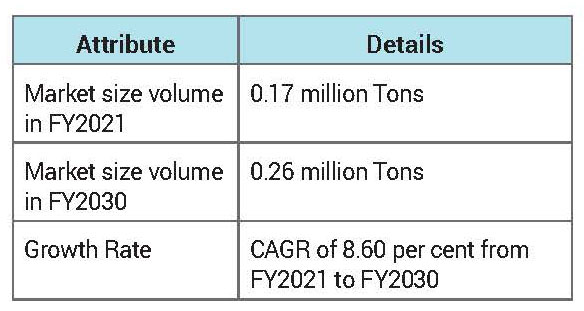
Attribute Details
Market size volume in FY2021 0.17 million Tons
Market size volume in FY2030 0.26 million Tons
Growth Rate CAGR of 8.60 per cent from FY2021 to FY2030
Construction and mining equipment sector
Sustainability should be the prime reason for implementing the usage of biodiesel, we all in the Industrial world are obliged to be sensitive to the environment and bring down the pollution levels. This is largely supported by usage of biodiesel. In absence of a clear mandate from environmental agencies, the adaptation of Biodiesel Is primarily taken as an initiative to reduce fuel cost. There should be another way, there should be incentives to the users by the agencies to adopt cleaner and green fuels such as Biodiesel. OMC’s are blending B100 with HSD , to a very small degree, yet it’s a long way to reach where we can be sustainable.
Although the intention of adaptability is good, the acceptability is in question due to fear arising out of Biodiesel quality and limited knowledge among the industry.
Supply of genuine Biodiesel is very difficult, with very few organised promoters of Biodiesel, the challenge is the supply of consistent quality
and quantity that is required by the heavy off highway machinery.
Growth prospects of biodiesel fuelled machines
The outlook is very positive for usage in terms of environmental benefits however environmental agencies strict legislation is the requirement. If the economic benefits on fuel costs is the only reason for moving to green fuels, then the adaptation shall be slow as presently one cannot define cost saving due to price variation of B100.
The key is consistency in quality and quantity, hence no single manufacturer can be identified as a sole vendor of fuel. What is needed is an
OMC or a fuel management company to take care of consistency of quality and quantity. The
future of B100 is very positive with increasing corporates and multinationals wanting to be sustainable, and OEM’s partnering in manufacturing and supporting Clean Green Fuel. The adoption of B100 in the retail market will take time due to regulatory issues.
Global Technical Services
Global Technical Services has been responsible for introducing Total Lubrication Management by implementing best lubrication practices to save millions of losses arising on account of premature failures. Core industries such as cement, mining and metals processing have hugely benefited by implementing TLM Adaptation to Clean Green Fuels is the need of the hour, already a lot of damage has been done by mankind and mother earth is already damaged to a large extent.
GTS is offering value added services to core industry where by three pillars of combustion are addressed and taken care of :
● Cleaner fuel results in better combustion. Thus, cleaning fuel and removal of all physical impurities from the diesel.
● Blending of Biodiesel with quality HSD for greener combustion.
● Quantity accounting, recording equipment wise fuel consumption, by installing WRAVI (Wireless RFID Automatic Vehicle Identification System).












BMC Cement Concretisation Cuts Pothole Repairs By 70 Per Cent

Shree Cement Approves Rs 1,800 Crore Meghalaya Plant

WCA Welcomes SiloConnect as associate corporate member

TotalEnergies and Holcim Launch Floating Solar Plant in Belgium

Cortec® Corporation applauded for its strong safety performance
BMC Cement Concretisation Cuts Pothole Repairs By 70 Per Cent
Shree Cement Approves Rs 1,800 Crore Meghalaya Plant
WCA Welcomes SiloConnect as associate corporate member
TotalEnergies and Holcim Launch Floating Solar Plant in Belgium