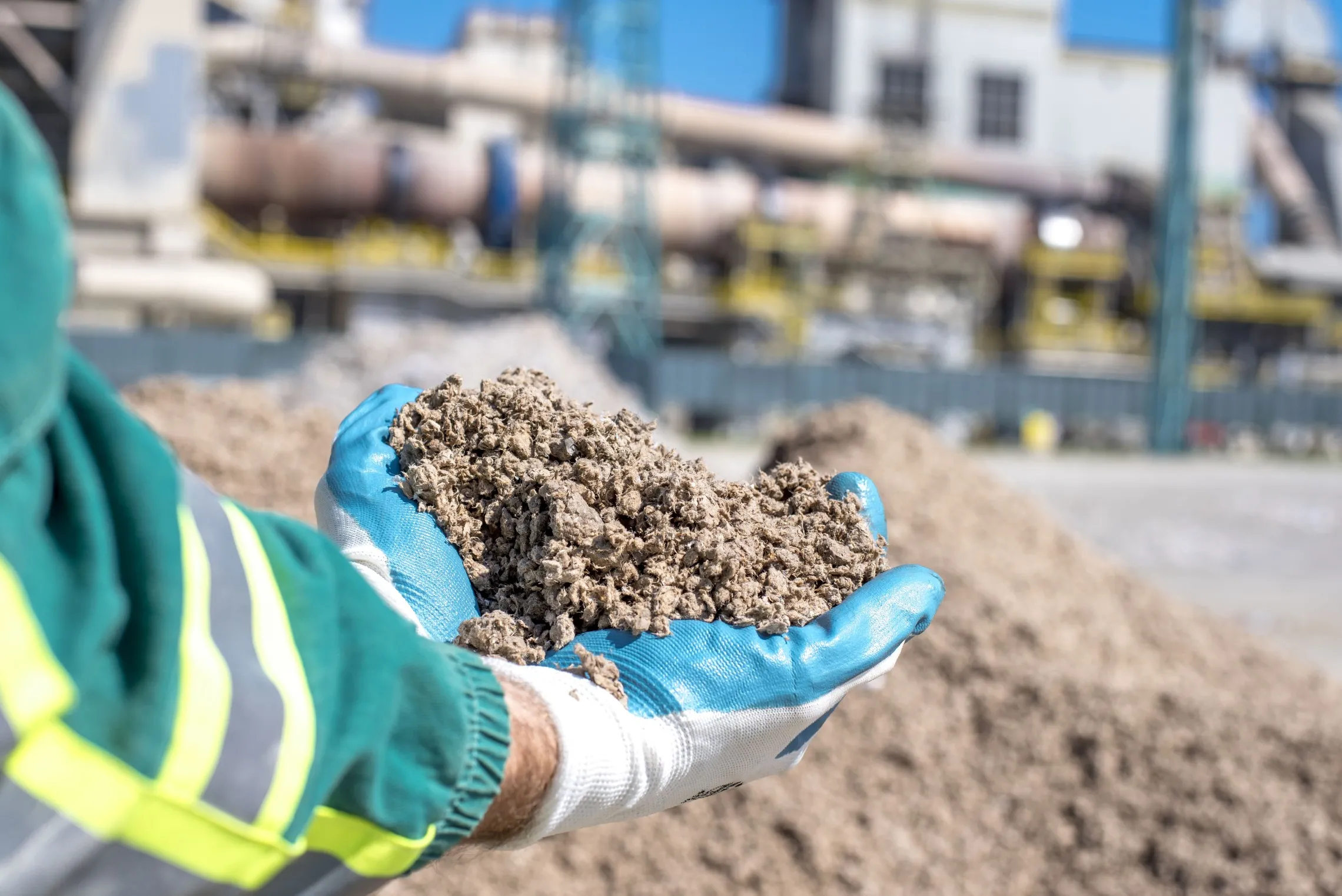
Dr Sujit Ghosh, Executive Director – New Product and R&D, Dalmia Cement (Bharat), discusses the alternative raw materials that can be used in the production of cement and its impact on carbon emissions while underscoring the major challenges faced in using other cementitious materials.
What are the core raw materials used in the production of cement?
The core raw materials used in the production of cement are limestone (calcium carbonate) and clay (a source of silica). First, the limestone is roasted/calcined to create activated lime (CaO) in a calciner and then the activated lime along with siliceous clay is proportioned along with some other minor ingredients into a raw mix design and charged inside a kiln to form cement clinker; which is basically made of complex compounds of calcium-silica-oxides primarily, which when mixed with water, reacts, to form a cementitious gel paste that binds all aggregates together and when dried up provides strength to the concrete/plaster, made with cement and the aggregates.
Limestone (calcium carbonate) and clay (silica), which are both available in nature, are inert materials. Only when they are heat-treated at temperatures above 900oC, they become activated lime (CaO) and activated/amorphous silica (SiO2), and fuse inside the cement kiln in liquid form to form complex calcium-silica-oxides, that is cement or cement clinker.
What are the alternative raw materials that can be used in the production of cement? How does that impact the process of production?
As explained in the previous paragraph, any activated lime (CaO) and/or activated/amorphous silica (SiO2), could be potential sources of cementitious material. These could be alternative raw materials for cement production. Thus far, the most widely found and used sources of alternative materials are primarily ‘fly ash’ and ‘blast furnace slag’. Fly ash is a waste product from the burning of coal (as in a thermal power plant etc). It primarily contains amorphous/activated silica (SiO2), but very little active lime (CaO) in the Indian context. So, it is not reactive on its own, it needs activated lime (CaO) to become cementitious – which is available from cement clinker, when the two are co-processed in a cement manufacturing plant. Blast furnace slag likewise is a waste product from the steel manufacturing process and does contain some activated silica and activated lime, but again, not in the proportion/concentration to itself become cementitious. It also has to be co-processed with a cement clinker in a cement manufacturing plant. Overall, these alternative or supplementary cementitious materials, which are other industry wastes, due to the need for co-processing with cement clinker, may add some costs to the production process, but since the use of such alternative raw materials, reduces the dependence on highly energy-intensive clinker, they are welcome by the cement manufacturing fraternity, that helps lower the carbon footprint of production. These cements are called ‘blended cements’ – either fly ash blended (popularly known as PPC) or slag blended (popularly known as PSC) or fly ash + slag blended (popularly known as PCC).
Can cement maintain its quality standard with the inclusion of supplementary raw materials as against limestone?
Absolutely yes. These blended cements made using supplementary raw materials, have ‘additional’ activated silica (SiO2) and/or activated lime (CaO), which when co-processed with cement clinker, provide ‘additional’ cementitious gel paste (complex calcium-silica-oxide-hydrates) when mixed with water, that renders improved strength and durability to the cement-concrete structure. Decades ago, when such co-processing commenced, the industry went through a learning curve, and then, use of supplementary cementitious materials, although provided improved strengths, the rate of strength gain was markedly slow. This is not the case anymore. With specialised processing and with the use of performance enhancers, blended cements using supplementary raw materials, provide acceptable rate of strength gains, comparable to pure-clinker cement and top-class long-term durability, with lower carbon footprints and at the same time effectively finding value-solution to other industry wastes.
Explain the impact on carbon emission of the production unit when alternative raw materials are used in various proportions.
Processing of alternative raw materials at a cement plant and transportation of such alternative materials from distant places (as they are not available in the adjacent limestone mines of a cement plant), do have associated costs and carbon footprints. However, since the use of alternative raw materials reduces dependency on highly energy-intensive clinker, net-net, there is an overall reduction in carbon footprint, in the production of blended cements using alternative/supplementary cementitious raw materials.
How can the cost of production be reduced by using alternative or supplementary raw materials in cement production?
Since the use of alternative / supplementary cementitious materials has been prevalent in the world and in India, for blended cement production, for the last couple of decades, the demand for such other industry wastes (primarily from thermal power plant or steel plant) has been increasing steadily. This has led to a steep increase in prices for these industry wastes (mainly slags from steel plants) which otherwise were previously dumped in landfills, by opportunistic players and profiteering groups. Also, since steel plants and thermal power plants are not co-located with cement plants geographically, transportation costs of such bulky waste materials have also been increasing. Cost of blended cement production has to reduce or at least maintain at par, as well as, at the same time assist the nation in beneficially getting rid of other-industry-wastes. Cement players can do justice to climate-change by producing less energy intensive blended cements that are in no way inferior in quality to pure-clinker cements. Transport subsidies should also be provided to cement manufacturers by the government as well as at the same time try and administer some polluter-to-pay mechanism (so that these wastes are not conveniently dumped away in nearby landfills by the relevant industries).
What are the major challenges in using other cementitious materials?
Sometimes the quality of other cementitious materials varies significantly, being other industry wastes – hence diligent quality checks of such incoming raw materials become important. And subsequent changes in co-processing with clinker, if necessary, is administered, such that the final product quality is maintained. We see many ready-mix concrete manufacturers, often blend fly ash and/or slag at site with cement, to produce some sort of blended cement concrete. Many times, this leads to questionable quality concrete in our nation – and sometimes earns a bad name to the use of supplementary cementitious raw materials! This is simply because a ready-mix concrete plant just cannot do the necessary processing (namely- polishing, grinding, classification etc) of such industry wastes (fly ash or slag) and neither have the stringent and highly automated factory precision of co-processing and blending, as happens at a cement plant.
What role does technology play in deciding which materials can be used, and than incorporating them in the production process?
Technology plays a very important role in the pre-assessing quality of incoming supplementary cementitious raw materials, with the same rigour, as is mined limestone assessed for its usability in the production process. State-of-the-art, highly automated and high precision expensive types of equipment are deployed along with highly skilled personnel, not only to pre-assess incoming feed quality but also in deciding necessary mix changes, at the production level, to ensure final product quality consistency. Typically, there are highly trained and experienced chemists, chemical engineers, process engineers, doctorates and specialists, who act in unison to produce consistent quality blended cements. Such capabilities and facilities are unfortunately not available to a ready-mix concrete operator or their plant, to try and produce consistent quality by site blending cement with alternative raw materials; and such need to stop. It is therefore recommended that consistent quality blended cements be purchased directly from cement manufacturers by downstream ready-mix-concrete manufacturers.
Does your organisation manufacture a variant of cement made from alternative raw materials? Tell us more about its performance and use.
Yes, we do. We manufacture many variants of cement from alternative raw materials, even some special applications, high-performance ones too! We produce and sell fly ash blended PPC, slag blended PSC, fly ash + slag blended PCC (composite cement), all of which meet all quality criteria of BIS (Bureau of Indian Standards) and are used for regular construction works. We also have blended special application cement like railway sleeper cement and oil well cement – in fact, we are the first manufacturer of such types of cement in India, since decades. Plus, of late, we have highly engineered, proprietary/patented, early strength and high performance blended cement (made using alternative/supplementary cementitious raw materials and special chemicals), that outperforms all cement types including pure-clinker cement, on all performance parameters of strength, crack control, water demand and all durability characteristics, at all ages and can hasten infrastructure construction, by allowing opening of structures within 3 to 7 days, instead of the normal 21 to 28 days. This cement has been in use by the Airports Authority of India at some of their airports’ apron/taxiway construction, for the last several years and is now being also tried for highway construction in the country. Thus, it is evident that blended cement using alternative raw materials, made under factory precision of a cement plant, can clearly outperform pure-clinker energy-intensive normal cement, and is clearly a much greener and environment-friendly alternative.
How do you foresee the future of cement production?
The future will demand less energy-intensive, greener cements, preferably with net zero carbon footprints! Is it possible to produce green cement and yet meet quality requirements? Of course, yes. Continuous research and development initiatives are on at our organisation and likewise, globally. We, as a cement manufacturing organisation, have continuously lowered our carbon footprint over the last decades and are very confident to meet future needs of even greener cements. Hence, we have voluntarily committed at global platforms like the Paris accord, COP26 etc. We recently also signed an MoU with FLSmidth, a major supplier of engineering, equipment, and service solutions to collaborate the research and development of disruptive solutions for next-generation cement manufacturing. All these initiatives are part of our journey to become a net carbon-negative cement company by 2040 and we’re well on our way!
–Kanika Mathur