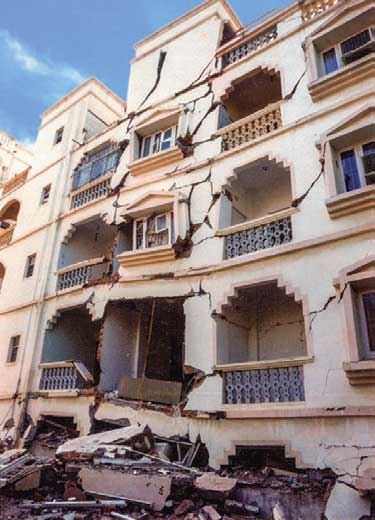
One crack, a tremor, a loud sound??nd Collapse! Buildings fall. This is true to India, And the string of accidents reported in recent Years is testament to this. Consider this: last September, five people were killed after an Apartment block collapsed in delhi; months earlier, A six-storey building collapsed on the outskirts of Delhi, killing nine; in march, a four-storey, underconstruction Building collapsed at dharwad in north Karnataka. These are just some recent mishaps ??Unfortunately, there have been more.
In fact, millions of indians live in dilapidated Buildings at the risk of collapse during the rains. Recent reports have indicated some statistics from The busy cities: mumbai has 4,299 dilapidated buildings, Of which, 633 come under the c1 ??xtremely Dilapidated??category; the bruhat bengaluru Mahanagara palike has so far identified 52 structures That are in a dilapidated state and run the risk of Collapsing; last year, Kolkata Municipal corporation Issued notices to 52 old and dilapidated buildings Located in different areas under its jurisdiction. What?? More, the condition and quality of the indian building Stock is poor when it comes to seismic performance And fire-outbreaks.
What leads to a collapse? The reasons are often related to planning, design And material. The use of inferior construction material Is believed to be the root cause that reduces the life Of a building. Some common causes for collapse Today, according to Dr Paresh Shah, professor and Dean, faculty of technology, cept university, Are ??mproper geotechnical investigation; poor quality Rcc construction practices; and improper formwork Practices, inadequate stripping time, lack of re-shoring Or shoring to lower floors.??/p>
According to Dr Pramod Kumar Gupta, professor, Structural engineering, department of Civil Engineering, IIT-Roorkee, ??n planning, we have To check the load transfer mechanism. Here, the External load, which may be owing to gravity or Earthquake, should be transmitted to the foundation Without creating any structural damage to the structural Elements. The foundation should be strong and stiff Enough to transfer the load to the soil or earth. So, An appropriate structural form may address this Issue.??/p>
Dr gupta adds that before designing any structure, An analysis is carried out, where reactive forces and Associated deformations in different structural elements Are determined using appropriate techniques. Thereafter, the design of elements is carried out by Choosing a suitable material. ??hoice and quality Of material are key parameters these days and properquality control should be ascertained when it comes To material,??affirms Dr Gupta. In his view, if all These steps are followed with due care, it would be Near on impossible for any structure to collapse before Reaching its age.
Building a strong foundati on A building?? foundation performs a number of Functions, such as bearing the load of the building, Anchoring it against natural forces, and isolating it From ground moisture. Thus, a poorly constructed Foundation can be hazardous for the occupants. ??he primary function of a building?? foundation Is to form the basis and hold the structure together,??Avers Shabbir Kanchwala, Senior Vice President, K Raheja Corp. ?? house anchored to its foundation Will retain its structure better and be less likely to be Swept away in a natural disaster.??/p>
And, Dr Niranjan Hiranandani, Founder & Managing director, Hiranandani group and President, Naredco, shares, ??n accurate Geotechnical investigation helps to build a strong Foundation. Selecting the correct type of foundation ??pile or open foundation ??and ensuring the most Appropriate founding strata are other important Factors.??he believes the concrete foundation should Be properly vibrated to ensure voids in the concrete Have refrained.
??tructural consultants and civil contractors have A significant role to play,??says Deepak Suvarna, Chief projects officer-head projects, Mahindra Lifespaces developers. ??xpertise in concrete Technology is a prerequisite. Also, exhaustive soil Investigation and effective designing of foundation Systems as per soil conditions are essential. Waterprone Areas are best avoided and a detailed subsoil Drainage system helps to ensure foundation strength.??/p>
A strong foundation can withstand natural disasters Or shocks and take adequate loads in most eventualities. ??esigning a building foundation is done in a Way that the weight of the entire structure is distributed Evenly to prevent the subsoil from spreading,??says Samyak Jain, Director, Siddha Group. ??t is crucial To assess the soil type; loam, rock, sand and gravel Are good as foundation-friendly soil. To get a stronger Base, concrete need to be poured in deeper trenches Dug in the soil till a hard surface is reached.??For his part, Rohit Poddar, Managing Director, Poddar Housing and Development, and joint Secretary, Nardeco Maharashtra, lays down Various steps: ??irst, you need thorough soil Investigation; then half-meter contour. After this, You need to slightly overdesign the load-bearing capacity of the foundation; strengthen the foundation Through a continuous pour process; give sufficient Time and use a modern curing compound; and provide Anti-termite treatment and waterproofing treatment According to international standards.Material advantage Concreting operations such as mixing, transporting, Placing, compaction and curing are important to Deliver optimal quality. The complete strength of a Structure is directly proportional to the properties And quality of materials and the quality of construction. Samyak Jain refers to two types of concrete that Construction companies use: ready-mix concrete (rmc) and site-mixed concrete. ??he quality of Both types is dependent on the number of formulas And steps,??he says. While application of rmc is Recommended for construction of high-rise structures, Especially during lack of proper logistical support, The quality of concrete mixed on site can be enhanced With stricter supervision and correct inputs.
That said, Prof Manu Santhanam, Department Of civil engineering, IIT-Madras, Avers, ??MC Has an advantage in terms of the quality of the blend Used, compared to site-mixed concrete.??further, Speaking from his experience over the years and data Analysis, Dr Hiranandani believes mixed concrete On site that has been produced with a scientific and Systematic way along with appropriate r&d helps Establish a system in place that ensures better quality. ??urther, the ??arbage-in, garbage-out??concept also Applies to the production of concrete,??he contends. ??ence, it is important to set criteria for the right. ??roper cover to Rebars and durable Concrete are key for a Safe structure.??- Dr. Niranjan Hiranandani, Founder & Managing Director, Hiranandani Hroup and National president, Naredco ?? house anchored to Its foundation is less Likely to sweep away In a natural disaster.??/p>
– Shabbir Kanchwala, Senior vice president, K Raheja Corp









 Concrete4 weeks ago
 Concrete3 weeks ago
 Concrete4 weeks ago
 Concrete3 weeks ago