Connect with us

Technology

Paradigm shift in RMC safety

Published

on

Shares

Challenges of creating a safe environment in "ready mix industry" is compounded by the interlinked but distinct environment. RDC Concrete believe that the challenges are catalyst in creating safe working spaces.

Life is the invaluable gift given to us. For centuries, we survived on instinct and many of our forefathers perished as instinct is not always right and even if it is right, it is many times too late to react. This has now been recognised and form safety systems and audit have been put in place for many decades now. Developed world is far advanced in implementing safety systems and processes. In India, we are far behind. More specifically, construction is not known for complying with safety measures. Although wearing helmets and safety shoes are now compulsory, one can look at any site and we will find a large number of people working there bare-headed and in slippers.

Ready mix concrete (RMC) is not exactly construction industry but is inseparably linked with it. There are variety of hazards involved during the processes of receiving the raw materials, processing it in a plant (plant safety), transporting it on the road (road safety) and delivering the finish product at the customer construction site (site safety). At customer’s site, it is poured in to formwork manually or by pumping to a required height reaching up to 400 m. Challenges in creating a safe environment in ready-mix industry is thus compounded by the interlinked but three distinct environments. In RDC, the challenges are the catalyst in creating safe working spaces. While it is difficult to compute deaths in RMC industry in percentage terms; based on the data presented, it is quite obvious that "Falls" and "Road Accidents" constitutes the main element of deaths in this industry. Road accidents frequently occur because the transit mixer carrying RMC while rotating it in a drum is an additional hazard on the road. Falls occur because of working at height while pouring concrete at higher levels. These are the primary challenges that need to be addressed in this industry. RDC concrete has had zero fatality in the last many years.

Delivering concrete is basically a three step process 1) Manufacturing it at batching plant 2)carrying it to the customer site using transit mixer 3) Pumping and levelling it in to the desired shuttering. All these processes have their own safety, environmental and health impacts. To mitigate these hazards and impact, we trust that our systems shall be fool-proofed. In journey to achieve this aim we implemented many best practices in our plants, in transit mixers and at delivery sites also. Some of amongst them are:

Design safety: First and foremost important is the planning for safe operations, while making layout selection of equipment and building safety features during construction of RMC plant. Plant layout has to be good to avoid criss-crossing of vehicles and smooth flow with minimum reversing of any vehicle. Hence special attention is required during construction of RMC plant of all equipment suppliers, user and safety expert.

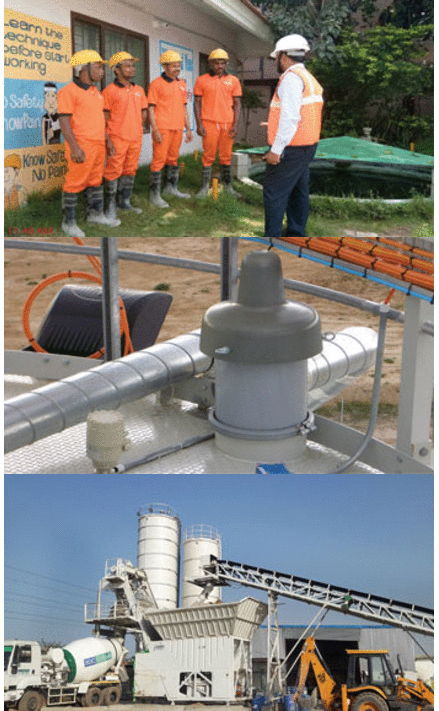
During construction stage all safety provisions in plant should be provided like barricading of moving parts like belt conveyor, blower, compressor, isolation lock out tag out during maintenance, containment of diesel storage, barricading of water tank pits, locking arrangement for silo ladder to avoid unauthorised access, fire extinguishers, water sprinkling system to prevent dust during aggregate unloading, bag filters for silos to contain cement/fly ash dust during unloading, RCCBs to prevent electrocution, fire extinguishers for different applications, proper covering of all electrical panels, adequate earthing and lightening arrestors, first aid box, PPEs, fall arrestor, etc.

Training: Training to staff and workers is one of the main aspects for improving safety compliance as attrition rate is very high among plant workers, drivers and pump gang. Display of safety provisions, SOP posters, assembly points, etc. should be done adequately in plant.

Health check: To ensure the good health of employee and workers routines check on blood pressure, sugar, eye sight and BMI, etc. are to be regularly carried out in the plant using portable BP/BMI machines or organising camp at plant. Employee’s annual health check is also should be done as per company policy to detect any warning signs.

Safety in plant operations
A-Type Lock:
This is mechanical interlocking between the main operating panel and plant mixer’s gate, using two special lock having only one common key. As there is only one key operator can either keep the panel on or keep the mixer open, that means when the main panel is on no one can open mixer gate and when the mixer gate will open no one can start the mixer panel. This will completely eliminate chances of accidents during mixer maintenance, whenever people are inside the mixer for chipping or repairs.

Silo top PRV cover: Pressure release valves (PRV) are installed on silo top, which gets open in case of sudden increase in pressure inside silo during material filling. We must ensure that this safety item is procured from reputed parties and regularly cleaned to avoid dust accumulation, which hinders spring mechanism to function.

Flushing of Bulker during unloading: Due to faulty bulker design, all material like cement or fly ash is not getting unloaded in to silo by blowing at normal pressure of 0.9bar and driver resort to pressuring bulker by closing outlet and suddenly releasing it to flush out last left out material in bulker. This is leading to opening of PRV and discharging material in surrounding atmosphere creating pollution and nuisance for neighbors. To control this we created a handy cover over PRV to contain this emitted dust and transfer it to dust collector at bottom. The design is in-house made and created with very low cost, using spare/ used chemical drums, but giving excellent result in dust control.

Calibration from Ground floor: Earlier in plants, employees were risking their life by climbing on mixer top for calibration of cement hopper, this activity is now made risk free by extending cables from the cement hopper till ground floors, with platform hanging on it. This arrangement facilitate employees to do the calibration from ground floor itself, thus avoiding the hazard of falling from height.

Lifeline and grabber: Plant people have to regularly climb on vertical ladder of silo for many jobs Like, PRV checking, stock measurement, etc. All silo’s vertical ladders are now equipped with lifeline and grabber system, this eliminate the risk of falling from silo height. In case of person slip from ladder the grabber will get locked on lifeline and hold the person in its position. Alternatively scaffold staircase should be installed in silo for safe climbing with all silos interconnected at top.

Safety during transportation
To ensure the safety in transportation of concrete, all the aspects of road safety need to be covered. Concrete carrying trucks have agitator drum to delay onset of hardening process of concrete. This drum revolution of 3RPM, shifts concrete on one side leading to shifting of centre of gravity, which keep on changing at curve roads. At high speed at road turning, combined effect of tilting of drum and moment of inertia may lead to toppling of concrete trucks. Many instances of concrete truck toppling reported in various cities due to this reason. Hence training to driver is of utmost importance because driving a concrete truck is a different ball game than an ordinary truck.

To avoid road accident and toppling of trucks due to over speeding, speed limit for transit mixer has to be kept 40 km/hr, and it is to be made sure by installing speed governors in TM, which will not allow driver to increase speed beyond limit set in speed governor. GPS are being installed in trucks to get alert for over-speeding and also voice alert for drivers. Immediate SMS is also going to the truck owner, plant in-charge and safety officer of the organisation. Drivers are being rewarded for safe driving and with minimum violations. It additionally prompts for wearing seat belt also once vehicle is started.

On road, drivers have to deal with various unseen factors that can affect their driving and they have to be fully trained to handle such factors. Training on defensive driving should be given to improve their driving skills and reducing their driving risks by anticipating situations and making safe well-informed decisions.

Driving under the influence of alcohol and drugs is one of the major causes of all road accidents. Alcohol checking should be done for drivers before leaving and coming back to the plant and educate to them about the life threatening consequences of having alcohol during driving. Engagement programme by involving drivers family helps in improving behavior change were quite successful. A poster showing family and message saying "your family is waiting for you at home is fixed in all transit mixers and form that points onwards we observed a considerable reduction in rash driving cases. To improve the safety condition of transit mixer and safety of driver all the transit mixer should be well maintained and equipped with side guard, front guard, reflective stickers, condition of brakes, reverse horn and side mirrors. Drivers have to ensure that safety inspection of TM is done regularly and pictorial checklist is maintained. Drivers should be in full PPE during driving and on site. All the road safety rules need to be followed such as seatbelt, road signs, maintain safe distance, etc. One experienced driver can be entrusted the job of checking condition of all trucks by driving it for certain distance helps in identifying issues while driving.

Safety during pumping operations
Placing of concrete at site is done by various means like pumping, tower crane, builder’s hoist, etc. and it has to be ensured that all the safety rules are followed. During pumping of concrete, safe site condition needs to be ensured by proper inspection of site before placement of pump at safe location. Soil and ground condition where concrete pump need to be placed, should be properly levelled and clear accessibility of trucks to the concrete pump maintained. Pipe line should not be very old or with leakage as pumping pressure in pipeline is very high and deteriorated pipeline can leads to major accident. Magnetic thickness gauge should be used to check thickness of pipe and pipes with lesser thickness than desired should be discarded. Scaffolding condition of slab needs to be check before start of pipe line laying, which should be dependent of the scaffold supporting the pipeline to avoid transmission of jerk to the main slab scaffold. Bamboo scaffolding must be avoided proper interconnection is not possible as compared to steel scaffold which has locks and pins to ensure good connection.

Pipe lifting clamp: Site gang were struggling from long time to carry concrete pipes. As per earlier practice, two persons used to lift pipes facing each other, but after using this holding clamp, both person can now walk in forward direction. Pump gang should use proper PPEs required for the job like hard helmet, safety shoe, reflective jacket, safety harness and goggles. Training should be given to them about all possible hazards and their mitigation plan. Pump supervisor must be made responsible during shifting and laying of pipeline safely.

Pump should be maintained with necessary safety features and no bypassing should be allowed. Regular inspection by equipment manufacturer helps in detecting the bypassing of any safety feature. The concrete pump operator should be well trained in the operation of the pump and should be made accountable for the safety in and around the pump. He also ensures the placing crew and the ready-mix driver are observing safe practices for a successful concrete placement. Concrete pumping is the most efficient way to place concrete and if all safety concerns are addressed before, during, and after a placement, the chance for accidents will be minimized.

Barricade around slab is normally missing during concrete operations and it should be brought to the notice of contractor and installed. Slab openings left uncovered at lower floors with poor lighting also pose serious danger to the pipeline gang during pipe shifting operation. Lift shaft should be avoided for pipeline laying if intermediate platforms are not made for proper pipeline laying. No overhead crane should work just above the pump and truck position to avoid falling of any object due to loose material and serious damage.

Remote indicator for Pump at site: On the site when pump placed at ground floor and delivery going on at some elevated floor, gang supervisor many time need to come to the edge of shuttering to instruct pump operator, this involves high risk of falling from height. To eliminate this we developed remote signalling system for pump operator. Gang supervisor is using handheld remote control to give signal to pump operator to start or stop the pump without risking his life.

Hazards reporting: Hazards reporting is the key in plant safety, and we should make the best use of available technologies. Plant staff can use their smartphone to report hazards with a photograph in the Google forms and the same is instantly get shared with other plants for information and action. Almost all reports can be in Google forms or on Google Drive, which can save a lot of time, and thus help in immediate action to attend to safety issue.

The article is authored by Anil Kumar Banchhor, MD & CEO of RDC Concrete since June 2016. Earlier he was CEO- Concrete Business of ACC Limited and also worked in Tata Consulting Engineers. He is a civil engineer with PG Diploma in Business management having 30 years of experience in construction, consultancy and Ready mix concrete. He worked with several construction and consultancy assignments in India and abroad. He is a panel member of the codal committee of BIS (Bureau of Indian standards) and was council member of "Indian Roads Congress" in 2006.

Continue Reading
Click to comment

Leave a Reply

Your email address will not be published. Required fields are marked *

Economy & Market

SEW-EURODRIVE India Opens Drive Technology Centre in Chennai

Published

on

By

Shares

The new facility strengthens SEW-EURODRIVE India’s manufacturing, assembly and service capabilities

SEW-EURODRIVE India has inaugurated a new Drive Technology Centre (DTC) in Chennai, marking a significant expansion of its manufacturing and service infrastructure in South India. The facility is positioned to enhance the company’s responsiveness and long-term support capabilities for customers across southern and eastern regions of the country.

Built across 12.27 acres, the facility includes a 21,350-square-metre assembly and service setup designed to support future industrial growth, evolving application requirements and capacity expansion. The centre reflects the company’s long-term strategy in India, combining global engineering practices with local manufacturing and service capabilities.

The new facility has been developed in line with green building standards and incorporates sustainable features such as natural daylight utilisation, solar power generation and rainwater harvesting systems. The company has also implemented energy-efficient construction and advanced climate control systems that help reduce shopfloor temperatures by up to 3°C, improving production stability, product quality and working conditions.

A key highlight of the centre is the 15,000-square-metre assembly shop, which features digitisation-ready assembly cells based on a single-piece flow manufacturing concept. The facility also houses SEW-EURODRIVE India’s first semi-automated painting booth, aimed at ensuring uniform surface finish and improving production throughput.

With the commissioning of the Chennai Drive Technology Centre, SEW-EURODRIVE India continues to strengthen its manufacturing footprint and reinforces its long-term commitment to supporting industrial growth and automation development in India.

Continue Reading

Economy & Market

RAHSTA Roundtable Sets Agenda for Smarter, Safer Highways

Published

on

By

Shares

Roundtable discussions focus on innovation for safer highways.

Held on 12 March 2026 at Courtyard by Marriott, Mumbai, alongside the Infrastructure Today Airport Conclave, the RAHSTA Roundtable brought together stakeholders from across the highways and infrastructure ecosystem to shape the agenda for the 16th RAHSTA 2026, scheduled for 8–9 July 2026 at the Jio Convention Centre, Mumbai. The session focused on key industry themes including road construction, technology, safety and long-term sustainability.

Opening the discussion, Pratap Padode, Founder, FIRST Construction Council, said the roundtable marked the beginning of a broader consultative process leading up to the July event. The aim, he noted, is to bring together industry stakeholders to refine the agenda for discussions on the future of roads, bridges, tunnels and allied infrastructure.

Padode noted that while central road project awards have slowed in recent years, states are increasingly driving the next phase of infrastructure growth. Maharashtra, with its long-term road development plans and agencies such as MSRDC and MSIDC, is expected to play a significant role in this expansion.

RAHSTA Expo 2026 as a specialised platform dedicated to road infrastructure, covering highways, tunnels, bridges and flyovers along with construction technologies, safety systems and maintenance solutions. He also highlighted the growing importance of rural connectivity and said the organisers are engaging with government bodies to highlight rural road development initiatives.

Tanveer Padode, CIO, ASAPP Info Group, presented insights from IMPACCT, the group’s infrastructure intelligence platform. He pointed to a strong project pipeline despite slower highway awards earlier in the year, noting that states such as Maharashtra, Odisha and Arunachal Pradesh are emerging as key drivers of new projects. The data also revealed that only a small group of contractors participates in large-value infrastructure bids.

Lt Gen Rajeev Chaudhary, former Director General, Border Roads Organisation and Chairman of the RAHSTA Expo Committee, emphasised the need for stronger collaboration across the ecosystem, including policymakers, contractors, technology providers and financiers. He also called for addressing systemic issues within the sector and encouraged greater participation of women in infrastructure leadership.

The discussion also explored the evolving economics of road development. Phani Prasad Mandalaparthy, Associate Director, CRISIL Intelligence, noted that the slowdown in project awards reflects a shift towards higher-value logistics corridors rather than simple road widening projects. However, private participation through BOT and TOT models remains limited.

From the contractors’ perspective, Sudhir Hoshing, Whole-Time Director, Ceigall, said companies are becoming more selective in bidding, favouring projects with clearer payment mechanisms and efficient processes. While NHAI continues to offer greater operational clarity, states such as Uttar Pradesh and Bihar were cited as relatively supportive environments for project execution.

Durability and sustainability also emerged as key themes. Himanshu Agarwal, COO – Road & Infrastructure, Zydex Group India, highlighted the need to prioritise lifecycle performance and resilient pavements, while participants discussed the potential of alternative materials such as plastic waste, steel slag and industrial by-products in road construction.

Dr LR Manjunatha, Vice President, JSW Cement, emphasised that India has abundant fly ash, slag and other industrial materials that can improve durability and sustainability if integrated into specifications and policy frameworks.

Technology and equipment challenges were also discussed. Dr Lakshmana Rao Mantri, Dy General Manager, Afcons Infrastructure, highlighted the shortage of tunnel boring machines (TBMs), which is delaying several underground infrastructure projects. Participants agreed that developing domestic TBM manufacturing capabilities will be critical for future infrastructure expansion.

The future of concrete pavements was another area of discussion. Dr V Ramachandra, President, Indian Concrete Institute, stressed that the debate should focus on lifecycle performance rather than material choice alone, noting that evolving design standards are improving the feasibility of concrete roads.

Prof Dharamveer Singh of IIT Bombay added that while India has made significant progress in infrastructure development, stronger capacity building and better execution practices are essential to ensure consistent road quality.

The discussion also touched upon technology adoption in the sector. Rushabh Mamania, Partner & CBO, Roadvision, highlighted the growing role of AI in road infrastructure, noting that AI-driven monitoring systems are already being deployed across large stretches of national highways.

Overall, the roundtable underscored that the future of highway infrastructure will depend not only on the pace of construction but also on durability, safety, technology integration and sustainable materials. The discussions offered valuable insights that will help shape the agenda for RAHSTA 2026 and guide future collaboration within the industry.

Continue Reading

Economy & Market

CTS Roundtable Charts Tech-Led Roadmap for Construction

Published

on

By

Shares

CTS Roundtable Maps Technology Roadmap for Construction

Ahead of the Construction Technology Show (Con Tech Show) 2026, industry leaders, technology innovators and academia came together in Mumbai to deliberate on how digitalisation, automation and industrialised construction can reshape the sector. The discussion made one thing clear: construction can no longer afford to treat technology as optional.

Held on 12 March 2026 at Courtyard by Marriott, Mumbai, alongside the Infrastructure Today Airport Conclave, the CTS Roundtable served as a precursor to the Construction Technology Show 2026, scheduled for 19–20 August 2026 at NESCO, Mumbai.

A platform to move from discussion to deployment

Opening the session, Pratap Padode, Founder and Editor-in-Chief, ASAPP Info Global Group, said construction technology has long remained close to his heart, especially given the sector’s traditionally slow pace of technology adoption. He noted that over the years, the Construction Technology Summit had steadily built interest, and the next step was now to expand it into a larger, more meaningful platform that could bring together technology providers, users, startups and innovators under one roof.

Padode said the vision for CTS is not limited to software alone. The platform aims to embrace all forms of technology that can improve construction efficiency, quality and execution—from digital tools and project management systems to lean construction, off-site fabrication and startup-led innovation. He also highlighted plans to deepen startup participation and create space for young companies to showcase emerging construction solutions.

Industry at a turning point

Moderating the roundtable, Naushad Panjwani, Chairman, Mandarus Partners, set the context by pointing out that the global construction industry, despite being a multi-trillion-dollar sector, continues to lag in productivity. He noted that while manufacturing has consistently improved efficiency, construction has remained slow to modernise.

Referring to both global and Indian trends, Panjwani underlined that the industry is now at a decisive moment. India, he said, is entering a major build cycle, and delivering the next phase of infrastructure and real estate growth through traditional methods alone is no longer viable. The goal of the roundtable, therefore, was not to debate technology in isolation, but to identify the most critical conversations that would bridge the gap between innovation and implementation.

His central message was clear: CTS 2026 must be shaped around themes that make CEOs, CIOs and CTOs feel they cannot afford to miss the event.

From BIM to AI, data to governance

A major theme that emerged through the discussion was the need for better data, better visibility and better decision-making. Dr Venkata Santosh Kumar of IIT Bombay echoed this, saying that the underlying data infrastructure itself needs attention. Construction projects, particularly remote ones, often face issues around connectivity, data collection and data use. Without this foundation, more advanced technologies cannot deliver their full value.

Chandra Vasireddy, CEO & Co-founder, Inncircles, expanded the discussion to governance, arguing that technology must help connect the many moving parts of a construction business. For him, the real value of digital transformation lies in creating better governance, clearer visibility and stronger business outcomes.

Tejas Vara of Inncircles stressed the importance of timely site data for leadership teams, especially in large and remote projects where decisions on materials, machinery and manpower often get delayed because information does not reach headquarters in time.

The role of AI also featured prominently. Rushabh Mamania, Partner and CBO, Roadvision said that while AI and machine learning are now common terms, vision intelligence and language intelligence have still not deeply penetrated the construction sector. He emphasised that startups in India are building relevant AI-led solutions and are already attracting international interest, showing that innovation need not be imported—it can be built locally and scaled globally.

Industrialised construction gains ground

The roundtable also placed strong emphasis on industrialised construction methods. Kalyan Vaidyanathan, CTO – Construction & R&D, Tvasta, called for greater focus on off-site fabrication and the broader industrialisation of construction. Bhargav Jog, General Manager, Dextra, highlighted precast technology and alternative sustainable materials as areas with immediate relevance.

Several participants agreed that modular, precast and pre-engineered approaches are no longer niche ideas. They are increasingly becoming practical responses to the sector’s challenges around labour shortage, timelines, quality control and predictability.

Anup Mathew, Sr VP & Business Head, Godrej, argued that the industry needs a fully integrated approach—from design and procurement to execution and asset management. Unless these are connected, technology adoption will remain fragmented and sub-optimal. He pointed to pre-engineered and modular systems as examples of how industrial thinking can compress timelines, improve quality and reduce dependence on difficult on-site conditions.

Adoption remains the biggest hurdle

While there was broad agreement on the promise of technology, the discussion repeatedly returned to one fundamental challenge: adoption.

Abhishek Kumar, COO, LivSYT, observed that the market is crowded with solutions, but many buyers still struggle to evaluate which technology suits which use case. According to him, the industry needs clearer frameworks to help users select, compare and adopt solutions, rather than expecting a single platform to solve every problem.

Dr Tenepalli JaiSai, Associate Professor, School of Construction(SoC), NICMAR University, noted that isolated technologies will not solve the productivity problem by themselves. What is required is an integrated Construction 4.0 approach, where digital, physical and cyber-physical systems work together rather than in silos.

That concern around silos was reinforced by Subodh Dixit, former Director, Shapoorji Pallonji, who said the issue is not just that technologies are disconnected, but that stakeholders are as well. Clients, consultants, contractors and partners often operate with different priorities. Unless these silos are broken, technology will struggle to percolate across the full project value chain.

Harleen Oberoi, Project Management, Tata Realty shared a practical perspective from the client side, saying that successful BIM implementation requires investment across the ecosystem, not just within one organisation. Trade partners, vendors and other stakeholders must also be trained and aligned if the technology is to deliver its intended results.

Beyond buzzwords

A notable takeaway from the session was that the industry is moving past the phase of treating technology as a buzzword. Participants repeatedly stressed that the real question is not whether technology should be used, but where it creates measurable value and how that value can be scaled.

The conversation also expanded beyond mainstream themes to include repairs and rehabilitation, construction and demolition waste, sustainability, circular economy, green sourcing, carbon measurement, design interoperability, generative design, robotics, and the role of horticulture and greener built environments.

Setting the agenda for CTS 2026

By the close of the session, the roundtable had surfaced a strong set of themes for the upcoming show: BIM and digital twins, AI and data platforms, industrialised construction, startup innovation, governance-led technology adoption, robotics, sustainable materials, and integrated project delivery.

More importantly, the session established CTS 2026 as more than an exhibition. It is shaping up to be a serious industry platform where users, technology providers, researchers and policymakers can collectively define the future of construction.

As Padode noted in his closing remarks, the conversation will continue through further consultations and possibly webinars in the run-up to the show. If the roundtable is any indication, CTS 2026 will aim not merely to showcase technology, but to push the industry towards meaningful adoption at scale.

Continue Reading

Trending News

SUBSCRIBE TO THE NEWSLETTER


Don't miss out on valuable insights and opportunities to connect with like minded professionals.


    This will close in 0 seconds