Connect with us

Concrete

Commonly used precast shapes

Published

on

Shares

In the olden days, wooden sleepers were used for laying the railway tracks, but due to the depleting wooden resources and increasing concern of the ecological balance, the use of concrete sleepers was started and now it has completely replaced the wooden sleepers. Concrete ties have become more common mainly due to greater economy and better support of the rails under high speed and heavy traffic. Ties are normally laid on top of track ballast, which supports and holds them in place, and provides drainage and flexibility. Heavy crushed stone is the normal material for the ballast, but on lines with lower speeds and weight, sand, gravel and even ash from the fires of coal-fired steam locomotives have been used. Regarding the market potential of the railway sleepers, their demand totally varies with the installation of new railway lines. To link almost every city and town with the other and to avoid the delay of trains because of ??ross??on single lines, number of new tracks is being installed. Tracks on high-density traffic routs with speed exceeding 100 km per hour, are being strengthened and modernised adopting improved methods of track maintenance for safer and comfortable rail travel.

Concrete sleepers can be produced from both new and recycled concrete. A railway sleeper is a rectangular support for the rails in railroad tracks. Generally laid perpendicular to the rails, ties transfer loads to the track ballast and subgrade, hold the rails upright and keep them spaced to the correct gauge. Railway sleepers are traditionally made of wood, but pre-stressed concrete is now also widely used, especially in Europe and Asia. Steel ties are common on secondary lines in the UK plastic composite ties are also employed, although far less than wood or concrete. From the view of region, Asia-Pacific and Europe have a larger sales market share in 2018 which together account for 74.02 per cent, and will witness a stable growth in following years.

The demand for sleepers will go on a lot better aspect in time to return. In the near future, the railways are probable to broaden as a minimum 5,000 to 8,000 km of rail network per year, which is almost 30 to 40 per cent extra than in past, assuming that kilometer of rail would need 1600 sleepers these plans are probable to outcomes in annual demand of about 1.3 crore of sleeper. Present manufacturing cost of monoblock broad gauge pre-stressed concrete sleeper is within the range of Rs 2,200 to Rs 2,500. The cement which is applied for the manufacture of the sleeper is the main raw material.

Cement requirement

The main requirement for railway sleepers is cement. There is a separate specification issued by Ministry of Railways through Research Design and Standards Organisation, Lucknow for the manufacture of concrete sleepers. It is popularly known as IRS T-40 grade of cement. The specification is quite similar to that of Ordinary Portland Cement 53 Grade except few parameters are different taking into account the requirement of manufacturing process of sleepers.

Likewise the cement fineness has to be minimum of 3700 sq. cm per gram. The compressive strength of cement mortar is measured only for the age of 7days and has to be minimum of 375 kg per sq cm. The tri calcium Silicate content (C3S) requirement has to be not less than 45 percent. The other requirements are same as that of 53 Grade of cement. The Indian cement industry is capable of fulfilling the entire requirement of sleeper manufacturing industry locally.

Vulnerability

The average lifespan of a pre stressed concrete sleeper is about 50 years. Over a period of time the pre stressed concrete sleepers have proved its superiority over wooden and steel sleepers. However the fundamental problems in these types of sleepers is vulnerability to chemical attack [DEF(Delayed Ettringite Formation), AAR(Alkali-Aggregate Reaction) and many others] and low impact resistance. It can be minimised by changing cement with Industrial waste cementitious materials, which will give extremely good engineering properties like protection against chemical degradation.

Railway produces around 1.3 crore (2019) sleepers each year and if they use industrial waste in concrete for sleepers, it’s going to reduce the value of manufacturing of each sleeper by approximately Rs 30, with the intention to imply a typical value saving of Rs 30 to 35 crore in keeping with annum for India Railways.

But critics have been quick to point out that the weight and bulk of concrete sleepers is a significant disadvantage when it comes to the cost ??both in time and money ??of initial installation and later repairs.

Spun pipes

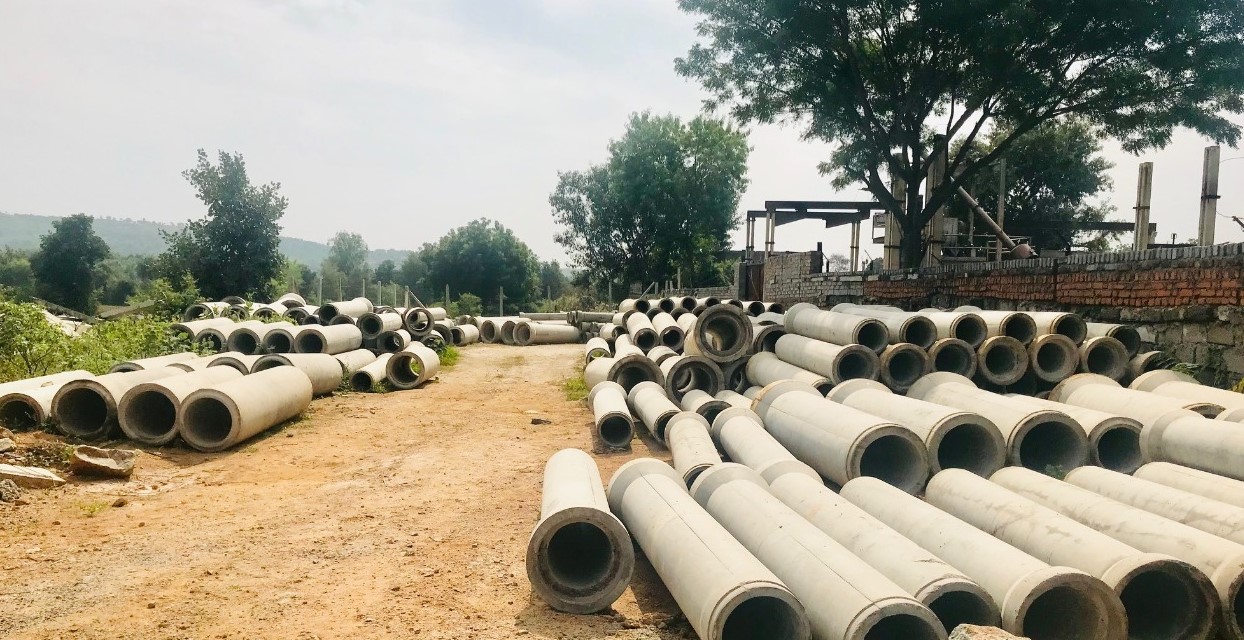
The other major consumed pre cast item is spun/hume pipes. It is produced in a small scale industry (SSI) and has a very wide market. The technology used is pretty old and has not changed much but the use of these pipes is very extensive. Only SSI units can manufacture the RCC (reinforced cement concrete) pipes up to 100 cm diameter. Such pipes are classified into two groups as pressurized and non-pressurised. Cement, coarse and fine aggregate, sand, and mild and HT steel rods are used for the manufacture of such pipes. These are mostly manufactured in two lengths such as 1.8 m and 2.8 m with varying diameters from 10 cm to 100 cm. The RCC pipes are used for irrigation, culverts construction, sewerage, and drainage purposes for smooth transportation of effluents and to avoid seepage. The main raw materials used are cement, sand, aggregates, M.S. reinforcement rod and wire etc.

Manufacturing process

A mixture with raw materials such as cement, sand, and stone chips in 1:2.5:2.5 ratios are prepared with the help of power operated cement concrete mixture. Steel rod with reinforcement case is made in accordance with the dimensions of the pipe in a reinforcement making/winding machine. This case is then placed inside the pipe mold. The mold is mounted horizontally on the runners of the pipe molding machine. The mold is then rotated at a slow speed. Concrete mixture is fed into the rotating molds through its open ends at both sides.

When the mold is filled with required quantity of the mixture to obtain requisite thickness, the speed of the rotation of the mold is increased and kept at a fixed speed for few minutes depending upon the pipe diameter, length, etc. the inside diameter of the green pipe in the rotating mold is then finished for smoothness with the help of wooden reaper and to remove excess water. Thereafter neat cement is sprinkled inside the pipe to obtain a well-polished surface and to reduce friction coefficient at the time of its setting. The mold is taken out from the machine by the system and left in curing bay for the initial setting. On the following day, the molds are removed and the pipe is passed on to the curing tank and allowed to remain in the water for 15 days and then taken out for inspection and quality test. The finished product is then stocked in the yard for disposal. The pipes so manufactured are tested as per the specifications IS 458:1971 drawn by the Bureau of Indian Standards for ensuring the quality of the product.

Source: A research paper by Prof. Suresh Kumar.A and Dr.Muthukannan M. published by in International Journal of Recent Technology and Engineering (IJRTE), December 2019.

Continue Reading
Click to comment

Leave a Reply

Your email address will not be published. Required fields are marked *

Concrete

Cement Makers Reaffirm Commitment to Sustainable Growth

Published

on

By

Shares

World Environment Day spotlight on innovation and circularity

On World Environment Day, the Indian cement industry reiterated its commitment to supporting India’s climate ambitions through sustainable manufacturing, resource efficiency and the adoption of cleaner technologies.

The Cement Manufacturers’ Association (CMA) said the sector remains aligned with the Government of India’s Net Zero commitments and is accelerating efforts to reduce its environmental footprint while supporting the country’s infrastructure and development agenda.

Parth Jindal, President, CMA and Managing Director, JSW Cement, said the industry is increasingly adopting cleaner technologies, improving energy efficiency and expanding the use of alternative fuels and raw materials. He also highlighted the growing importance of circular economy practices, where industrial by-products and waste streams from one sector are utilised as resources in another.

“The Indian Cement Industry is aligned to the Government’s commitments on carbon mitigation and is accelerating the adoption of cleaner technologies, resource efficiency and circular economy practices while actively exploring the potential of Carbon Capture, Utilisation and Storage (CCUS) as a critical pathway for deep decarbonisation,” said Jindal.

He added that coprocessing industrial waste and by-products helps conserve natural resources, reduce disposal requirements and lower the environmental footprint across multiple sectors.

According to Jindal, sustainability is no longer limited to manufacturing processes but is increasingly influencing investment decisions, innovation strategies and long-term growth plans within the industry.

Echoing similar views, Dr Raghavpat Singhania, Vice President, CMA and Managing Director, JK Cement, said sustainable development extends beyond emissions reduction and must also focus on responsible resource utilisation and waste minimisation.

“Sustainability in the built environment cannot be measured by emissions alone. It is equally about how efficiently we use resources, how effectively we minimise waste and how responsibly we create the infrastructure that will serve future generations,” said Singhania.

He noted that the cement industry is advancing its sustainability agenda through greater resource efficiency, increased circularity, technological innovation and continuous improvements in manufacturing practices. As a key contributor to India’s infrastructure development, the sector has a critical role to play in balancing economic growth with environmental responsibility.

On the occasion of World Environment Day, industry leaders reaffirmed their commitment to supporting India’s climate goals while delivering the materials required for resilient, durable and sustainable infrastructure.


Continue Reading

Concrete

Building a Greener Future Together

Published

on

By

Shares

Environmental sustainability requires immediate action, not just long-term commitments and discussions. Recycling, circular economy practices, and technology-driven waste management can help industries reduce environmental impact while supporting sustainable growth.

Author: Jignesh Kundaria, Director and CEO, Fornnax Technology

World Environment Day serves as an important reminder that environmental sustainability can no longer remain confined to discussions, reports, or long-term commitments. The environmental challenges facing the world today demand immediate, measurable, and collective action. Across industries and communities, waste generation continues to outpace our ability to process it responsibly, placing increasing pressure on ecosystems, natural resources, public health, and the well-being of future generations.

One of the most significant shifts required today is a change in how society perceives waste. Rather than being viewed as a material to be discarded, waste must be recognised as a valuable resource that can contribute to both economic growth and environmental protection when managed through the right technologies and systems. This mindset forms the foundation of the circular economy model that countries across the world are increasingly adopting to reduce landfill dependence, recover valuable materials, and create more sustainable industrial ecosystems.

India has made meaningful progress in strengthening awareness around sustainability, recycling, and environmental responsibility over the past decade. Significant efforts are being made to formalise the recycling sector through improved infrastructure, technology adoption, policy implementation, and broader stakeholder participation. These developments are creating a stronger foundation for responsible waste management and resource recovery across the country.

However, achieving long-term environmental impact requires collaboration from all stakeholders. Industries, policymakers, technology providers, and communities must work together with greater accountability to strengthen recycling ecosystems, encourage responsible waste management practices, and create sustainable outcomes through consistent execution rather than temporary interventions.

As someone closely associated with the recycling industry, I firmly believe that technology will play a decisive role in addressing future environmental challenges. Advanced recycling systems have the potential to recover valuable resources, reduce pollution, minimise landfill burdens, and conserve energy, creating a more sustainable future for generations to come. This belief is deeply reflected in Fornnax’s motto, “Committed to Create a Green Future,” which embodies our commitment to building long-term environmental value through innovation and responsible action.

At the same time, technology alone cannot deliver meaningful change. Real progress requires intent, awareness, participation, and a shared sense of responsibility. Sustainable development can only be achieved when innovation is supported by collective action and a genuine commitment to environmental stewardship.

On this World Environment Day, let us move beyond conversations and take meaningful steps towards creating a cleaner, greener, and more sustainable planet. By embracing innovation, strengthening recycling ecosystems, and acting responsibly today, we can create lasting environmental impact and secure a better future for generations to come.

Continue Reading

Concrete

JK Lakshmi Advances LC3 Cement Expansion

Company highlights commercial production and research partnerships

Published

on

By

Shares


The meeting reviewed progress in limestone calcined clay cement (LC3) technology and its commercial adoption in India’s cement sector, focusing on low-carbon alternatives to conventional binders. JK Lakshmi Cement noted that limestone calcined clay cement can reduce carbon dioxide emissions by up to 40 per cent compared with conventional cement and said this reduction supports industry decarbonisation. The company highlighted that it was among the first two cement manufacturers in India to move LC3 into commercial production after the Bureau of Indian Standards approved the technology as a cement standard.

Vinita Singhania said the transition of LC3 from research to commercial production reflected collaboration between industry, academia and international institutions. Maya Tissafi acknowledged JK Lakshmi Cement’s role in advancing LC3 adoption in India and its contribution in taking the technology from laboratory trials to commercial implementation. Both representatives underlined the growing relevance of sustainable construction materials as India expands infrastructure and urban development.

The meeting explored continued collaboration with Swiss research institutions such as EPFL, EMPA and ETH Zurich alongside Indian academic partners and development organisations. JK Lakshmi Cement has been associated with the LC3 initiative since 2014 and worked with EPFL, IIT Delhi, IIT Madras, Development Alternatives and Technology and Action for Rural Advancement. The company conducted one of the earliest industrial trials of LC3 and recently announced commercial production of Green Pro LC3 cement from its Jaykaypuram plant in Rajasthan.

India remains the world’s second-largest cement producer and expansion of infrastructure, urbanisation and housing demand continue to support long-term sector growth, increasing interest in low-carbon technologies. The company reported an annual turnover of more than Rupees (Rs) 60 bn and current cement capacity of about 18 million (mn) tonnes (t) per annum, with a target of reaching 30 million (mn) tonnes (t) by 2030. Apart from grey cement, the company also makes ready-mix concrete, gypsum plaster, wall putty, primers, adhesives and fly ash blocks, and both sides concluded on the need for continued collaboration to develop sustainable construction solutions.

Continue Reading

Video Thumbnail

    SIGN-UP FOR OUR GENERAL NEWSLETTER


    Trending News

    SUBSCRIBE TO THE NEWSLETTER


    Don't miss out on valuable insights and opportunities to connect with like minded professionals.


      This will close in 0 seconds