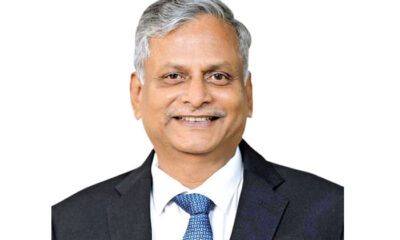
Manish Toshniwal, Vice President and Mines Head, JK Cement, talks about the various aspects of sustainable mining.
Tell us about the volume of mined raw materials and fuels consumed by your organisation annually.
Limestone is a major raw material for cement manufacturing mined from our captive limestone mine, with consumption of over 10.0 million tonnes per annum, and the fuel (high speed diesel) being consumed at the rate of 0.42 litres per tonne of limestone.
What are the conveyor channels used to carry the mined materials to the plants?
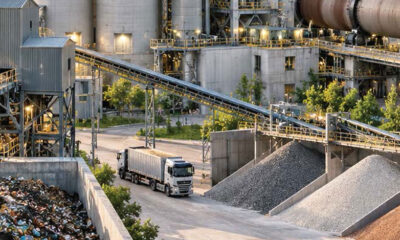
Limestone is majorly conveyed through OverLand Belt Conveyor (OLBC) from the mine crusher to the plant. OLBC stretched up to a distance of 7.5 km crossing highway and railway tracks, and covered completely with rain hood along with acoustic hood provided near habitant areas to minimise dust and noise pollution, and reducing carbon footprints.
Mining leads to depletion of natural resources. Is there any action taken to combat the same?
The availability of natural resources is limited and mining leads to depletion of natural resources. It is quite important that on the one hand we meet the needs of the present, and on the other, we conserve natural resources to meet future needs. We have taken various actions for mineral conservation as below:
- Detailed exploration was carried out in G1 Category under UNFC Classification for reassessment of the deposit. It is well supported in optimum utilisation and blending of different grades of minerals from depth. It resulted in enhancement of proven reserves and in turn the mine life.
- The data obtained from exploration was converted into a geological database in SURPAC software to determine the extent of the ore deposit and its geo-statistical characteristics.
- The total volume of reserves is estimated by developing a solid block model comprising all bore hole data. Mine planning is carried out by dividing the ore body into suitable blocks and sub blocks. Suitable ultimate pit depth selected from which mine pit is designed. With this, the different grades of mineral blended effectively for optimum utilisation and consumption of low-grade minerals. The sub grade minerals, which are lower than cutoff grade minerals, are consumed by adding high-grade limestone (sweetener) procured from nearby areas for their effective utilisation, leading to increase in mine life.
- In a few block areas, clay was found interbedded with limestone, which needed to be separated to improve the quality of limestone. A screen reject separator installed with a crusher, which separates out the clay through a reject belt conveying system, and only the clean limestone is transported to the plant. It results in more quantity of low-grade utilisation and consumption from mine.
- Real time production data is monitored continuously including quality, quantity and productivity. Cross-belt analyser installed at conveying belt, which is linked with Automated XRF analyser.
How does your organisation address the issue of dust pollution and noise pollution while mining and grinding limestone?
The key effective measures taken for combating the dust and noise pollution while mining and crushing of limestone are as below:
A high-pressure jet is installed in water tankers to wet the blasted muck before loading of limestone, to minimise the fugitive emissions during loading.
Automated stationary water sprinklers installed along haul roads and cold dry fogging in crushing units were installed, which proved to be effective in fugitive dust control. Moreover, it resulted in reduction of water consumption to half per square metre of haul road as compared to mobile water sprinkling.
The limestone from the crusher is transported to the plant by closed conveyor belts to control dust generation. The conveyor system stretched from the crusher to the plant covering a distance of 7.5 km crossing highway and railway lines.
The drill machines are automated and equipped with wet drilling systems. The green belt developed all along the periphery of the lease boundary or ultimate pit limit boundary and on both sides of the roads.
There are continuous on-line ambient air quality monitoring stations (CAAQMS) installed at various locations. All the on-line monitoring stations are connected with SPCB site for capturing real time data. The drone survey of mining lease is carried out as per provisions of MCDR.
What is the technology behind mining of limestone for the cement process?
What is its impact on the productivity of the organisation?
Mine planning and scheduling carried out using SURPAC block modelling for developing scientific and systematic formation of benches in the ore body.
To enhance equipment and workforce productivity, higher capacity equipment deployed in mine. Fleet Management System (FMS) implemented in mine. Fleet management system upgraded subsequently to maintain real time health monitoring system to attain high reliability, real time quality monitoring system, real time productivity monitoring systems to capture, monitor and analyse various KPI’s.
Controlled blasting techniques are in practice at the mine. Nonel initiation system is used to limit the fly rocks and ground Vibrations. The haul roads and ramps are designed to always maintain the shortest lead. The haul roads were maintained with road graders and compactors for attaining shorter cycle time of equipment used for transportation of limestone from mine to crusher.
Tell us about the efforts taken by your organisation to make limestone mining a sustainable process?
Mining can become more sustainable by developing and integrating practices that ensure cost effective mining, reduce the environmental impacts of mining operations, improve socio economic development of people, and comply with statutory obligations. The various measures adopted by us to make limestone mining a sustainable process are:
- Higher capacity equipment is deployed in the mines that are highly productive and cost effective. A highly skilled workforce is deployed to attain higher output per man shift. It has resulted in reduction of mining costs.
- Conveying of limestone through OLBC from the mine crusher to the plant, stretching up to 7.5 km crossing highway and railway lines, has resulted in improved productivity, cost effective mining while mitigating environmental hazards like carbon emissions and dust generation associated with road transportation.
- Massive plantations have been taken up for conservation of flora and fauna in the mines.
- So far, the plantation drive in mines involves planting 4,07,294 saplings covering an area of 158.07 hectares.
- The development of bio diversity park, to create safe and secure habitat for local flora and fauna to improve the ecological footprint of the mine, spreads over an area of 50.0 hectares. The park will be developed in three phases with a total of 50,000 saplings and is targeted to be complete by FY 2024-25. In the first phase, planting of saplings of a variety of species in consultation with DFO to the tune of 25,000 is under process.
- The mining equipment is loaded with safety features as required by DGMS. A Safety Management plan is prepared and implemented in the mine through which the workers’ participation in safety management is promoted. Both internal and third-party authorities conduct safety audits.
- By installing solar panels and fulfilling power consumption of the mines through solar energy, the mine is able to reduce its carbon footprint to a considerable extent.
- Vocational training is imparted on various H&S aspects. The mine has a well equipped Group VTC with internal and external trainers. On the job training is imparted through OEM trainers for skill upgradation and capacity building.
- Water harvesting measures are implemented such as construction of storm water drains and ponds within the mine area for storage of rainwater, artificial ground water aquifer recharge structures to improve the groundwater level and collection of rainwater in mine-pits. Our rainwater harvesting activities are beneficial to the mine as well as to the community surrounding mines. Water ponds constructed in the surrounding villages and water infrastructures have been created to supply water from the mine to these ponds for agriculture, livestock etc.
- The mine has also undertaken well appreciated CSR activities, which are aligned with the pressing needs of the nation – public health and sanitation, education, water infrastructure to provide water for irrigation and drinking, infrastructure development etc. We have built schools, colleges, training institutes, hospitals, temples and other social infrastructure as a part of our community intervention.
Tell us about the government compliances that your organisation strictly adheres to.
The mining activities are carried out as per the Mining Plan approved by Indian Bureau of Mines under the Mineral Conservation and Development Rules (MCDR) amended as on date, and all the provisions of MCDR are complied with. The technical aspects are complied as per provisions of the Metalliferous Mining Regulations (MMR), to ensure safe operations in the mine. The welfare of mine employees as per provisions of Mines Rules and Mines Act amended as on date under DGMS directives and guidelines are complied with. The records, registers and returns are regularly submitted to concerned authorities as prescribed within the timelines. The conditions of Environment Clearances, CTE and CTO are complied with, as per provisions of the Air and Water Act amended as on date and as per MOEF/SPCB directives and guidelines.
What are your plans to make mining a sustainable process for the cement business?
To achieve climate change targets, we are geared up for adoption of carbon reducing technologies like use of alternative fuels such as LNG, hydrogen powered base mining equipment, integrating electrification with automation and digital systems as well as the use of renewable energy, recycling and reuse for minimising the amount of waste produced.
–Kanika Mathur
















 Concrete4 weeks ago
 Concrete4 weeks ago
 Concrete4 weeks ago
 Concrete3 weeks ago