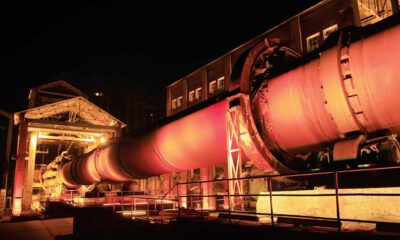
CCUS is positioned as the only scalable pathway for India’s cement industry to achieve deep decarbonisation. Lovish Ahuja, Chief Sustainability Officer, Dalmia Cement (Bharat) explores a balanced approach combining utilisation with long-term storage.
CCUS is emerging as a critical lever for deep decarbonisation in the cement industry, especially as traditional efficiency measures reach their limits. In this interaction, Lovish Ahuja, Chief Sustainability Officer, Dalmia Cement (Bharat), shares insights on India’s CCUS readiness, key challenges, and the path from pilots to large-scale adoption.
How critical is CCUS to achieving deep decarbonisation in cement compared to alternative levers like clinker substitution and energy transition?
Deep decarbonisation in the cement industry is uniquely challenging because most emissions stem from calcination—which inherently releases carbon dioxide. This means that even a fully renewable powered cement plant would continue to generate substantial process related CO2 emissions. In India, the industry has already achieved meaningful reductions through improved energy efficiency, increased use of alternative fuels, and expanded adoption of Secondary Cementitious Materials (SCMs) such as fly ash and slag. However, these interventions are nearing their technical and economic limits due to the fundamental chemistry and process requirements of cement production. Given these constraints, Carbon Capture, Utilisation, and Storage (CCUS) emerges as the only scalable and durable pathway to push emissions below the 350–400 kg CO2 per tonne threshold and enable deeper, sector wide decarbonisation. For India’s large and growing cement capacity, CCUS becomes indispensable for aligning the industry with long term national and global climate goals.
What stage of CCUS readiness is the Indian cement sector currently at—pilot, demonstration, or early commercial adoption?
India’s cement sector CCUS landscape remains nascent, with activity yet to reach genuine pilot or demonstration scale. While government led initiatives have announced targeted testbeds and several producers are exploring capture technologies, no integrated, full scale CCUS project has reached financial closure or commercial operation. Even so, recent years have seen meaningful progress in building domestic engineering capability, adapting capture technologies to Indian flue gas conditions, and improving clarity on utilisation and storage pathways. In contrast, several international first mover projects already have mechanically complete or operational capture units. These offer useful benchmarks, but replication in India requires context specific engineering to accommodate local constraints such as power reliability, water availability, high dust loads, and cluster based transport and storage logistics. The key barrier now is not technical feasibility but the financial ecosystem—demanding stronger government support through grants, carbon market mechanisms, and risk sharing frameworks.
In the near term, 1–2 tonne per day CCU testbeds are expected to come online with support from the Department of Science & Technology (DST). A proactive, mission mode approach from the government will be essential to accelerate deployment and move the sector toward large scale commercial readiness.
What are the biggest technical challenges of integrating carbon capture into existing Indian kiln systems without disrupting productivity?
One of the major challenges in deploying CCUS at cement plants is the significant space requirement. Most brownfield expansion sites—and even many greenfield facilities—are already tightly configured. With capacity expected to grow over the next 30–40 years, finding adequate space for capture trains, blowers, pre treatment units, compression systems, and intermediate CO2 storage becomes extremely difficult.
A second constraint is input gas quality. Cement flue gas carries high dust loads along with SOx, NOx, and other trace elements, all of which accelerate solvent or membrane degradation. This necessitates complex and costly pre treatment before capture can begin. Utilities present a third major challenge. Current carbon capture technologies demand substantial heat and power, yet cement plants typically operate without surplus steam or electricity. Since CCUS would significantly increase total energy demand—most of which would need to come from renewable sources—ensuring a stable and adequate energy supply becomes a major hurdle. Finally, once CO2 is captured, large scale transport, storage, or utilisation remains a technically and logistically demanding challenge.
How does the high cost of CCUS impact cement pricing, and who ultimately bears this cost—the producer, policymaker, or consumer?
CCUS significantly shifts the cost curve for cement production. Beyond carbon capture itself, the added requirements for compression, purification, transport, and storage introduce substantial capital and operating costs. Depending on the technology pathway and site conditions, the fully loaded cost of CCUS can more than double the price of low carbon cement compared with conventional production. For a commodity sector with thin margins, absorbing or passing through such costs is extremely challenging without external financial support. Experiences from advanced markets explain how large scale CCUS deployment has been possible there. In Europe, cement producers benefit from free EU ETS allowances, access to the EU Innovation Fund for large scale projects, low cost renewable power, and policy mechanisms that support price premiums for green or low carbon materials. These instruments collectively bridge upfront capital needs and early stage learning costs. Yet even with this extensive support, CCUS projects remain uncommon—illustrating the scale of the challenge for India, where enabling frameworks are still evolving and markets are highly price sensitive.
That said, there are pockets where cost pass through is feasible. In premium housing, using low carbon or net zero materials typically raises overall project costs by only 2 per cent to 3 per cent. This suggests that the luxury and high value real estate segment could serve as an early adopter—creating the first demand signal needed to scale CCUS enabled cement and build broader market acceptance.
What role do carbon utilisation pathways (such as concrete curing, fuels, or chemicals) realistically play versus long-term geological storage in India?
Utilisation is attractive because it converts a liability into a long term business opportunity. CO2 cured concrete products, synthetic fuels, methanol, and carbonates are among the promising utilisation pathways. In India, industrial symbiosis with refineries, fertiliser plants, and chemical industries can absorb part of the captured CO2, and these avenues should be prioritised to drive early commercial viability. Precast curing also offers a practical near term option, as carbon can be mineralised within controlled logistics and at relatively low cost. However, scale remains a challenge: a single large cement plant emits 1.5–2 million tonnes of CO2 annually—far beyond what current utilisation markets can absorb. Meanwhile, fuels and chemical pathways are energy intensive and require inputs such as green hydrogen, which remain uncompetitive without fiscal support. For these reasons, utilisation alone cannot deliver
Net Zero; CO2 storage will need to serve as the backbone, with utilisation playing an important but supporting role.
On the storage side, India has credible geological options. Offshore saline aquifers, mature oil and gas fields, and basalt formations such as the Deccan Traps offer significant CO2 storage potential. Strategically mapping cement clusters to nearby storage basins can reduce logistics complexity and make CCUS deployment more feasible. The pragmatic approach is clear: utilise where it is easy and economical, store where it is necessary.
How important is government policy support—carbon markets, incentives, or mandates—in making CCUS commercially viable for Indian cement plants?
Policy is the central fulcrum for CCUS success globally, and India is no exception. CCUS requires investment well beyond what market demand alone can support, making grants, fiscal incentives, and robust carbon market mechanisms essential to transition projects from strong environmental concepts to financially bankable solutions. Clear standards are equally critical—covering storage regulations, permitting processes, transport frameworks, CCU product specifications, removal of market barriers, and supportive tax structures. Together, these elements form the foundational prerequisites for CCUS project realisation and scale up. India has begun this journey from a promising starting point. The country’s lead policy think tank, NITI Aayog, has already convened national level workshops, developed detailed policy recommendations, and is progressing toward a dedicated CCUS Mission. Such coordinated policy action will be pivotal in accelerating India’s CCUS ecosystem and enabling commercial deployment at scale.
Can CCUS be scaled across mid-sized and older plants, or will it remain viable only for large, new-generation integrated facilities?
In our view, early CCUS projects will logically cluster around large, modern cement plants, where space constraints are minimal and process as well as energy integration can be optimised. These facilities offer lower incremental costs for integration and better energy efficiency, while their scale naturally improves the economics of carbon capture—positioning them as ideal anchor points for shared CO2 transport and storage infrastructure.
Mid sized and older plants can be considered in later phases, once the value chain is established and sufficient local experience has been built.
However, if older facilities are planning major refurbishment, that window provides an opportunity to incorporate CCUS friendly design choices from the outset, improving long term readiness and reducing retrofit complexity.
Over the next decade, do you see CCUS becoming a competitive advantage or a regulatory necessity for Indian cement manufacturers?
The trajectory of CCUS adoption will depend heavily on policy direction, market sentiment, and the pace of technological maturity. Early movers stand to benefit if green procurement strengthens and embodied carbon performance begins to attract measurable and rewarded premiums. As India progresses toward its Net Zero 2070 target, CCUS will gradually shift from an optional initiative to a necessary compliance requirement. Companies
that invest early—through pilots, supply chain partnerships, and capability building—will be better positioned to optimise cost, execution timelines, and regulatory alignment when mandates and incentives eventually converge.
CCUS should be viewed as both a shield and a sword. It acts as a shield by future proofing assets against long term climate and regulatory risks, and a sword in markets where compliance remains mandatory but enabling support systems are limited. India likely has a 15–20 year window before such pressures fully materialise—time that the cement industry must use to build technical readiness, operational know how, and strategic preparedness for the moment when CCUS becomes unavoidable.