Dinesh Sampath, Global Product Manager – Process Optimisation, FLSmidth Cement, discusses the results of a pyroprocess application of ECS/ ProcessExpert® (PXP) solution.
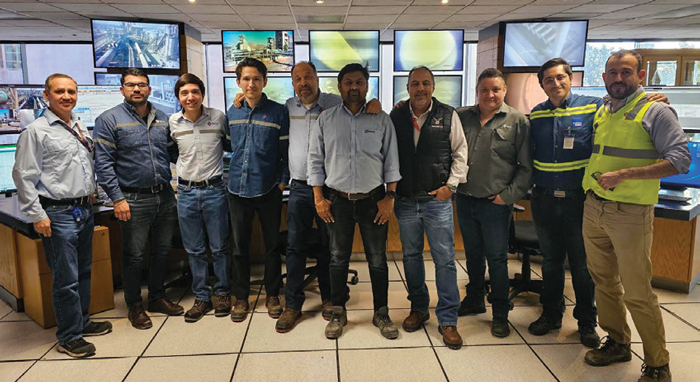
In 2023, Kiln 04 at GCC’s Chihuahua cement plant in Mexico was running manually. In pursuit of increased productivity, an advanced process control system was pursued with the specific aims including:
Reduce free-lime variation to improve clinker quality
Increase the substitution alternative fuels without risking carbon monoxide or sulphur spikes
Reduce stoppages and thus improve overall performance.
Avoid build-up, rings, and coating falls resulting from high temperatures
After another supplier’s advanced process control system did not deliver to expectation, the company turned to FLSmidth Cement and ECS/ ProcessExpert® (PXP) solution.
We commissioned PXP v.8.5 at the Chihuahua plant in early 2024. It wasn’t long before the plant saw results. Production rose by two per cent while heat consumption reduced by one per cent.
These numbers along with the new self-adaptive controller convinced GCC to upgrade the kiln line to PXP v9.1.
The ECS/ ProcessExpert (PXP) v9.1 effect
PXP v9.1 features our latest advanced self-adaptive controller. An alternative to traditional MPC-based systems, self-adaptive control enhances the software’s responsiveness to changing process dynamics without depending on detailed process models. It evaluates process information in real time, making it more resilient to process changes and better able to generate dynamic predictions. The result? Even more significant performance benefits than previous PXP iterations.
This manifested as a 4.2 per cent increase in production at the GCC Chihuahua plant compared to manual operations. Power and heat consumption also significantly reduced, while the free lime standard deviation dropped by 31 per cent. Implementing PXP v9.1 also enabled the plant to significantly increase alternative fuel consumption, supporting GCC’s aims to raise alternative fuel use at
its operations.
What made the difference?
So, what made the difference at the Chihuahua plant? PXP improved stability to a degree never seen before, and at the same time resulted in better control of NOx, carbon monoxide and oxygen such that allowed more alternative fuels could be used safely. Ring and coating formation was also reduced. Ultimately, there were fewer process upsets thanks to smarter, self-adaptative controller.
Shree Cement expects to outpace the industry in the financial year 2026-27 as it pursues organic expansion and pricing discipline following a recent investor conference. The chairman said the company has completed a pricing realignment and recovered volumes lost during that exercise. Management signalled a clear preference for internal investments rather than acquisitions to support growth.
The company reported that capacity additions and demand growth across core markets are expected to underpin stronger volume performance, with a target of growing volumes at around 1.1 times the industry growth rate. Cash levels are likely to decline as capital expenditure progresses and shareholder distributions increase, the chairman indicated. The board has prioritised higher dividends over a buyback as a means of reducing excess cash.
Shree Cement described a market shift towards value and affordability rather than a race to the lowest price, which links demand expansion more closely with pricing. Historically, prices have risen at around three per cent annually over long periods, the company noted, and while prices may increase faster this year because of cost pressures from geopolitical tensions, a material improvement in industry profitability is not anticipated. In North India, the company expects additional capacity to be absorbed as demand grows, estimating a requirement of roughly 10 million (mn) tonne (t) of incremental demand annually.
The next phase of expansion will focus on the north, west, east and northeast regions, with existing projects and planned capacities viewed as sufficient to meet future demand without pursuing acquisitions. Management said it has already regained lost volumes while sustaining higher prices and will continue to monitor regional opportunities, including a possible investment in West Bengal pending clarity on industrial policy. The company, which has a current market capitalisation of Rs 852,948.9 mn, has seen its shares lose more than 20 per cent over the past year.
The Hard Worker campaign by The Ramco Cements has secured seven honours at the Good Ads Matter Awards 2026, adding to its growing list of accolades and reinforcing its standing among the year’s most recognised advertising campaigns.
The awards were presented during the Good Ads Matter Awards Night 2026 held at Mehboob Studios in Mumbai. The campaign received recognition across multiple categories, highlighting excellence in direction, editing, cinematography and storytelling.
Among the honours, the campaign won Silver in the Campaign of the Year – Direction category, while filmmaker Prakash Varma was named Director of the Year for the films Tortoise & Hare and Eco Plaster. Tortoise & Hare also received Silver awards for Best Editing and Best Colour Grading, along with a Bronze award for Best Cinematography. Eco Plaster earned Bronze awards in the Best Direction – Narrative and Best Direction – Humour categories.
Both films extended their award-winning run, with Eco Plaster being recognised for its narrative centred on water conservation through innovative construction solutions, while Tortoise & Hare was honoured for its storytelling and craft execution.
The Hard Worker campaign was built around the idea that hard work deserves recognition and respect. Through culturally rooted and emotionally engaging stories, the campaign has connected with consumers, engineers, masons and the wider construction community across the country.
Commenting on the achievement, A V Dharmakrishnan, CEO of The Ramco Cements Limited, said that the continued recognition across leading creative platforms reflects the company’s commitment to meaningful and authentic communication rooted in the values of the people it serves.
Balaji K Moorthy, Executive Director – Marketing, The Ramco Cements Limited, said the awards recognise the craftsmanship behind the storytelling, from direction and cinematography to editing and narrative execution.
Following recognition at both the Kyoorius Creative Awards and the Good Ads Matter Awards, the Hard Worker campaign continues to demonstrate the impact of purpose-driven storytelling combined with strong creative execution and consumer relevance.
World Environment Day spotlight on innovation and circularity
On World Environment Day, the Indian cement industry reiterated its commitment to supporting India’s climate ambitions through sustainable manufacturing, resource efficiency and the adoption of cleaner technologies.
The Cement Manufacturers’ Association (CMA) said the sector remains aligned with the Government of India’s Net Zero commitments and is accelerating efforts to reduce its environmental footprint while supporting the country’s infrastructure and development agenda.
Parth Jindal, President, CMA and Managing Director, JSW Cement, said the industry is increasingly adopting cleaner technologies, improving energy efficiency and expanding the use of alternative fuels and raw materials. He also highlighted the growing importance of circular economy practices, where industrial by-products and waste streams from one sector are utilised as resources in another.
“The Indian Cement Industry is aligned to the Government’s commitments on carbon mitigation and is accelerating the adoption of cleaner technologies, resource efficiency and circular economy practices while actively exploring the potential of Carbon Capture, Utilisation and Storage (CCUS) as a critical pathway for deep decarbonisation,” said Jindal.
He added that coprocessing industrial waste and by-products helps conserve natural resources, reduce disposal requirements and lower the environmental footprint across multiple sectors.
According to Jindal, sustainability is no longer limited to manufacturing processes but is increasingly influencing investment decisions, innovation strategies and long-term growth plans within the industry.
Echoing similar views, Dr Raghavpat Singhania, Vice President, CMA and Managing Director, JK Cement, said sustainable development extends beyond emissions reduction and must also focus on responsible resource utilisation and waste minimisation.
“Sustainability in the built environment cannot be measured by emissions alone. It is equally about how efficiently we use resources, how effectively we minimise waste and how responsibly we create the infrastructure that will serve future generations,” said Singhania.
He noted that the cement industry is advancing its sustainability agenda through greater resource efficiency, increased circularity, technological innovation and continuous improvements in manufacturing practices. As a key contributor to India’s infrastructure development, the sector has a critical role to play in balancing economic growth with environmental responsibility.
On the occasion of World Environment Day, industry leaders reaffirmed their commitment to supporting India’s climate goals while delivering the materials required for resilient, durable and sustainable infrastructure.