

Concrete
Actively preventing corrosion extends the operational life


Ana Juraga, Content Writer, and Julie Holmquist, Marketing Content Writer, Cortec Corporation share how Cortec’s VpCI® and EcoLine® technologies offer unmatched corrosion protection and sustainability for cement plants operating in India’s harsh environments.
In the relentless environment of the cement manufacturing plants—where dust, humidity and corrosive agents combine to threaten the integrity of vital equipment—effective corrosion control is not just a maintenance concern, but a business imperative. Enter Cortec Corporation, a global leader in corrosion protection solutions, whose advanced Vapor phase Corrosion Inhibitor (VpCI®) technology is transforming the way cement plants protect their assets. Ana Juraga, Content Writer, and Julie Holmquist, Marketing Content Writer, Cortec Corporation, discuss how with its range of biobased lubricants, Cortec delivers a powerful, sustainable performance edge to an industry
under pressure to improve efficiency, safety and environmental compliance.
How does Cortec’s VpCI® technology specifically benefit cement plant equipment operating in India’s humid and corrosive environments?
Cortec’s VpCI® technology offers significant benefits for cement plant equipment operating in humid and corrosive environments, precisely because of its unique mechanism of action and the range of product forms available.
Environmental challenges for cement plants are:
High Humidity: Moisture is the primary catalyst for most corrosion reactions. In humid environments, condensation readily forms on metal surfaces, creating an electrolyte layer that allows electrochemical corrosion to occur.
Corrosive Contaminants: Cement plants are inherently exposed to:
- Dust and Abrasive Materials: While not directly corrosive, these can wear down protective coatings, exposing bare metal to the elements. They also create crevices where moisture and corrosive agents can accumulate.
- Chlorides: Especially in coastal regions or if certain raw materials or alternative fuels are used, chlorides can be highly aggressive, breaking down passive layers on steel and accelerating pitting corrosion.
- Complex Geometries and Inaccessible Areas: Cement machinery often has intricate designs, enclosed spaces, internal cavities, and hard-to-reach areas (e.g., inside rotary kilns, grinding mills, ductwork, electrical cabinets).
In such cases benefits of Cortec VpCI® technology are: Unlike traditional coatings that require direct application and struggle with complex geometries, VpCI® molecules vaporise and diffuse throughout an enclosed space. They then condense on all metal surfaces, forming a monomolecular protective layer.This ensures comprehensive protection for internal surfaces of pipes, vessels, gearboxes, electrical components, and other inaccessible areas that are often missed by conventional methods. This is crucial for preventing hidden corrosion that can lead to catastrophic failures.
VpCI® technology provides:
- Multi-Metal Protection: Cement plants utilise a variety of metals. Cortec VpCIs are formulated to protect both ferrous and non-ferrous metals simultaneously. This simplifies inventory, eliminates the need for different corrosion inhibitors for different materials, and prevents galvanic corrosion when dissimilar metals are in contact.
- Protection During Shutdowns, Layup, and Storage: VpCI® products (e.g., emitters, powders, films, fluids) are ideal for preserving equipment during planned or unplanned downtime. VpCI technology prevents flash rusting and long-term degradation of expensive machinery and spare parts exposed to high humidity and corrosive atmospheres while not in operation. This significantly reduces recommissioning time
and costs. - Minimal Surface Preparation and No Removal Required: Many VpCI® products can be applied to surfaces with minimal pre-cleaning, and the protective VpCI® layer typically does not need to be removed before equipment is put back into service. VpCI® ‘s save significant labor, time, and associated costs compared to methods that require extensive surface preparation (e.g., sandblasting) and post-application cleaning or degreasing. This allows for faster startup after maintenance.
- VpCI’s are environmentally frriendly and safe: Many Cortec VpCI® formulations are non-toxic, recyclable, and free from heavy metals, nitrites, and other harmful chemicals. They align with increasing environmental regulations and corporate sustainability goals, improving worker safety and reducing hazardous waste disposal concerns.
- Cost-Effectiveness and Extended Equipment Lifespan: By actively preventing corrosion, VpCI® technology extends the operational life of critical and expensive cement plant equipment. VpCI’s reduces the frequency and cost of repairs, replacements, and unscheduled downtime, leading to substantial long-term savings in maintenance and improved overall plant productivity.
Cortec’s VpCI® technology provides a comprehensive, adaptable, and often more economical solution for managing corrosion in the challenging humid and corrosive environments typical of cement plants, by providing continuous, multi-metal protection to both accessible and inaccessible surfaces.
Can you elaborate on the advantages of using EcoLine® biobased lubricants in cement manufacturing, particularly regarding sustainability and performance?
Cortec’s EcoLine® biobased lubricants offer significant advantages for cement manufacturing, focusing on both sustainability and performance.
- Sustainability Benefits: Renewable Resources: Made from natural seed oils, reducing reliance on finite petroleum.
- Biodegradability: Rapidly break down in the environment, minimising soil and water contamination from spills – crucial for meeting environmental regulations.
- Lower Toxicity: Safer for workers and ecosystems, reducing health risks and environmental damage.
- Reduced Carbon Footprint: Contribute to lower greenhouse gas emissions compared to conventional lubricants.
Cortec’s EcoLine® biobased lubricants provide excellent corrosion protection and superior defense against rust in humid, dusty, and corrosive environments. EcoLine® lubricants provide a greener, safer, and highly effective solution for maintaining cement plant equipment.
What role do Cortec’s corrosion-inhibiting additives play in extending the lifespan of heavy-duty machinery during equipment layup periods?
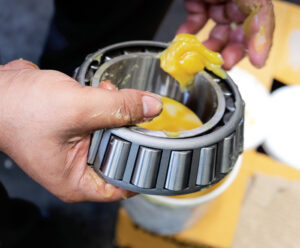
The primary purpose of Cortec® greases are to inhibit corrosion in NLGI 2 and 3 applications. This is especially important during periods of layup when the equipment may be more prone to corrosion because of inactivity. Both CorrLube™ VpCI® Lithium EP Grease (NLGI Grade 2) and EcoLine® Biobased Grease (NLGI Grade 3) contain added corrosion inhibitors to go above and beyond the basic corrosion inhibiting properties of grease (sealing out corrosives) for greater protection when needed—whether due to idleness or extremely hot, humid, and/or seaside climates like those in India. Furthermore, EcoLine® Biobased Grease contains inhibitors with vapor-phase action, which allows protection on metals in enclosed spaces that are near but not directly touching the grease. While the primary purpose of these two greases is to offer corrosion protection during layup, in many cases they also have the option to be used during operation, adding to their convenience and flexibility. This is extremely helpful when intermittent operation is needed, allowing plant personnel to start the equipment temporarily without having to change out the grease, saving time and hassle. By protecting lube points from corrosion during layup, Cortec® greases help maintain idle assets in good condition to retain value and to keep them ready for startup when needed.
How do Cortec’s metalworking fluids enhance operational efficiency in cement plant maintenance tasks like cutting, drilling, and grinding?
Cortec’s metalworking fluids significantly enhance operational efficiency in cement plant maintenance tasks by improving tool performance, protecting equipment, and streamlining processes.
- Extended Tool Life: Superior lubrication and cooling reduce wear and heat, meaning fewer tool changes and less downtime.
- Superior Corrosion Protection (VpCI® Technology): Prevent flash rust on new surfaces and protect machinery, even in humid conditions, eliminating extra rust preventative steps.
- Cleanliness and Stability: Resist microbial growth and residue buildup, requiring less fluid maintenance and machine cleaning.
- Simplified Processes: Multi-functional fluids and integrated corrosion protection streamline workflows and reduce product inventory.
Cortec’s metal working fluids are engineered to optimise the cutting, drilling, and grinding processes in cement plant maintenance by enhancing tool performance, ensuring part quality, and providing critical corrosion protection, ultimately leading to greater efficiency and cost savings.
In what ways does Cortec® tailor its lubrication solutions to meet the specific demands of the cement industry?
The cement industry has many lubrication points that require NLGI Grade 2 grease that can be used in high temperature applications. These may include bearings on vibrating screens and roller mills; rotating joints on grinding units; and various shafts, pivots, and metal to metal contact points found throughout the plant. CorrLube™ VpCI® Lithium EP Grease has a dropping point of 360 °F (182 °C), allowing it to be used in a broad range of temperatures. For areas that need a slightly harder grease of NLGI Grade 3, EcoLine® Biobased Grease offers a similar dropping point of 365 °F (185 °C).
– Kanika Mathur
















JSW Cement Commissions 1 MTPA Unit in Rajasthan

Wonder Cement appoints Mahesh Singh as VP Corporate Brand Communication

JSW Cement commissions additional 1 MTPA grinding unit in Rajasthan

JSW Cement Boards Approve Proposed Shiva Cement Merger

JSW Cement commissions additional 1 MTPA grinding unit at Nagaur
JSW Cement Commissions 1 MTPA Unit in Rajasthan
Wonder Cement appoints Mahesh Singh as VP Corporate Brand Communication
JSW Cement commissions additional 1 MTPA grinding unit in Rajasthan
JSW Cement Boards Approve Proposed Shiva Cement Merger







