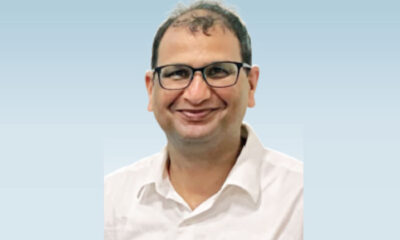
Dr Yogendra Kanitkar, VP – Research and Development, Pi Green Innovations, discusses groundbreaking, scalable clean-tech solutions.
As the world races to combat climate change, a simple observation sparked a powerful vision for a pollution-free tomorrow. Dr Yogendra Kanitkar, VP – Research and Development, Pi Green Innovations, talks to Kanika Mathur about how filter-less technology is changing the game – from capturing soot to permanently sequestering CO2 in building materials. Read on to explore how this startup is turning industrial waste into climate solutions.
Can you briefly introduce Pi Green Innovations and its mission for a pollution-free tomorrow?
Pi Green Innovations is a clean tech startup. Our founders are Irfan Pathan, Shantanu Sonaikar, and Rizwan Shaikh. We started with a vision of a pollution-free tomorrow. Our founder, Rizwan Shaikh, observed the dust accumulation on AC filters and realised Delhi’s air pollution was a massive issue. Inspired to create a solution, he began searching for a filterless technology to clean air. That’s how the initial Carbon Cutter machine was conceptualised. The first application was for diesel generators. In 2012–2013, the National Green Tribunal (NGT) ordered diesel generator operators to install Retrofit Emission Control Devices (RECDs) to capture more than 70 per cent of particulate matter. This initially rolled out in Delhi NCR and later became mandatory nationwide.
We invented a filterless technology using electrostatic precipitation (ESP) to capture soot from diesel generators without interfacing with the engine. The soot is collected in a separate tank or vessel that can be cleaned later. This innovation gained traction, and major diesel generator OEMs became our channel partners, certifying and fitting our devices to their generators.
Later, some customers asked if we could also capture gaseous emissions like SOx and NOx. While exploring this, we accidentally discovered that our technology had a greater affinity for capturing CO2. This led to the birth of the Net Zero Machine — a point-source greenhouse gas capture device that converts CO2 into carbonates using accelerated mineral carbonation technology.
To our knowledge, we are the only company in India to operate this technology at such a large scale. While typical lab-scale pilots capture around 1 tonne of CO2 per day, our largest pilot with an Institutional Thermal Power Plant Operator which will be commissioned soon. It will two tonnes of CO2 per day, operational for 21 consecutive days.
Our focus is not just on carbon capture but on carbon utilisation — turning captured CO2 into building materials like bricks, aggregates and road fill. This provides a scalable solution to address industrial emissions while creating valuable byproducts.
How does your Net Zero Machine contribute to carbon capture and green cement production?
To understand our contribution, you first need to understand how cement is produced. Cement production typically involves calcining dolomite to form clinker — the main binding agent in cement. Our ethos is to use industrial waste to capture CO2. We have developed 10 different chemistries with the Net Zero Machine tailored for hard-to-abate sectors like cement, steel, petrochemicals, FMCG and others. For instance, if we are operating at a thermal power plant, we use the fly ash generated there along with other chemicals. When the flue gas passes through the Net Zero Machine, it reacts to form a sludge that self-hardens upon curing. This sludge can be moulded into bricks, road fill, coarse aggregates and other building materials. Importantly, the CO2 captured is permanently sequestered within the solid material — it will not release back unless heated to above 600°C. Unlike other technologies, like amine-based or retisol systems that produce pure CO2 gas, our process embeds CO2 into solid building materials, ensuring long-term storage.
In the cement industry context, let’s say we are working with a steel manufacturer. Normally, blast furnace slag is sold as a cement additive. In our case, we carbonate the industrial waste like slag — through the Net Zero Machine. The carbonation adds CO2 mass into the material, which can then be used as a substitute for clinker or other additives in cement production. For example, if you start with one tonne of blast furnace slag and add 500 kg of CO2 during carbonation, you end up with 1.5 tonnes of carbonated slag. Chemically, the properties remain largely similar.
Thus, instead of disturbing the existing symbiosis between industries like steel and cement, we add value by enhancing the material mass and permanently sequestering carbon — directly contributing to the decarbonisation of the cement industry.
What makes your carbon-negative bricks unique compared to conventional building materials?
They are different in two major aspects. First, if you look at how traditional bricks are made, you take sand, add a binder and then bake the bricks at high temperatures. Each of these steps requires a certain amount of energy, and the biggest energy input is during the baking process, where fossil fuels are burned, emitting CO2.
Now, when you use our bricks, because they are made from industrial waste, there is no CO2 output associated with the raw material itself. You are avoiding emissions by substituting traditional bricks with our product. This is known as an ‘avoidance credit’ or avoided CO2 — you are preventing a certain amount of CO2 emissions by choosing a product with a lower carbon footprint.
The second aspect is the way we manufacture our bricks. We do not bake them. Instead, the bricks are sun-dried and carbonated. The industrial waste, like blast furnace slag or fly ash, is carbonated and self-hardens to form the brick. This means the brick already has captured and sequestered CO2 stored within it.
So, in our product, you have two forms of CO2 benefits: one is captured CO2, and the other is avoided CO2. When you combine these two, that becomes our unique selling proposition compared to normal bricks. That’s why we call them carbon-negative bricks.
How scalable is your Net Zero solution for industries like cement manufacturing?
For the cement industry, scalability is built into the core of our Net Zero solution. Our machine is entirely modular. What we usually propose to clients is: install one unit first, see how it works and then scale up. We have the flexibility to install up to a hundred units in a facility. It is very scalable and modular — you can easily grow based on requirements.
Now, the scaling isn’t purely linear or exponential, but it definitely scales, and there’s a cost curve based on techno-economic analysis where we help clients determine the optimum amount of CO2 they want to capture.
In your view, how critical is CCUS technology for India’s decarbonisation journey, especially in heavy industries?
It is highly critical. If you are exporting to carbon-sensitive markets, you are likely to be hit with a carbon tariff. The Carbon Border Adjustment Mechanism (CBAM) is one such example. Even within India, the Carbon Credit Trading Scheme (CCTS) has been notified, and around 283 entities have been obligated to reduce their CO2 footprints. So, Indian industries should wake up to this reality. If you want to remain competitive in foreign markets, adopting CCUS is non-negotiable.
Specifically for cement manufacturers — and speaking frankly — the margins are razor-thin. Steel manufacturers might still afford a capture cost of $50 per tonne of CO2, but for cement companies that’s much harder. That’s where we come in. Our cost of CO2 capture is significantly lower than conventional market solutions. We can achieve capture costs of less than $25 to $30 per tonne. That’s a game-changer.
What future innovations is Pi Green working on to further advance sustainable construction practices?
There are two broad approaches we are pursuing under Project Net Zero. First, under carbon capture utilisation, we are working on using the sludge generated from industrial waste in very innovative ways to sequester CO2 and form different products out of it. That’s an active vertical.
The second vertical involves evaluating whether our technology can be coupled with Compressed Biogas (CBG) plants. In CBG plants, a major impurity in the biogas is CO2. If we remove that CO2, we can increase the purity of the fuel, turning it into high-quality PNG or CNG. This purified fuel can then be used in internal combustion engines and other applications.
Another interest for us in the near future is to evaluate if NetZero Technology can be coupled with coal gasification to produce blue hydrogen.
Besides that, we are actively working on sludge utilisation — finding multiple pathways to make valuable products from the byproducts of the Net Zero process.
Those are the three major innovations we are actively working on.