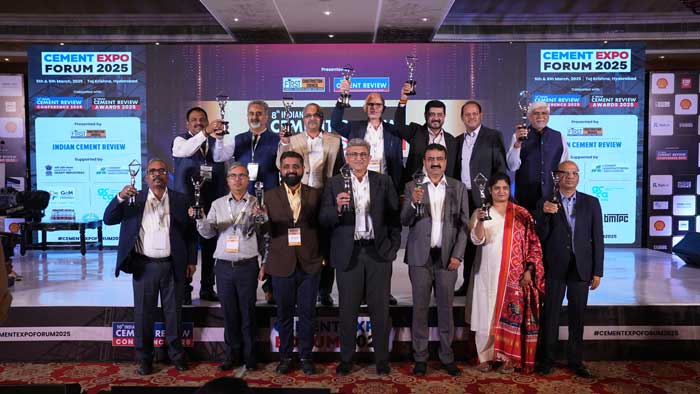
The Indian Cement Review Awards 2024-25 honored excellence in the cement industry, recognising innovation, growth, and sustainability across various categories. A distinguished jury selected the winners, with a special Lifetime Achievement Award presented to academician Dr. Ravindra Gettu.
The Indian Cement Review Awards 2024-25 celebrated outstanding achievements across the cement industry, recognising innovation, growth, and sustainable practices. Winners were announced across a range of categories, including Innovation Awards and Fastest Growing Companies in the small, medium, and large segments. These accolades were the result of rigorous deliberations by a distinguished jury comprising industry veterans and domain experts.
The esteemed jury included Dheepan Ramalingam, MD, Ringfeder Power Transmission; Sumit Banerjee, Former Vice Chairman, Reliance Infrastructure and Board Member, FIRST Construction Council; Anupama Reddy, Vice President and Co-Group Head, Corporate Ratings, ICRA; KN Rao, Consultant – Energy, Environment & Sustainability and former Director, ACC; Ulhas Parlikar, Global Consultant; Goverdhandas Daga, Director, Secmec Consultants; Manoj Kumar Rustagi, Executive VP and Chief Sustainability & Innovation Officer, JSW Cement; Kaustubh Phadke, India Head, Global Cement & Concrete Association (GCCA); and Sudeshna Banerjee, MD, PS Digitech-HR India.
A special highlight of the event was the conferring of the Lifetime Achievement Award to renowned academician and researcher Dr. Ravindra Gettu, in recognition of his exceptional contributions to cement and concrete research, and for shaping the future of construction through academia.
The awards underscored the industry’s ongoing commitment to innovation, growth, and sustainability.
The 8th Indian Cement Review Awards
The prestigious Indian Cement Review Awards were held on the evening of 6th March 2025, in the presence of the veterans of the industry. Here are the highlights from the award ceremony.
Sr No. Award Category Winner
1 Lifetime Achievement Award Dr. Ravindra Gettu, V.S. Raju Chair Professor, Department of Civil Engineering, IIT Madras
2 Fastest Growing Cement Company (Large Category) JK Cement
3 Second Fastest Growing Cement Company (Large Category) Ultratech Cement
4 Third Fastest Growing Cement Company (Large Category) Nuvoco Vistas Corporation
5 Fastest Growing Cement Company (Medium Category) JSW Cement
6 Second Fastest Growing Cement Company (Medium Category) Star Cement
7 Third Fastest Growing Cement Company (Medium Category) Orient Cement
8 Third Fastest Growing Cement Company (Medium Category) JK Lakshmi Cement
9 Fastest Growing Cement Company (Small Category) Udaipur Cement Works
10 Fastest Growing Cement Company (Small Category) Shree Digvijay Cement
11 Third Fastest Growing Cement Company (Small Category) NCL Industries
12 Third Fastest Growing Cement Company (Small Category) KCP
13 Green Innovation of the Year Innomotics India
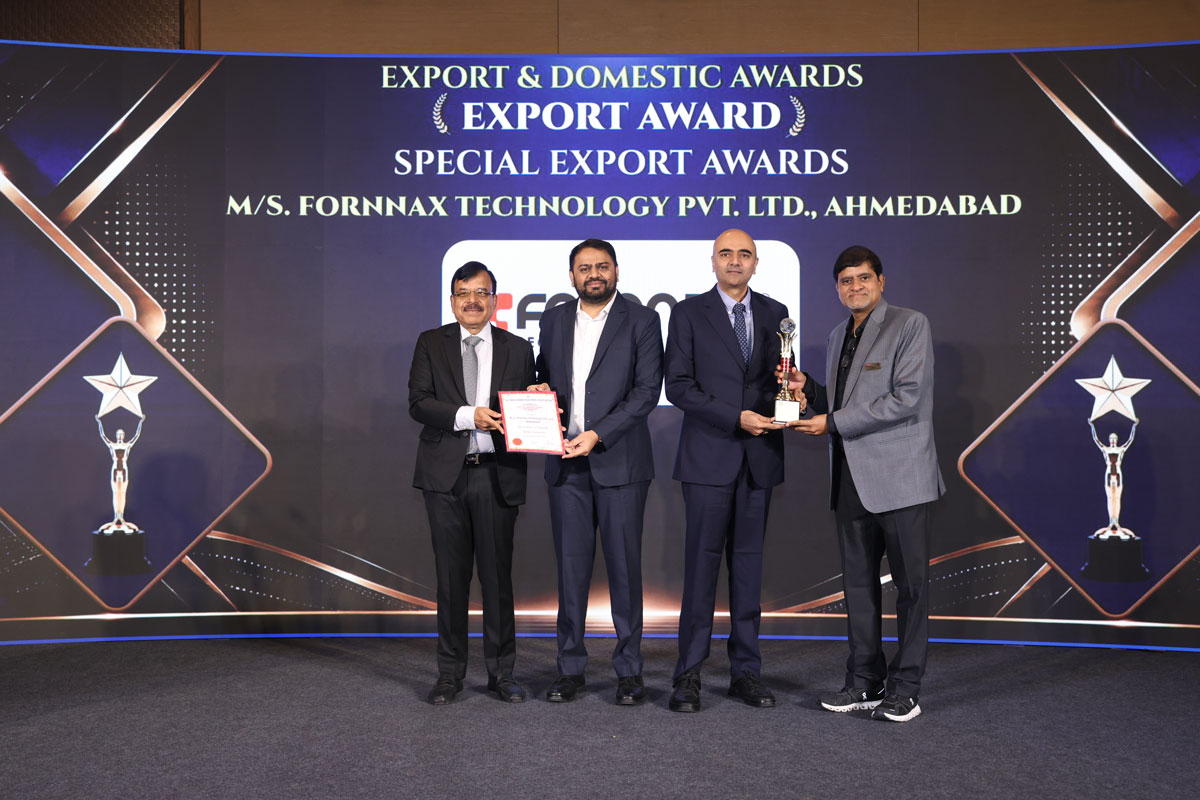
14 Green Innovation of the Year Fornnax Technology
Lifetime Achievement Award
“I am really humbled to be in the company of champions of industry. It’s a true honour! I receive this award on behalf of many people. My former students, my present students, my institute IIT Madras, my colleagues at TLC2, IJS, my friends and, of course, my family. It’s very important for an academic to get recognised by industry. We try to work, to help the industry and when the industry recognises us, it’s truly an honour. I thank the jury. I don’t know how I got nominated but I’m sincerely grateful to the organisers. I am very honoured.”
– Professor Gettu, Winner of ICR Lifetime Achievement Award
Fireside Chat: Driving Infrastructure, Cementing Growth
In this Fireside Chat, Nilesh Narwekar, KVB Reddy, and Pratap Padode discuss the transformational potential of infrastructure development in India, particularly in Mumbai. They highlight the critical role of public-private partnerships, project management, and strategic vision in executing large-scale urban projects. The conversation also addresses challenges in governance, funding, and balancing sustainability with rapid development.
Mumbai, India’s financial nerve center, is in the midst of a massive infrastructure renaissance. In a thought-provoking Fireside Chat, leaders Nilesh Narwekar, CEO, JSW Cement; KVB Reddy, MD & CEO, L&T Metro Rail – Hyderabad, and Pratap Padode, President and Founder, FIRST Construction Council delved into how the city is navigating this transformation and what lies ahead.
From the new coastal road to expanding metro lines, Mumbai’s skyline and subterranean routes are being reimagined. But as the panelists pointed out, infrastructure development isn’t just about laying concrete—it’s about vision, execution, and impact. One of the driving forces behind the progress has been strong leadership and the willingness of administrators to challenge traditional bottlenecks in planning and execution.
However, financing such mega-projects presents its own challenges. The discussion shed light on innovative funding strategies like land value capture and public-private partnerships that are enabling growth without overburdening public coffers. The panel emphasized the need for a shift from civil engineering-centric approaches to project management-led execution to ensure timeliness and efficiency.
Sustainability, too, was a hot topic. With climate resilience becoming critical, the speakers stressed the importance of integrating green solutions and urban design to foster livable, future-ready cities. There’s also a growing recognition that infrastructure must enhance citizen experience—mobility, safety, and convenience are no longer optional.
Ultimately, Mumbai’s infrastructure story is not just about concrete and steel—it’s about redefining how a city lives, breathes, and thrives. With collaborative efforts and visionary thinking, Mumbai could well become a model for urban transformation across the country.
Key Takeaways:
- Mumbai is undergoing an infrastructure transformation with projects like the coastal road and metro rail gaining momentum.
- Innovative financing models, including land value capture and public-private partnerships, are essential for sustainable development.
- Improving mobility through metro systems, integrated transport, and road networks is a top priority.
- Balancing rapid infrastructure growth with environmental sustainability remains a major concern.
- Cities need integrated planning across transportation, housing, utilities, and social infrastructure.
- There’s a need to shift from civil engineering-led to project management-led approaches to boost efficiency.
- The private sector must step up with investment, technology, and expertise to support public efforts.
The 10th Indian Cement Review Conference
The 10th Indian Cement Review Conference included a 360-degree view of the sustainability efforts of the cement industry. The well-curated event had three expert-led panel discussions, one invigorating fireside chat and four informative partner presentations over the span of two days. Here’s a glimpse of the topics of the panel discussions:
Growth has always been instrumental for the Indian cement industry, the second-largest in the world, with the aim to add 80 to 100 million tonnes of cement capacity by the end of 2025. Led by visionaries and thought leaders, the industry is now on a green trajectory as it is speedily moving ahead on the path of sustainability, innovation and expansion. In keeping with its status of being a trailblaser, the 10th Indian Cement Review Conference focussed on the theme of ‘Driving Sustainability Through Technology,’ highlighting the sector’s commitment to decarbonisation, efficiency, and technological advancement. It was held concurrently with the 14th Cement Expo Forum 2025 and the 8th Indian Cement Review Awards, on March 5-6, 2025, in Hyderabad.
The Expo hosted more than 70 companies and welcomed over 1200 visitors, and provided them with a platform to witness the latest innovations, to conduct high-profile networking and to be a part of game-changing strategic discussions. The event catapulted the talk around sustainability to a higher orbit, while providing a platform for industry experts to converge and share ideas.
Panel: Impact of Consolidation and Strategic Realignment in the Cement Industry
As India’s cement sector undergoes rapid consolidation, leading firms are leveraging mergers and acquisitions to enhance market positions and optimise operations. This session examined recent deals, their market impact and strategies for HR, supply chain and marketing during M&As. It also highlighted global trends and lessons for India.
Panel: Technologies for Driving Efficiency
This session explored how automation, digitalisation, AI, robotics, drones and 3D printing are transforming the cement industry. Experts discussed strategies for Industry 4.0, predictive maintenance, OT-IT integration, workforce upskilling and optimising asset utilisation to enhance productivity, safety and operational efficiency.
Panel: Decarbonisation Strategies for Progress
Experts discussed the cement sector’s decarbonisation efforts, focusing on India’s net-zero goals, energy efficiency, waste recycling and low-carbon materials. They highlighted innovations in green cement, renewable energy integration, carbon capture and sustainable logistics, addressing challenges and opportunities in scaling environmentally friendly practices across the value chain.















 Concrete3 weeks ago
 Concrete3 weeks ago
 Concrete4 weeks ago
 Concrete3 weeks ago