Thought leaders of the Indian cement industry gathered together to discuss the efforts towards sustainability and decarbonisation with a laser focus on C.A.S.E – Cost-Efficiency, Automation, Skilling and Energy-Efficiency, at the 8th Indian Cement Review Conference and the 13th Cement Expo, in Hyderabad on 24th February, 2023.
The Indian Cement Review has over the years tracked and applauded the sustainable endeavours undertaken by the cement industry in achieving net zero emissions, through its editorial pieces. So, when it was time for the 8th Indian Cement Review Conference, we decided to widen our lens and look at the multiple parameters that are helping cement manufacturers and allied companies to align their processes to the overall green goals of our country. The resulting confluence of ideas proved to be a gold mine of strategies, solutions and policies that can catapult the industry on the sustainability highway. The presentations and panel discussions by key opinion leaders further highlighted the fact that the Indian cement industry is at the forefront of decarbonising cement, producing green cement and enriching each and every step of the way with C.A.S.E – Cost-Efficiency, Automation, Skilling and Energy-Efficiency.
In this special report, we present to you a synopsis of the ideas exchanged at the 8th Indian Cement Review Conference at Sheraton Hotel, Hyderabad on the 24th of February, 2023. The 13th Cement Expo was also held concurrently with the Conference, along with the Indian Cement Review Awards 2023.
Leading the Way
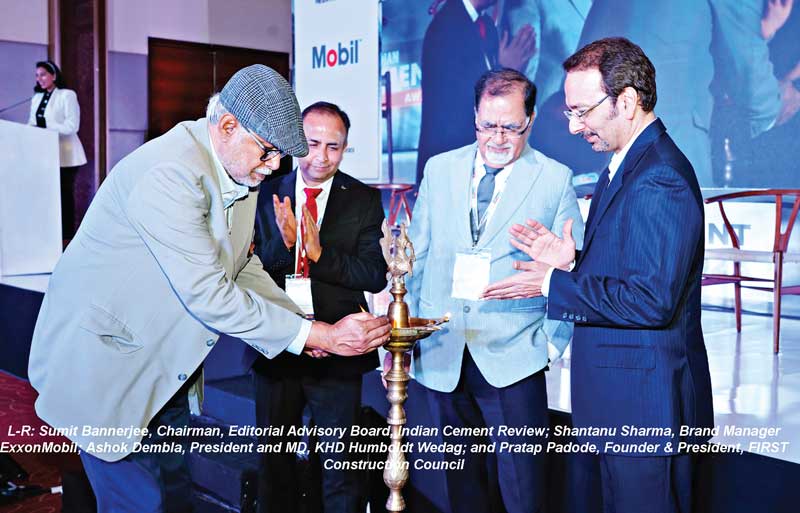
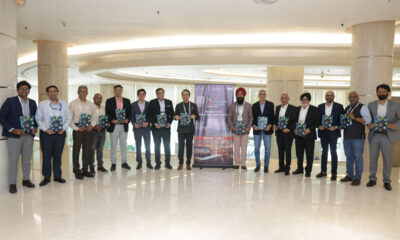
Pratap Padode, Founder & President, FIRST Construction Council, invited Sumit Bannerjee, Chairman, Editorial Advisory Board, Indian Cement Review; Shantanu Sharma, Brand Manager, ExxonMobil; and Ashok Dembla, President and MD, KHD Humboldt Wedag, to start the proceedings of the day with a traditional lamp lighting ceremony and the unveiling of the Indian Cement Review Annual Issue. The collector’s edition focussed on the C.A.S.E for decarbonisation of cement as it encapsulated Cost-Efficiency, Automation, Skilling and Energy-Efficiency while highlighting the latest developments in this sector and discussing impending changes.
Padode went on to welcome the speakers, delegates and exhibitors and encouraged their active participation in the day-long deliberations that were planned around the theme of decarbonising cement. He further summarised the challenges faced by the Indian cement industry as well as the growth opportunities it presented for manufacturers in terms of technological innovation and capacity building. He supported his opinions with statistical findings and his in-depth knowledge about the Indian cement and construction industries. This was followed by Sharma’s welcome speech wherein he underscored the importance of taking assured steps towards sustainability.
Dr Sriharsha Reddy, Director, IMT Hyderabad, took to the dais to deliver the session keynote address on the topic of ‘ESG – Green Financing: A new opportunity for the cement industry.’ He brought to light a number of important issues pertaining to fund procurement through traditional methods and the challenges therein.
The keynote address presented by Dr Mohapatra, DG, NCCBM, was titled ‘Towards Circular Economy and Sustainability.’ He started off with the thought-provoking idea “There’s no waste in India; everything is wealth.” The questions he raised and the ideas he presented were enriched with his decades of experience of working on research, development and analysis of alternative raw materials and renewable fuel for the cement industry. He highlighted the struggles in manufacturing blended cement and the opportunities that are available for its use. Finally, he suggested ways to ensure that each manufacturing plant falls within the gamut of a circular economy.
The C.A.S.E. in Point
The first panel discussion for the day revolved around ‘ESG – Green Financing: A new opportunity for the cement industry.’ The panellists included:
- Moderator: Sudipta Ghosh, Partner, PwC
- Dr BN Mohapatra, DG, NCCBM
- K N Rao, Corporate Head (EHS, AFR, Energy and Sustainability), MY Home Industries
- Manoj Rustgi, EVP & Chief Sustainability and Innovation Officer, JSW Cement
- Manoj Vyas, LEAD – AFR Sourcing and Business Development, VICAT
- Dr Sriharsha Reddy, Director, IMT Hyderabad
- Shantanu Sharma, Brand Manager, ExxonMobil
Key Takeaways
- Cement manufacturing technology has matured due to which the industry has arrived at the current best numbers of 676 kCal per kg clinker and 56 units of power consumption per tonne of cement. Now the biggest challenge is how to go from the lowest average of 300 kg of CO2 per tonne of cement to zero. Breakthrough technologies in carbon capture are required for the industry to achieve this.
- Some of the solutions that are required to address this issue include solar calcination of limestone to get pure form of CO2 and obtaining by-products like methanol or urea.
Only carbon capture is mitigation; it doesn’t have commercial value.
Cement OEM and government need to work together in order to bring out the economic value of carbon capture with the latter bringing in aspects such as carbon labelling, carbon trading and green funds.
- Non-contact grinding and heat recovery from kilns are other aspects that need to be explored to bring Scope 1, 2 and 3 emissions to zero.
Digital transformation will lead us to the next level of our journey of CO2 emissions, sustainability and low carbon footprint.
- Decarbonisation and profitability are not mutually exclusive.
With well-planned processes, the right source of fuel and raw materials and technologically advanced solutions, it is possible for cement companies to thrive and yet be eco-friendly.
Cement manufacturers should look at not only creating economic value but also at ecological value.
- Putting in green processes requires finance. Traditional lending institutions like banks evaluate how these changes would reflect on the topline or would result in net profit or bottomline or will it be able to service the debt. RBI has enlarged the scheme of purity sector lending, which includes green initiatives.
- The main challenge in bank lending is long term loans as green initiatives have a long term payback.
- Other lending institutions include venture capitalists, government grants and bilateral or multilateral financial institutional grants.
- Saurabh Palsania, Executive Director and Group Commercial Head, Dalmia Cement (Bharat), who joined in virtually, made the keynote address around the theme of carbon capture and its benefits for the cement manufacturers. He underscored the need to implement innovative technology and most importantly a proper strategy, in order to revolutionise the efforts towards net zero emissions. Carbon capture, utilisation and storage (CCUS) is an investment-intensive process that also requires a commitment of time and labour. Keeping all these factors in mind, cement companies need to chart out an effective strategy to incorporate CCUS into their eco systems, ensure purity of the captured carbon and channel it towards predetermined activities for its optimum utility.
Towards Digitalisation
The Cement Leaders’ Roundtable was about ‘Demystifying digitalisation and maximising the value chain impact.’ The panellists included:
- Moderator: Madhav Vemuri, Industry Digital Transformation Entrepreneur
- Ashok Dembla, President and MD, KHD Humboldt Wedag
- Ganesh Jirkuntwar, Executive Director and Head Manufacturing, Dalmia Cement
- Subhasis Chattopadhyay, Head – Projects, Birla Corporation
- Karthick Raja, Chief Information Officer, Orient Cement
- SS Luthra, Global Cement Digital, ABB
- Vishal Bhargava, Associate Director, Global Industries, IBM
Key Takeaways
- Digital tools are mandatory as digitalisation will help optimise all stages of cement production.
- Industry 4.0 gives tools that will help in determining the desired product quality.
- ESG is mandatory but digitisation will help improve the processes.
- Cloud based platform and transparency is very important.
- Automation at the plant is vital.
- Without being profitable, we cannot be sustainable.
The last topic of the day was ‘Innovative Supply Chain Strategies in the Cement Industry.’ Gaurav Gautam, Head of Sales, Beumer Group, made a presentation on the topic, which highlighted the innovations in material handling systems that they are undertaking in order to make the movement of finished products smoother along the supply chain. They specialise in tailor-made intralogistics solutions that help maximise productivity of cement companies.
This was followed by the panel discussion. The panellists included:
- Moderator: Raveen Reddy, Chief Administrative Officer – Systems, Indian Railways
- Praveen Garg, Sr VP – Logistics and Energy Sourcing, VICAT
- Vaibhav Agarwal, Research Analyst, PhilipCapital
Key Takeaways
- Innovation in first and last mile connectivity is crucial to cost efficiency.
- Logistics should be looked at not as a commercial function but as a technology function.
- If logistics is based on technology, we will be able to drive the supply chain in a much better way. Therefore, investment in technology is important.
- To correctly evaluate the processes, cement manufacturers need to look at them not from a cost perspective but from a revenue angle.
- The only differentiator a cement company can have today is not cost or quality but logistics.
- Non-renewable sources of energy need to be explored to address the energy demand for distribution.
- Automation is the key for future solutions in logistics.
Each panel discussion was followed by a Q&A round, which witnessed active participation from the members of the audience. The fact that the panels were thought-provoking was evident in the way the audience was engaged in discussions even during the networking breaks.
Apart from the panel discussions, the Conference also included presentations by industry experts. The presentation partners were as follows:
- Jayesh Patil, Assistant Manager, Flow Aids, Martin Engineering
- Nischal Basavaraj, Regional Head – South, Liugong India
- Sasi M Kumar, Business Development Manager – Cement, ExxonMobil
- S Chakravarti, Managing Director, Ecodea Projects and Control
The conference also saw the unveiling of the annual issue of the Indian Cement Review, which focussed on C.A.S.E – Cost-Efficiency, Automation, Skilling and Energy-Efficiency. It ended with a vote of thanks to all the participating speakers and attending delegates.
The day, however, was far from over as it was time for the Indian Cement Review Awards 2023.
The Conference was well-supported by the industry and we had collaborations with key brands.
Presenting Partner
ExxonMobil Lubricants Private Limited
Gold Sponsor
JK Cement Limited
PhillipCapital India Pvt Ltd
Silver Sponsor
LiuGong India Pvt Ltd
Associate Sponsor
Humboldt Wedag India Pvt Ltd
Presentation Partners
Martin Engineering Company India Pvt. Ltd.
Beumer India Pvt Ltd
Ecodea Projects & Control Private Limited
Logo Sponsor
Stotz Gears Private Limited
Exhibiting Partners
Toshniwal Industries Pvt. Ltd.
TIDC Limited (Murugappa Group)
Ringfeder Power Transmission India Pvt. Ltd.