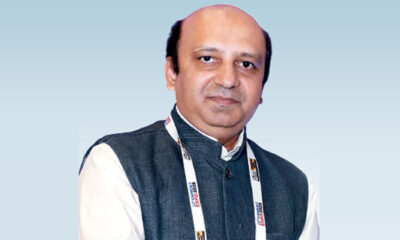
Jim O’Brien, CSR Consultant and Convenor of Global Aggregates Information Network (GAIN), evaluates how far the industry has come with the efforts to decarbonise cement and to have a positive impact on the environment as he places India’s performance on the spectrum of the international cement industry.
The cement industry is responsible for approximately 8 per cent of emissions globally. What are the key factors the industry must be looking into to reduce this?
Yes, the cement industry is responsible for around 8 per cent of the global CO2 emissions, and it is taking very active steps to reduce that footprint. In parallel, it must be realised that cement is an essential building material for a rapidly-developing modern society like India. Cement, aggregates, and concrete are essential to building the much-needed infrastructure and housing for what is now the most populous and rapidly-developing region in the world. Those concrete structures will gradually absorb much of the CO2 emitted during the cement production, and enable adaptation to whatever changes in climate may occur in the decades ahead. That wider perspective needs to be understood.
What is your outlook about India’s decarbonisation scenario? How is the country faring vis-a-vis other countries in the West?
Even though India pledged to reach Net Zero by 2070, its cement industry is forging ahead on a decarbonisation path to reach that goal by 2050 – or even earlier. In the analysis based on their 2021 sustainability reports, the top Indian players like Ultratech, Shree and Dalmia, demonstrably lead the world in process parameters like:
- Achieving best kiln thermal efficiencies, approaching as low as 3000MJ/tonne clinker, against an industry average of around 3500MJ/tonne clinker.
- Achieving best specific net CO2 emissions, now in the region of only 500kgCO2 /tonne cementitious product, against an industry average in the region of 600kg/CO2 /tonne.
- Achieving reduction in specific net CO2 emissions by over 40 per cent compared to their levels in 1990, which are world-leading performances, of which the Indian cement industry can be truly proud.
- These world-leading trends witness the major past and ongoing investments in modern kiln technology in India, in turn motivated the rapidly growing market and buoyant economic outlook for at least this decade.
Tell us more about the impact of alternative fuels and raw materials on the energy efficiency of the cement industry.
There are surprisingly contrasting results for the Indian players in this area:
- The use of alternative fuels in India is amongst the lowest in the world, amounting to only a few per cent of thermal substitution; this is probably because waste legislation is not yet as advanced in India as it is in Europe, where, for example, kilns often use up to nearly 100 per cent of the alternative fuels.
- These alternative fuels bring two distinct advantages. Firstly, use of these fuels (or at least the biomass component thereof) allows credits in the calculation of net CO2 emissions. Secondly, these fuels are cheaper, the more hazardous ones coming even with a negative cost, with significant commercial benefit.
- The use of alternative materials in India is, on the other hand, amongst the highest in the world, ranging from 20 per cent to 40 per cent substitution, allowing very low clinker/cement ratios approaching 60 per cent; this is viable through the plentiful availability of puzzolans, slags and fly-ashes in India compared to Europe.
- The high use of alternative materials and consequent low clinker/cement ratios in India not only greatly reduces the net specific CO2 emissions, but also reduces the volume of limestone needed to produce cement, an important factor in India.
How can technology and automation contribute towards building a sustainable environment?
The leading Indian players are also technology leaders in:
- Highly efficient electrical energy consumption in the region of 70-80kWh/tonne cement, compared to the international average of around 100kWh/tonne, in India achieved through advanced grinding technology, probably also helped by the less demanding cement fineness required.
- The extensive investment in waste heat recovery systems, plus the move to renewable energy, in particular through solar installations, all of which help to reduce Scope 2 CO2 emissions.
- Automation is clearly key to optimising all processes both within and beyond the cement plant, and the latter can help in reducing Scope 3 transport emissions of both incoming raw materials and outgoing products.
- In the Indian context, what would be the best practices to follow to ensure a sustainable environment?
- There is much more to sustainability performance than CO2 emissions; the larger Indian players also feature prominently in other aspects.
- In air emissions, they laudably achieve particulate emissions less than 40g/tonne clinker, NOx less 1000g/tonne clinker and SOx less 100g/tonne clinker, all well below industry averages, but do not yet report on minor air emissions.
- Because of water scarcity in India, the larger players are highly focused on water use optimisation, achieving as low as 84 litres/tonne of cement, way below the industry average of around 300 litres/tonne; the major players pride themselves in being many times water-positive through rainwater harvesting.
- The Indian players are highly conscious of waste reduction and re-use, one reporting itself as ‘plastic-positive’, their high use of alternative materials indeed puts them amongst the biggest recyclers in any industry.
- As part of their ‘licence to operate from society’, the leading players have restoration plans for all their quarries, several with replanting programmes and biodiversity monitoring action plans where appropriate.
How can organisations overcome the challenges of maintaining a healthy and sustainable environment?
A number of relevant social indicators can be cited:
Like the cement industry globally, the Indian industry has a strong focus on occupational health and safety.
- However, a number of fatalities to employees, contractors and third parties were reported amongst the Indian players in 2021; while the industry has achieved major improvement in fatality reduction over the last decade, the only acceptable figure is zero.
- Indian employee accident rates are extremely low, as also are contractor rates, bearing witness to the strong operational focus on those key areas.
- In terms of training, the Indian figures of 10-20 hours of training per employee per year are at or below the industry average of 20 hours, though many international players now have from 30 to 90 hours per employee per year.
- Employee turnover rates in the Indian companies tend to be in the region of 6 per cent to 8 per cent, below the industry average of 12 per cent, indicating long-term employee loyalty in the Indian companies.
- The employee age profiles in the Indian companies tend to be about 10 per cent below the age of 30, with 70 per cent between the ages of 30 and 50, with 20 per cent over 50, the average employee age being less than industry average, which bodes well for the future; however, the Indian companies have typically less than 5 per cent female employees, much lower than the industry average of 12 per cent.
- Indian companies have world-leading programmes in terms of vital support to local communities in education (particularly for women), medical facilities, provision and clean water and sanitation; these witness the Indian cement industry’s huge dedication to the broader social needs of Indian society.
How do you envision the future of a sustainable environment in relation to the cement and building materials sector?
As demonstrated, the Indian cement industry is achieving an exemplary performance within the context of its cement plants and surrounding communities. So far, the Indian industry has in general little downward integration into concrete and aggregates, as is much more common in Europe and other developed regions. Accordingly, both the aggregates and concrete sectors are less developed in India compared to other countries, and could, I suggest, benefit in terms of broader synergistic, sustainability, quality and reputational terms through greater involvement of the cement industry.
The Indian cement industry, in the broadest sense, I believe, is all about delivering the most sustainable solutions in housing, infrastructure, transport and well-being to its society of 1.4 billion people; they deserve and rightly expect a happy, secure, prosperous, and sustainable future in the world’s fastest growing major regional economy. Accordingly, the opportunities for ambitious Indian entrepreneurial companies in further developing its cement, concrete and aggregates industries are immense.
–Kanika Mathur