

Concrete
Increasing productivity

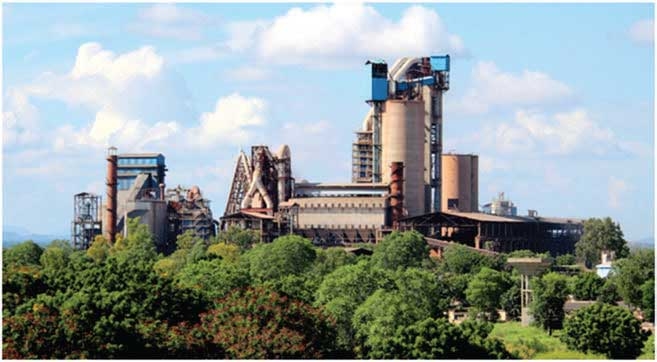
UCWL’s trials and use of grinding aids have been focused on towards increasing strength and output.
UCWL’s trials and use of grinding aids have been focused on towards increasing strength and output. The company believes that cement companies embracing the power of analytics and Industry 4.0 will earn a competitive advantage and build resilience.
Cement is the key material that is institutional to any future vision for growth and development of a nation. Being the second largest cement industry in the world, Indian cement industry stands at around total installed capacity of around 550 million tonne. It is one of the eight core manufacturing sectors that are considered by government for analysis of the Index of Industrial Production (IIP) of the country.
As India has a good quantity and quality of limestone deposits throughout the country, it provides for huge potential of growth in the cement industry w.r.t the growing demand in building infrastructure of the country. It is one of the most energy efficient industry around the world. According to National Council for Cement and Building Materials (NCBM), about 99 percent of capacity in the industry in India, based on latest dry technology and has state of art grinding systems installed with higher capacities and efficiency.
By the start of third quarter – FY 2022, as the Nation reached the 100 billion mark of vaccination coverage across the country, more confidence has been observed in the market w.r.t the demand of cement. Earlier, upon re-opening of markets, demand was mostly driven by state government projects in areas such as schools, roads and affordable housing and tier 1 and tier 2 cities. Now with the restart of infrastructure projects this growing consumption of cement can led to the pent-up demand translating into higher utilisations of capacities.
However, the only major issue at present is trend of rising prices of fuel since last two quarters, that have translated into serious concern for the cement manufacturers. The fuel related concern that has arisen out of multiple issue factoring in like, rising prices of crude oil in the international markets, non-timely payments in the supply chain systems that includes state governments, discoms and power generators, etc. This has a direct impact on the operating leverages of the energy intensive industries, resulting in increase in production cost of cement that is yet could not be successfully transferred to the consumer. Some other impacts of the rising fuel scenario include-factors like, increase in freight charges and cost of electricity.
At Udaipur Cement Works (UCWL), we have been exploring options through optimising process to maximum possible levels. In addition to conventional methodology of improving operational efficiencies we are also working on other key levers of cost like logistics and especially inventory management systems such as – just in time (JIT) along with material requirement planning and day sale inventory, etc. that allows company to save significant amounts of money and reduce wastage by keeping only the inventory they need to produce and sell products. This approach reduces storage and insurance costs, as well as the cost of liquidating or discarding excess inventory, however the system comes with a risk.
Cement Grinding
Operational Understanding
Cement grinding is the second to last major stage in the process of cement manufacturing, where the feed materials are reduced in size from several centimetres in diameter, down to less than 100 microns. This is accomplished by grinding, with the use of milling machines and equipment setup, such as ball mills, vertical roller mills, roller press mills, etc. The present system of cement grinding has become quite efficient, especially in terms of energy consumed and productivity. The energy, consumption per ton of cement product grinding is based on various factors, such as –
- Type of grinding technology installed (ball mill, roller mill or roller press, etc.),
- Process control parameters like Filling of ball mill chambers, piece weights for VRPM and roller press, mill inlet draft, energy consumption by separator fans, separator efficiency, bag filter energy consumption, etc.
- Quality of material feed- chemical composition of clinker, hardness of clinker, fineness of blended materials, moisture content in the material, etc.
We at UCWL have focused diligently on our cement grinding process, with specific optimisation of process parameters along with energy consumption. Our specific energy consumption w.r.t cement grinding for blended cement stands better than the industry average.
Economic Understanding
Large integrated cement plants are established near the limestone reserves, which is the key raw material. But these reserves are localised to certain regions across the country’s geographical area. Hence in view of tapping on the demand of cement in different locations other than the cement manufacturing clusters, the concept of standalone grinding came into existence. Cement griding being independent of the clinker manufacturing process, provides flexibility of setting up grinding units anywhere, subject to the overall cost benefit analysis. The only dependency it has is in terms of major raw material i.e. clinker., which is met through supplying clinker from integrated unit via rail or road. So, most of the grinding units are strategically set up near a major cement consumption centre to capture the market demand, factoring in the basic key aspects like-
- Maximum market coverage.
- Quick and fast absorption of demand.
- Reasonable vicinity to source of blending materials like fly ash, slag, gypsum, etc.
- Increasing footprint of the company.
Drivers of cement grinding process
Grinding Technology
At UCWL, we understand the crucial science behind quality cement and concrete. The most important properties of cement, such as strength and workability, are affected by its specific surface fineness and particle-size distribution. These can be modified to some extent by the equipment used in the grinding circuit, particularly type of separator. including its configuration and control.
Considering grinding technology, at present there are various technologies available. The most common and widely used is Ball mill. Ball mills were first introduced way back in the1860’s, the main progress was made during the 1870’s to 1900’s in Europe (Germany), where the growing cement manufacturing and other industries demanded for finer grinding equipment and machines. Present Ball mill is a horizontal cylinder that’s partially filled with high-chrome steel balls (generally called grinding media) of suitable dimensions that rotates on its axis imparting a tumbling and cascading action to the grinding media. Material is fed through the mill inlet and initially crushed by impact forces and then ground finer by attrition (chipping and abrasion) forces between the balls.
Another efficient technology based on size reduction of many particles by compression of the particle bed using high pressure grinding rollers, were introduced in late 1970s and early 1980’s. Being implemented as pre-crusher and installed with ball mill close circuit and high efficiency separators made them high output and low energy consuming setup.
In addition to the ball mills and roller mills, another basic grinding method is use of high-pressure grinding rolls (HPGR). The material between the rolls is submitted to a very high pressure ranging from 100 to 200 MPa, griding the material by developing cracks. The comminution efficiency of a HPGR is considered better than ball mills such that it consumes only 30–50 percent of the specific energy as compared to a ball mill and is generally used as pre-grinder mill with ball mill closed circuit.
Grinding aids
The most significant development for the cement industry in view of grinding, started way back in year 1931, when an attempt was made in United States to mix carbon black in concrete to make a darker middle lane on US route 1, in Avon for passing*.
Since then, there have been various studies that has led to successful implementation of Grinding additives in the cement grinding for different purposes, such as- optimising and increasing productivity through mills, increasing strength of cement product, etc. The working of grinding aids includes principles such as- preventing agglomeration of cement particles caused by development of electrostatic charge, increasing reactivity through formation of complex, reducing surface energy of clinker, etc.
Grinding aids are common cement additives. They generally consist of several different types of compounds such as glycols, alkanolamines, or phenolic compounds. They are fed into the grinding mill mostly along with the material feed. Based on its type they are both solid and liquid in nature. In cement Industry they are mostly liquid and sprayed or poured over the feeding belt of grinding mills for better effectiveness.
At UCWL, being committed to our agenda of continual improvement and delivering research based superior quality product to our customers, we have been continuously conducting trials with multiple grinding aids. The methodology of adding grinding aids in grinding mills starts with defined objective and planned route of action, such as:
Step -1 Identifying objective for use of griding aid
Step -2 Lab based trials of Grinding aids
Step -3 Operational grinding mill trials of grinding aids
Steps-4 Cost based analysis in view of realisation of objective
Step-5 Continuation or Discontinuation of the griding additive under trial
UCWL’s trials and use of grinding aids have been focused on towards increasing strength and output. For which we conducted multiple trials as per our defined methodology. Details of some of the recent major trails conducted are given in the table below:
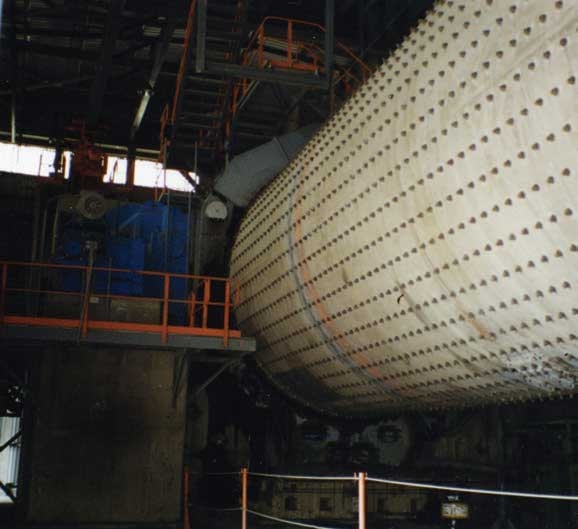
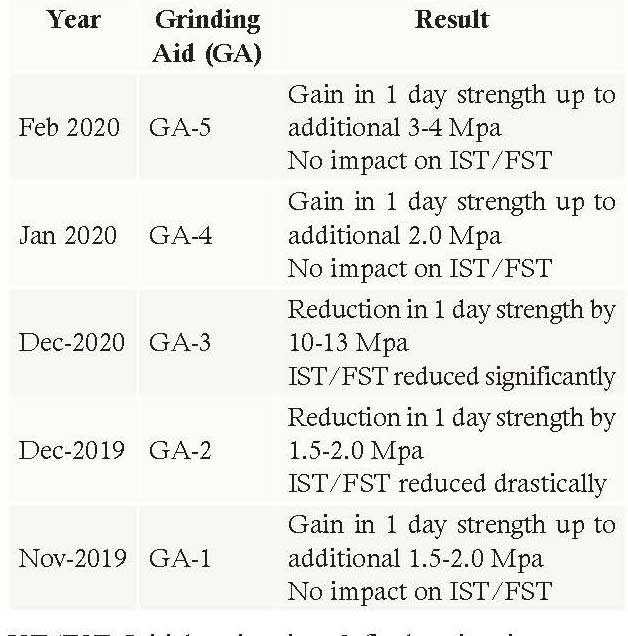
Mpa- Megapascal
The basic key parameters that were analysed as per the set objective were – One day strength, effect on IST/FST and workability, etc.
It is hence concluded by the trials that different types of grinding aids behave differently in each set of provided conditions, that includes the process parameters and most importantly the chemical and physical quality the raw materials fed. To our defined objective of increasing strength, certain grinding additives proved to be efficient. And however, some gave surprisingly opposite results of what was expected.
Indian cement industry has been using the grinding aids for different purposes over last many years. The aid not only helps to achieve the desired objectives but also leads to increase productivity, reducing energy consumption in grinding, lower maintenance of machines and equipment in the grinding circuit, etc.
Role of Analytics and AI/ML (Artificial Intelligence/Machine Learning)
Technology embedded in ESG (environment, social and governance) related aspect for cement sector is the key to future of manufacturing, especially cement grinding. Cement grinding is the most sought section by the analytical agencies after the clinkerisation process in cement industry that allow better control and optimisation for gaining maximum efficiency.
Clinker grinding includes large share of the electrical energy consumed in a plant; hence the efficiency of grinding operations has a big influence on overall energy as well as product costs. Advanced process controls, fuelled with AI/ML powered by analytics and supported by grinding aids can optimise the grinding circuit to increase throughput and secure consistent output quality, while also lowering energy consumption.
Cement companies embracing the power of Analytics and the world of Industry 4.0, will no doubt earn a competitive advantage and build resilience.
Aspects such as deeper analysis of feeding rate w.r.t the quality of feed to grinding mill that in turn synchronised with further grinding circuit such as operation of bag house, classifier reject, regulating dosage of grinding aids, etc. need to be undertaken for improving system efficiencies. Advanced mathematical modelling based on AI/ML shall be incorporated to achieve the best results out of the established milling circuit.
With the optimistic projections of increasing demand in future, the cement sector eyes for a growth on sustainable fronts, maintaining its status as one of the most energy and resource efficient industry in its sector around the world using various measures including use of grinding aids.
ABOUT THE AUTHORS:
Naveen K. Sharma (Whole-time Director), Tushar Khandhadia (GM Production), Jitesh Singh Darmwal (Manager Sustainability), Manish Samdani (Asst. Manager-QC) from Udaipur Cement Works.

Concrete
Cement Prices Likely to Rise Rs. 10-15 per Bag from Mid-October
Input costs and steady demand may drive cement price increases
Concrete
Nuvoco Marks 10 Years, Targets 35 MMTPA Capacity by FY28
Nuvoco celebrates a decade of growth, targeting 35 MMTPA cement capacity by FY28.

Concrete
J&K Government Notifies City Gas Distribution Policy
Policy targets PNG and CNG expansion across all 20 districts


Cement Prices Likely to Rise Rs. 10-15 per Bag from Mid-October

Nuvoco Marks 10 Years, Targets 35 MMTPA Capacity by FY28

J&K Government Notifies City Gas Distribution Policy

JSW Cement Commissions 1 MTPA Grinding Unit at Nagaur

JSW Cement Commissions 1 MTPA Unit in Rajasthan
Cement Prices Likely to Rise Rs. 10-15 per Bag from Mid-October
Nuvoco Marks 10 Years, Targets 35 MMTPA Capacity by FY28
J&K Government Notifies City Gas Distribution Policy
JSW Cement Commissions 1 MTPA Grinding Unit at Nagaur
JSW Cement Commissions 1 MTPA Unit in Rajasthan
-

 Concrete3 weeks ago
JSW Cement Receives Rs. 2.3 bn GST Demand Notice
-

 Concrete3 weeks ago
Andhra Pradesh Clears Rs. 30 bn My Home Cement Plant
-

 Concrete4 weeks ago
Jammu Division Begins First Cement Rail Traffic to Anantnag
-

 Concrete3 weeks ago
Montra Electric, Wonder Cement Deploy 250-Vehicle EV Fleet