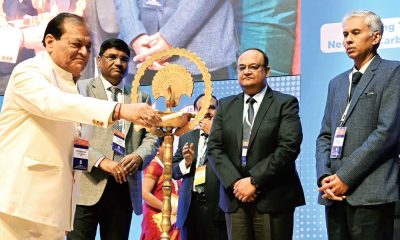
NCB’s ’15th International Seminar on Cement, Concrete and Building Materials’witnessed nearly 1,000 delegates congregate in New Delhi to deliberate on cement, concrete and construction technologies. Stakeholders opined that India had what it would take to assume a leadership role in the global cement business.
It was half past nine in the morning and long queues had already formed at all the registration counters in New Delhi’s sprawling Manekshaw Centre. The waiting crowd, which was growing in numbers with each passing minute, patiently waited to register itself for the biennial National Council for Cement and Building Materials’ – better known by its acronym NCB – ’15th International Seminar on Cement, Concrete and Building Materials’.
Sometime this year, India would overtake the UK and France to become the world’s fifth largest economy in dollar terms, data released by the Centre for Economics and Business Research (CEBR) has predicted. In the past couple of years, the country is back in the reckoning as one of the principle emerging powerhouses of the global economy. But even then, it is rare to come across such overwhelming response to an event catering to a highly-specialised industry.
NCB, the country’s apex body for research, technology development and transfer, education and industrial services in cement, allied building materials and construction industries, started the initiative as early as 1986. Over the years, it has emerged as an important event in South and South-East Asia, attracting a diverse range of stakeholders from the cement and construction space. The four-day seminar was held in the second week of December 2017.
"The objective of this event, eagerly awaited by the industry and the academia alike, is to bring together the captains of the industry and engineering community, on to a common platform for sharing the knowledge on latest innovations and taking India’s growth story forward," noted Ashutosh Saxena, Director General (Acting), NCB.
Notable developments in the areas of Alternate Fuels and Raw Materials (AFRM), climate change, emissions control, Clean Development Mechanism (CDM), ready mix concrete, nanotechnology, etc., were thoroughly discussed. A technical exhibition held simultaneously complemented the forum by providing ready insights into the latest in available technologies and services for efficient operation of cement plants, preparation of concrete and construction activities. A total of 86 firms showcased a diverse range of products and services in automation, instrumentation, grinding, pyro processing, coolers, AFRM utilisation and quality control.
A variety of topics ranging from manpower planning, use of raw materials and AFRM and latest developments in equipment technology were covered at the seminar. Two special technical sessions were also organised. The first, on the subject of ‘Formation and Control of Dioxins in Dry Pre-heater or Pre-calciner Kilns Co-Processing Wastes’, was addressed by the world-renowned expert on pollution and waste management, Dr Kare Helge Karstensen of the Foundation for Scientific and Industrial Research (SINTEF), Norway. Dr Karstensen spoke about the formation and control of dioxins in pre-heater and pre-calciner kilns burning waste materials. The second technical session was a panel discussion on ‘Low Carbon Transitions for the Cement and Concrete Sector, a Global Partnership Approach’. It was moderated by Philippe Fonta, Managing Director, Cement Sustainability Initiative, World Business Council for Sustainable Development (WBCSD). Speakers included Sanjay Jain, AED, Dalmia Cement (Bharat) Ltd, Sivaram Krishnamoorthy, International Finance Corporation (IFC), South Asia and Berthold Kren, Head, Geocycle India. The panel deliberated on means to reduce the industry’s carbon footprint.
This edition saw participation by nearly 1,000 delegates. INDIAN CEMENT REVIEW has learned that over 10 per cent of the delegates were from abroad. The nearly 200 papers presented in the 25 technical sessions at the seminar touched upon new research and innovations in cement, concrete and construction technologies. Over the years, the event has also become the primary platform for the Indian cement industry to discuss recent developments, identify new areas of research, and brainstorm on developing and emerging trends.
Most delegates sounded very satisfied with the event. Rakesh Sharma, Director, AMCL Machinery Ltd, said, "The NCB provides an interesting forum for people from across the cement industry to converge in one place. The opportunity to see the latest developments leaves you wiser at the end of the day." Rajesh Pathak, Director, Sales & Operations, Raymond Bartlett Snow opined, "It makes sense to come here and interact not only with your peers but also potential customers. One also gets to experience firsthand the latest technical knowhow available in the market. It’s an excellent opportunity to share ideas as well as learn from entrepreneurs from all over the globe."
Poised for significant expansion
Today, India is the world’s second largest producer of cement. As per the Government’s Department of Industrial Policy and Promotion (DIPP) and analytics agency CRISIL data, the total installed production capacity for cement in the country stood at over 435 million tonnes (MT), in June 2017. The industry presently produces 280 MT for meeting the domestic demand and 5 MT for export. Even while agreeing that reduced capacity utilisation was affecting the overall efficiency of the production process, NCB’s Saxena emphasised, "The present government is trying to do a lot for development of the housing sector and infrastructure. Therefore, I am very optimistic that within the next six months to one year, the cement industry will get back on course."
The federal Government’s emphasis on infrastructure projects such as focus on affordable housing, construction of roads and highways, development of 100 Smart Cities, interlinking of 60 rivers and development of inland waterways is expected to help the industry grow between 6 to 7 per cent in the 2017-18 fiscal.
The country’s per capita consumption stands at around 225 kg. The domestic consumption of cement is likely to exceed supply over the next three years. The cement industry is expected to grow at a CAGR of 5 to 6 per cent between financial year 2017-20. Moreover, the sector also plays an important role in job creation as it employs over a million people directly or indirectly.
Industry insiders point out the fact that the Indian cement industry is very proactive in adopting new technologies that provides it with a huge advantage over competition. Sunil Potdar, Managing Director, Schenck Process Solutions India Pvt Ltd, said, "From our perspective, cement plants in India are run very efficiently and that happens by virtue of the entrepreneurs being technically very savvy, with a lot of them directly involved in technical decision making, which ultimately works to their benefit."
Observed Thomas C Dannemiller, CEO, SABIA, "India is key because it is next to China as the biggest market. India, if it chose to, could export cement. And India is the place where we could learn to stand up to China. In order to do that we need to modernise the Indian cement industry." He urged the industry to aggressively imbibe IT, big data analytics and artificial intelligence if it wanted to attain to the top spot.
At 67 per cent, the housing sector consumes the lion’s share of cement produced in the country. Infrastructure (13 per cent), commercial construction (11 per cent), and industrial construction (9 per cent), are the other major consumers of the commodity. Moreover, with an expenditure of around $427 billion, India is the fourth largest construction market globally. A joint report by KPMG and real estate body National Real Estate Development Council (NAREDCO) has said that the country would climb to the third spot by 2030.
According to the Indian Brand Equity Foundation (IBEF), a trust managed by the Department of Commerce, India’s leading 20 cement manufacturers account for almost 70 per cent of its total production. Interestingly, 188 large cement plants alone account for 97 per cent of the country’s total installed capacity, while 365 small plants account for the rest. Of these large cement plants, 77 are located in the states of Andhra Pradesh, Rajasthan and Tamil Nadu.
Foreign fund inflow for manufacturing of cement and gypsum products reached $5.24 billion between April 2000 and June 2017, reveals government data. The FDI inflows in cement and gypsum product sector increased significantly from $19.69 million during 2015-16 to $2130 million during 2016-17. Ready availability of raw materials and limestone makes the country further attractive to overseas investors.
Experts aver that in the coming years, India’s eastern states could drive the demand for cement. They also believe that over the next 10 years, India could become the main exporter of cement to developing economies.
Further, the impending growth holds an opportunity for homegrown equipment makers. Affirmed Mayank D Kamdar, Marketing Director, Lilanand Magnesites Pvt Ltd, "In terms of opportunities, as many new cement plants have come up, and several more are in the pipeline, this offers a good opportunity for refractory manufacturers to introduce more efficient products. Since China’s output has been declining internationally, it’s a good time for the Indian refractory manufactures to start exporting." He felt that the Indian equipment makers have the potential to become major global players.
Key challenges persist
In August 2017, tropical cyclone Hurricane Harvey resulted in production shutdowns at oil and gas refineries in the US, with in turn also hit pet coke supplies. Since several Indian cement firms rely on imported pet coke, they ended up paying more for it and this was reflected in their second quarter results for the 2017-18 fiscal. Moreover, cement manufacturers are apprehensive that if the present surge in global crude oil continues, it could result in further hardening of pet coke prices. Some manufacturers had to shell out more towards raw material costs after a sharp increase in slag prices. Meanwhile, freight costs have also risen due to higher diesel prices.
In October last year, the Supreme Court banned use of pet coke and furnace oil in Uttar Pradesh, Haryana and Rajasthan in view of the spike in pollution levels in the National Capital Region (NCR). However, in December, the apex court gave relief to industries like cement, lime stone and thermal power plants by permitting the federal government to modify the ban notification. The court also asked states and union territories to consider a ban on pet coke.
Reacting to the calls an embargo on pet coke use, Saxena said, "Refineries within Indian and world over generate huge quantities of pet coke and other waste materials. The cement industry has upgraded technology and its operational skills to utilise even the low volatile content pet coke with several benefits. There is a substantial saving in coal consumption as it is directly substituted by pet coke." He added that because of the low ash content in pet coke, the cement industry could utilise low grade limestone. Similarly, the fear that that pet coke burnt in boilers releases lot of sulphur into the atmosphere, was unfounded as the intrinsic chemistry of the process ensured that a substantial portion of the sulphur present in pet coke reacted with the calcium carbonate content of the limestone to convert it into calcium sulfate or gypsum. "As for the release of sulphur dioxide, there are wet scrubber and other technologies available to take care of the emission," said Saxena.
Adequate utilisation of AFRM is another challenger before the industry. Speaking to the magazine on the sidelines of the event, Ashok Kumar Dembla, President and Managing Director, Customer Service Center India, KHD Humboldt Wedag International, strongly recommended that materials such as stubble burnt by farmers in large parts of Punjab and Haryana could instead be used as fuel in cement kilns with proper regulatory support. Similarly, preparation of municipal and chemical waste could also go a long way in reducing the industry’s dependence on coal. "Several European countries use 60 per cent of waste materials as fuel. But in India, on an average, it is not more than 10 per cent. There are bottlenecks in terms of handling, government support and interest from entities that generate waste," rued Dembla.
But using AFRM requires manufacturers to put appropriate systems in place. Advised Sunil Kumbhar, Manager Projects, ATS Conveyors India Pvt Ltd, "Cement manufacturers want an assured supply of fuel. However, since you cannot rely on a single source if you are using AFRM, one must be flexible about accepting all alternatives and prepare the cement plant accordingly."
Stakeholders point out that despite the government giving certain relaxation to cement manufacturers on environmental guidelines, they were presently in a quandary on the level of expenditure they could incur on their expansion plans, even while incorporating the best possible environment-friendly technologies. "They are also trying to convince the government to move slowly while implementing stringent environmental norms, because they are facing problems of higher production costs and improving overall sales," said Dembla.
Due to the increasing demand in various sectors, the Indian cement industry is expected to reach 550-600 million tonnes per annum (MTPA) by the year 2025. But industry insiders believe that with restoration of the growth momentum in the economy, the sector might do even better. Echoing this sentiment, Mogen Fons, Managing Director, FONS Technology, remarked, "For several years I’d been repeatedly telling myself that the Indian market will surely pick up the following year before I stopped doing that. Now I say that though the boom here won’t be like what we saw ten years ago in China, it is certainly coming!"
– MANISH PANT
















 Concrete3 weeks ago
 Concrete3 weeks ago
 Concrete4 weeks ago
 Concrete3 weeks ago