The 17th NCB International Conference on Cement, Concrete and Building Materials focussed on important aspects such as circular economy, sustainability, net zero and enhancing the use of alternative fuels for the Indian cement industry.
“The conference has given an opportunity for the industry to exchange thoughts and learnings through panel discussions and networking,” said Dr BN Mohapatra, DG-NCB.
The 17th International Conference on Cement, Concrete and Building Materials by the National Council for Cement and Building Materials (NCB) was held at Manekshaw Centre, Parade Road, New Delhi, from 6th to 9th December, 2022. Around 1,100 delegates attended the conference, which included 48 foreign delegates from 11 countries. During the span of the four-day event, 160 presentations were made in 20 technical sessions; 4 panel discussions were held, covering key topics of concerns for the industry; and speeches were delivered by keynote speakers.
NCB is the apex body in India for research, technology development and transfer, education and industrial services for cement, allied building materials and construction industries. The first NCB International Conference was held in the year 1987 and since then this is the 17th edition of the biennial event. ‘Moving Towards Net Zero Carbon Emissions’ was the theme of this year’s conference.
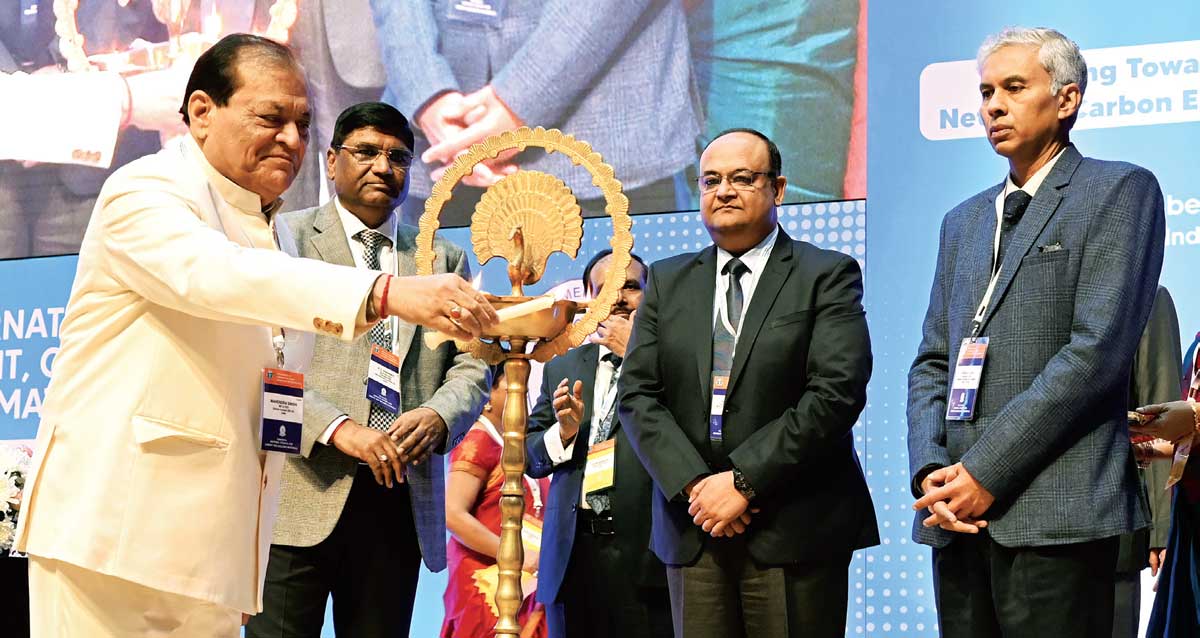
The conference was inaugurated by Chief Guest Shri Anurag Jain, Secretary, Department for Promotion of Industry and Internal Trade (DPIIT), Ministry of Commerce & Industry, Government of India, while Shri Anil Agrawal, Additional Secretary, DPIIT, Guest of Honour, delivered the speech on outlook of the Indian cement industry. The programme was initiated by Dr BN Mohapatra, DG-NCB, with a welcome address. KC Jhanwar, Chairman, NCB; President, Cement Manufacturers Association; and MD, UltraTech Cement, deliberated his views on ‘Indian Cement Industry-Future Outlook, Challenges & Opportunities.’ Mahendra Singhi, MD & CEO, Dalmia Cement (Bharat), presented his view on ‘Cement Industry Global Perspective.’
The Scientific Committee, comprising members from Niti Aayog, BIS, cement and construction industry, premier academic and research
institutes, was formed under the chairmanship
of Dr AK Chatterjee, Chairman, Conmat Technologies Pvt Ltd.
Chief Guest Shri Anurag Jain released four
NCB publications during the inaugural session.
These were:
- The third edition of Compendium – The Cement Industry – India 2022
- Publication on ‘Alternative Fuels – A Green Solution for Indian Cement Industry’
- NCB Guide Norms on Cement Plant Operation
- NCB Conference Proceedings containing full papers published in the conference
The conference was beneficial for a host of professionals from the industry such as cement and concrete professionals, top management personnel from cement and allied sectors, equipment / machinery manufacturers, designers and consultants, engineers, technologists, scientists, academicians, research scholars, students and economists, and users of cement and building materials as well as construction agencies.
The conference was sponsored by industry leaders such as UltraTech Cement
Dalmia Cement, JSW Cement, IKN India, Shree Cement, Nuvoco Vistas Corp, JK Cement, HeidelbergCement, JK Lakshmi Cement and KHD Humboldt Wedag India amongst others.
Supporting Organisations / Departments included:
- Department of Promotion of Industry and Internal Trade (DPIIT), Govt. of India
- Ministry of Environment, Forest, and Climate Change (MoEF&CC), Govt. of India
- Council for Scientific and Industrial Research (CSIR)
- Bureau of Indian Standards (BIS)
- Bureau of Energy Efficiency (BEE)
- Cement Manufacturers’ Association (CMA)
Its media partners were Industrial Angles, Indian Cement Review, Construction World, International Cement Review, World Cement, ZKG International and Civil Engineering & Construction Review (CE&CR).
Exclusive interaction with Dr Mohapatra
Impact on the Industry
“Our Honourable Prime Minister Shri Narendra Modi has undertaken a target of achieving Net Zero by 2070. Cement and steel sectors shall play a prominent role in achieving this target. At the conference, there are multiple technical experts who are addressing the five core levers of decarbonisation i.e., clinker factor, enhancing alternative fuels and raw materials, reduction of thermal and electrical energy consumption, waste heat recovery and carbon storage.
Indian plants are doing well in four of the five levels. NCCBM will be taking the support of Ministry of Environment and Forest, Bureau of Energy Efficiency and DPIIT to collaborate with industries to launch pilot projects and get government help for its implementation. Without carbon storage becoming a strong lever, it would be difficult to achieve carbon the neutrality target.”
Towards Net Zero Target
“The Ministry of Commerce & Industry – DPIIT is taking up numerous roles in helping the cement industry achieve this objective. They have formed Divisional Council for Cement Industry (DCCI), which will monitor and support all five parameters. They will also fast track the implementation of rules and regulations for getting clearances in a single window for the cement business, as well as taking the lead in supply of gypsum. The Gati Shakti is looking into reducing the substantial logistics costs and lot more.
DPIIT is taking bold steps in supporting the Indian cement industry in streamlining all areas where the industry is facing issues. NCCBM is also member of all teams that support sustainability for the cement industry like innovation for decarbonisation, carbon sequencing etc.”
“NCCBM is taking a stewardship role in connecting the Indian cement industry, academia and research institutes on a single platform, to together come up with solutions.”
The Panel Discussions
PANEL 1: Moving towards Net Zero Carbon Emissions in Indian Cement Industry
Panellists:
- Shri Jamshed N Cooper, Managing Director, HeidelbergCement India Ltd
- Shri Kiran Patil, Managing Director, Wonder Cement Ltd
- Shri V S Narang, Director (Technical), My Home Industries Pvt Ltd
- Shri Ganesh Jirkuntwar, National Manufacturing Head, Dalmia Cement (B) Ltd
- Matthias Mersmann, Chief Technical Officer, KHD Humboldt Wedag International, Germany
- Dr B N Mohapatra, Director General, NCB
PANEL 2: Sustainability and Circular Economy in Cement and Construction Sector
Panellists:
- Sanjay Pant, DDG (Standardization), BIS,
- Neeraj Sinha, Sr Advisor (S&T), NITI Aayog
- Prof D N Singh, Professor, Department of Civil Engineering, IIT Bombay
- Prof Manoranjan Parida, Director, CSIR-CRRI
- K J Patel, Director & Unit Head, IFFCO Paradeep
- Madhumita Basu, Chief Strategy & Marketing Officer, Nuvoco Vistas Corp Ltd.
- Dr S K Chaturvedi, Joint Director, NCB
PANEL 3: Enhancing AF & ARM utilisation in Indian Cement Industry
Panellists:
- Shri Arun Kumar Shukla, CEO & Director, J K Lakshmi Cement Ltd.
- Shri Vivek Agnihotri, CEO & Executive Director, Prism Johnson Ltd.
- Shri Pankaj Kejriwal, Whole Time Director & COO, Star Cement Ltd.
- Shri Sanjay Joshi, Chief Manufacturing Officer, Nuvoco Vistas Corp Ltd.
- Shri S K Rathore, Chief Manufacturing Officer, J K Cement Ltd.
- Shri G Veera Babu, Chief Manufacturing Officer, JSW Cement Ltd.
- Shri Bimal Modi, Head (AFR), UltraTech
Cement Ltd.
- Dr B N Mohapatra, DG-NCB
PANEL 4: National Mission on Sustainable Habitat -2030
Panellists:
- Dr Shailesh Kr. Agrawal, Executive Director, BMTPC
- Dr B Bhattacharjee, Emeritus Professor, Department of Civil Engineering, IIT Delhi
- Prof K V L Subramaniam, Professor, Department of Civil Engineering, IIT Hyderabad
- Prof Amit Hajela, Director and
Domain Head, Amity School of Architecture and Planning
- Yatin Choudhary, Fellow, TERI
- P N Ojha, Jt. Director, NCB
The keynote presentations in the technical sessions covered the following topics:
160 papers were presented in 20 technical sessions based on specific themes like:
- Low Carbon Cements
- Other Binders and Building Materials
- Alternate / Waste Fuels and Raw Materials
- Net Zero Emissions, Carbon Capture, Utilisation & Storage (CCUS)
- Cement Plant Machinery and Project Engineering
- Productivity Enhancement and Process Optimization
- Energy Conservation Systems
- Performance and Durability of Concrete
- Concrete Deterioration Mechanisms and Advanced Concrete System
- Advances in Grinding Systems
- Emerging Trends
- Total Quality Management
- Analytical Methods and Lab Automation
- Smart and High Performance Concrete
- Environmental Management and Sustainable Development
- Distress Investigation, Repair/ Strengthening/ Retrofitting of Concrete Structures
- Sustainable Construction Practices and Other Building Material and Binders
The chairman and co-chairman of the technical sessions were chosen from the senior executives of major cement companies. The papers were presented by cement plants personnel, cement plant machinery suppliers/OEMs, NCB scientist & Engineers, students from IITs, NITs, BITS Pilani etc. Based on evaluation done by the respective Chairman and Co-chairman of the technical session, one paper from each technical session has been selected as paper of high merit.
The Exhibition
The 17th NCB International Conference also had a technical exhibition, which was held concurrently at the conference venue. The exhibition gave additional exposure to the latest in available technologies and services for efficient operation of cement plants, making of concrete and construction activities. A cultural programme was also organised on day 2 of the conference, with performances that depicted India’s cultural diversity.
Speaking about the success of the conference, Dr Mohapatra said, “After this 4-day conference, I see a huge potential with the knowledge accumulated amongst the industry experts and an opportunity for cement manufacturers to innovate with low carbon cement products and support a circular economy. This conference has given high mileage to every sector.”
“NCCBM was a great platform for participating, where cement companies, machinery manufacturers and allied service providers shared technical knowledge and commercial aspects. Showcase of technical papers, achievement of various plants in terms of carbon emission, environment protection and good working conditions of various plants gives a feeling that we can feel proud of the Indian cement industry and say, ‘Saare jahan se acha, Hindustan hamara’. We distributed badges and tie sets marked with
‘Proud Indians’ at the conference,” said Pradip Kalra of Stotz Gears.
The Conference was received very well by the cement industry as was evident by the attendance and engagement of the delegates and visitors, who left behind encouraging testimonials, appreciating the successful organisation of the biennial conference by NCB.
The Awards
The concluding session of 17th NCB International Conference was held on 9th December 2022 and attended by Chief Guest Shri Som Parkash, Hon’ble Minister of State for Commerce & Industry, Govt. of India and Guest of Honour Shri Shashank Priya, Special Secretary & Financial Advisor, DPIIT, Ministry of Commerce and Industry, Govt. of India along with Shri Jamshed N Cooper, MD, Heidelberg Cement India Ltd..; Dr B N Mohapatra, Director General-NCB and Dr S K Chaturvedi, Organising Secretary, 17th NCB International Conference. The Chief Guest also distributed the National Awards for Energy Efficiency, Environmental Excellence and Total Quality Excellence in the Indian Cement Industry for years 2019-22.
S.NO. AWARDS Plant Name
I. Awards for Energy Excellence in Integrated Cement Plants
1 Best Award for Energy Excellence in Integrated Cement Plants RCCPL Pvt. Ltd.,
Maihar, Madhya Pradesh
2 Second Best Award for Energy Excellence in Integrated Cement Plants Sree Jayajothi Cements Pvt. Ltd., My Home Group Industries, Nandyal, Andhra Pradesh
3 Third Best Award for Energy Excellence in Integrated Cement Plants JK Cement Works, Muddapur,
Karnataka
4 First Consolation Prize for Energy Excellence in Integrated Cement Plants UltraTech Cement Ltd., Unit: Kotputli Cement Works, Rajasthan
5 Second Consolation Prize for Energy Excellence in Integrated Cement Plants JK Lakshmi Cement Ltd., Sirohi, Rajasthan
II. Awards for Environment Excellence in
Integrated Cement Plants
1 Best Award for Environment Excellence in Integrated Cement Plants Dalmia Cement (Bharat) Ltd., Belagavi Unit, Karnataka
2 Second Best Award for Environment Excellence in Integrated Cement Plants Dalmia Cement (Bharat) Ltd., Dalmiapuram, Tamil Nadu
3 Third Best Award for Environment Excellence in Integrated Cement Plants JK Cement Works, Muddapur,
Karnataka
4 First Consolation Prize for Environment Excellence in Integrated Cement Plants Shree Beawer Cement Plant,
Ajmer, Rajasthan
5 Second Consolation Prize for Environment Excellence in Integrated Cement Plants Dalmia Cement (Bharat) Ltd., Ariyalur, Tamil Nadu
III. Awards for Total Quality Excellence
in Integrated Cement Plants
1 Best Award for Total Quality Excellence in Integrated Cement Plants Shree Cement Ltd. (RAS), Pali, Rajasthan
2 Second Best Award for Total Quality Excellence in Integrated Cement Plants Birla Corporation Ltd.
Unit: Birla Cement Works & Chanderia Cement Works, Chittorgarh, Rajasthan
3 Third Best Award for Total Quality Excellence in Integrated Cement Plants UltraTech Cement Ltd.,
Unit: Aditya Cement Works, Chittorgarh, Rajasthan
4 First Consolation Prize for Total Quality Excellence in Integrated Cement Plants Shree Raipur Cement Plant, Shree Cement Ltd., Baloda Bazar, Chhattisgarh
5 Second Consolation Prize for Total Quality Excellence in Integrated Cement Plants JK Cement Works, Muddapur, Karnataka
IV. Awards for Achieving Circular Economy in
Integrated Cement Plants
1 Best Award for Achieving Circular Economy in Integrated Cement Plants UltraTech Cement Ltd.,
Unit: Reddipalayam Cement Works, Ariyalur, Tamil Nadu
2 Second Best Award for Achieving Circular Economy in Integrated Cement Plants JK Cement Works, Muddapur, Karnataka
3 Third Best Award for Achieving Circular Economy in Integrated Cement Plants Shree Beawer Cement Plant, Ajmer, Rajasthan
4 First Consolation Prize for Achieving Circular Economy in Integrated Cement Plants Dalmia Cement (Bharat) Ltd., Ariyalur, Tamil Nadu
5 Second Consolation Prize for Achieving Circular Economy in Integrated Cement Plants Nuvoco Vistas Corp. Ltd., Chittor Cement Plant, Chittorgarh, Rajasthan
V. Awards for Energy Excellence in Grinding Units
1 Best Award for Energy Excellence in Grinding Units UltraTech Cement Ltd., Unit: Jharsuguda Cement Works, Odisha
2 Second Best Award for Energy Excellence in Grinding Units JK Lakshmi Cement Ltd., Kalol, Gujarat
3 Third Best Award for Energy Excellence in Grinding Units JK Cement Works, Jharli, Haryana
4 First Consolation Prize for Energy Excellence in Grinding Units Ambuja Cement Ltd. –Adani Group, Roorkee Grinding Unit, Uttarakhand
5 Second Consolation Prize for Energy Excellence in Grinding Units Calcom Cement India Ltd., Dalmia Cement (Bharat) Ltd., Lanka, Assam
I. Awards for Environment Excellence in Grinding Units
1 Best Award for Environment Excellence in Grinding Units My Home Industries Pvt. Ltd., Mulakalapalli, Anakappali, Andhra Pradesh
2 Second Best Award for Environment Excellence in Grinding Units Star Cement Ltd., Guwahati, Assam
3 Third Best Award for Environment Excellence in Grinding Units Dalmia Cement (Bharat) Ltd., Bokaro, Jharkhand
4 First Consolation Prize for Environment Excellence in Grinding Units JK Lakshmi Cement Ltd., Kalol, Gujarat
5 Second Consolation Prize for Environment Excellence in Grinding Units JK Cement Works, Jharli, Haryana















 Concrete1 month ago
 Concrete4 weeks ago
 Concrete3 weeks ago
 Concrete1 month ago