Connect with us

Concrete

GCCA India–NCB Carbon Uptake Report Released at NCB Foundation Day

New report highlights CO? absorption by concrete in Indian conditions

Published

on

Shares

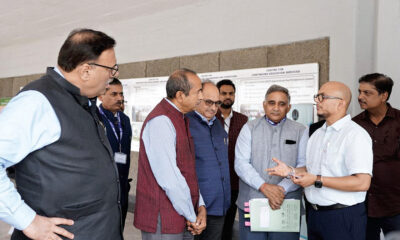
The Global Cement and Concrete Association (GCCA) India–NCB Carbon Uptake Report was recently released during the 63rd Foundation Day celebrations of the National Council for Cement and Building Materials (NCB). On the occasion, a Gypsum Board Testing Laboratory and a Micro-Characterisation Laboratory were also inaugurated, strengthening India’s research and quality infrastructure for construction materials.

The laboratories were inaugurated by Urmila, Economic Advisor, Department for Promotion of Industry and Internal Trade (DPIIT), and Mohd. Kamal Ahmad, Special Director General, Central Public Works Department (CPWD), in the presence of L. P. Singh, Director General, NCB.

The newly established Gypsum Board Testing Laboratory will support quality assurance and standardisation requirements of the gypsum board industry, particularly in the context of the Gypsum-Based Building Materials (Quality Control) Order, 2024. The Micro-Characterisation Laboratory is equipped with advanced analytical tools for detailed investigation of cementitious and construction materials.

Addressing the gathering, Ms Urmila highlighted NCB’s sustained contributions to research, technology development, quality assurance and capacity building for the cement sector. Shri Mohd. Kamal Ahmad also commended NCB’s role in promoting sustainable construction practices through focused research and development.

The GCCA India–NCB report titled Carbon Uptake by Concrete assesses CO? uptake through carbonation in concrete under Indian conditions. Prepared in collaboration with the Global Cement and Concrete Association (GCCA) India, the study is based on the Tier-I methodology of IVL Swedish Environment Research Institute. It notes that while the cement industry contributes around seven per cent of global anthropogenic emissions, carbon uptake by concrete can partially offset process-related emissions.

The report outlines future actions to improve data robustness, refine estimation methodologies and support integration of carbon uptake into national sustainability and climate reporting frameworks. It will be submitted to the Ministry of Environment, Forest and Climate Change for consideration of inclusion as a carbon sink in India’s National Communications to the UNFCCC.

Concrete

Cement Firms to Invest Rs. 130 bn in Green Energy by FY28

Cement companies plan to expand clean energy capacity to 6 GW by FY28

Published

on

By

Shares

India’s major cement companies are set to raise their clean energy capacity to 6 GW by March 2028 from around 4 GW at the end of March 2026, according to ratings agency ICRA. The planned expansion is expected to involve investments of Rs. 130 bn over the next two years.

The additional capacity could generate annual savings of Rs. 62 bn to Rs. 67 bn, resulting in an estimated payback period of 1.8 to 2.2 years. Cement is an emission-intensive industry, and leading producers have established net-zero roadmaps covering the next 15 to 20 years.

The calcination process accounts for 57 to 60 per cent of the sector’s total emissions, while fuel combustion contributes 27 to 30 per cent and electricity consumption accounts for 10 to 13 per cent. ICRA said the figures highlighted the need for a broad decarbonisation strategy involving green power, blended cement, alternative fuels and improvements in clinker efficiency.

Green energy is considered one of the most commercially attractive decarbonisation options because it can reduce emissions while lowering operating costs. Every 5 per cent increase in green power replacement can reduce power and fuel costs by Rs. 15 to Rs. 16 per tonne. A 25 per cent replacement level could therefore save Rs. 75 to Rs. 80 per tonne and expand operating margins by 140 to 160 basis points.

Cement producers are also assessing carbon capture, utilisation and storage, although high implementation costs, energy requirements and limited transport and storage infrastructure are expected to slow commercial adoption. The government has proposed Rs. 200 bn over five years to support deployment across key sectors. Meanwhile, companies are targeting thermal substitution rates of 10 to 15 per cent over the next three to five years, compared with the current industry level of around 6 per cent.

Continue Reading

Concrete

Centre Defers Clearance for Limestone Mine Near Bustard Habitat

Panel seeks revised mining plan and safeguards for pipelines and wildlife

Published

on

By

Shares

The Centre has deferred environmental clearance for a proposed limestone mine near a Great Indian Bustard habitat in Ramgarh, Rajasthan’s Jaisalmer district. The critically endangered species has an estimated wild population of about 130 in India.

Continue Reading

Concrete

Telangana to Supply Subsidised Cement for Indiramma Houses

Poor families allotted Indiramma houses to receive cement at Rs. 230 per bag

Published

on

By

Shares

The Telangana government will supply cement at a subsidised price of Rs. 230 per 50-kg bag to poor and low-income families allotted Indiramma houses. The prevailing market price is between Rs. 310 and Rs. 320 per bag, the Assembly was informed on Thursday.

Continue Reading

Video Thumbnail

    SIGN-UP FOR OUR GENERAL NEWSLETTER

    Trending News

    SUBSCRIBE TO THE NEWSLETTER


    Don't miss out on valuable insights and opportunities to connect with like minded professionals.


      This will close in 0 seconds