Economy & Market
Oil Monitoring and Maintenance


The progressive approach that industries are adopting to move towards condition-based oil change and maintenance can prove to be a game changer.
Lubrication oil in thousands of litres is changed in the industrial world, based on the periodic oil change intervals or schedules, which is part of a preventive maintenance programme. Most of the oil is prematurely changed in the equipment resulting in disposal of oil still having a remaining useful life. This results in loss of revenue due to cost of new oil and disposal of the used oil. The flip side of the preventive oil change schedules is that the lubricant can exceed its useful life before oil change interval, which can result in equipment breakdown resulting in loss of revenue again.
A better way, which progressive companies are adopting, involves periodic oil analysis and scheduling oil changes based on the oil condition, which not only maximises the lubricant life based on condition but also acts as a tool for a proactive approach to prevent equipment breakdown because of oil quality.
The oil analysis programme is a useful tool to monitor the condition of the oil and the equipment where it is being used. It consists of predetermined oil sampling plans from the equipment, testing the oils for major tests and determining the condition of oil and equipment. There are industry accepted precautionary and critical limits for the major tests, which are well established. The interpretation of these major tests help determine the oil and condition equipment and is the backbone of the condition-based oil changes. Almost 50 per cent of equipment damages are caused by oils and about 70 per cent of equipment defects are visible in the lubrication oil.
Lubricant contamination or degradation
Lubricant consists of either mineral or synthetic base stock fortified with performance chemicals called additives. These impart the specific properties required by lubricant based on its application. Over its usage, we all know that lube oil gets polluted due to internal contaminants like wear particles or degradation products or external contaminants like dirt, dust, water etc. Oil contamination is the major reason why oil is condemned. More and more companies are getting into oil regeneration programmes to extend the oil’s life.
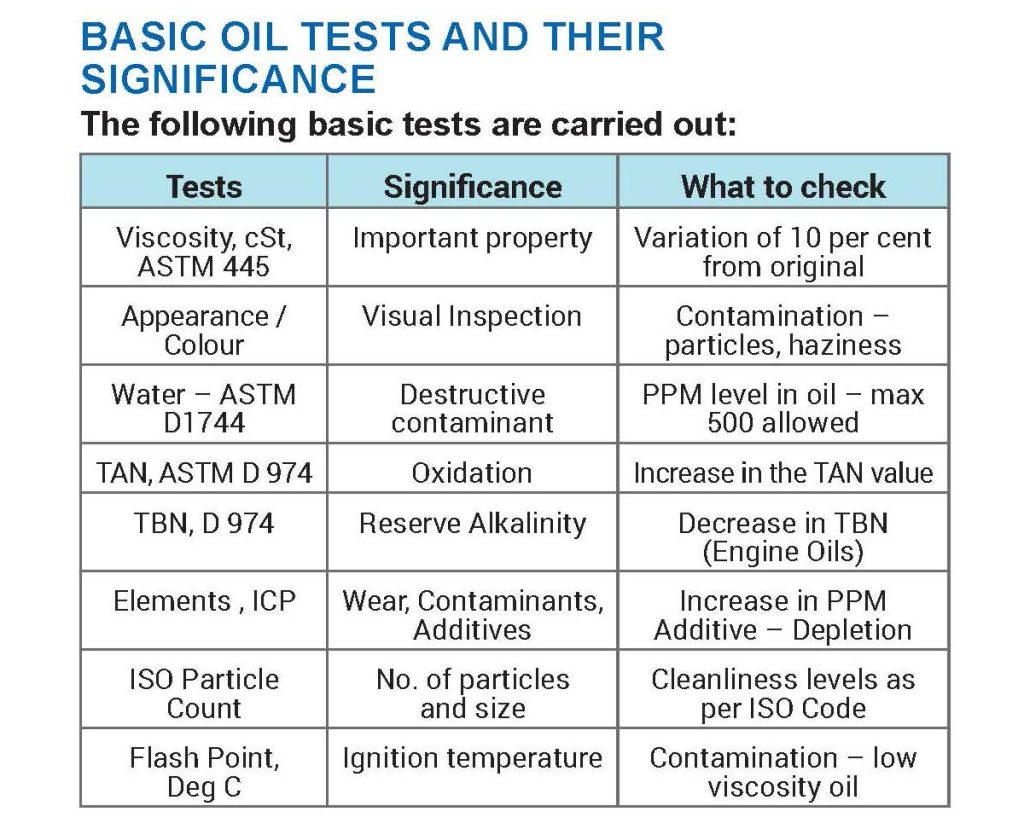
Drawing oil samples at periodic intervals for analysis, trends are monitored of the oil condition, The oil is retested if any significant changes occur in the test results of the sample in comparison to the previous. The test results are compared to the standard Industry limits which are used as guidelines. These limits are based on oil and equipment types. The oil analysis results can be used to make intelligent decisions on maximising oil life without compromising the equipment.

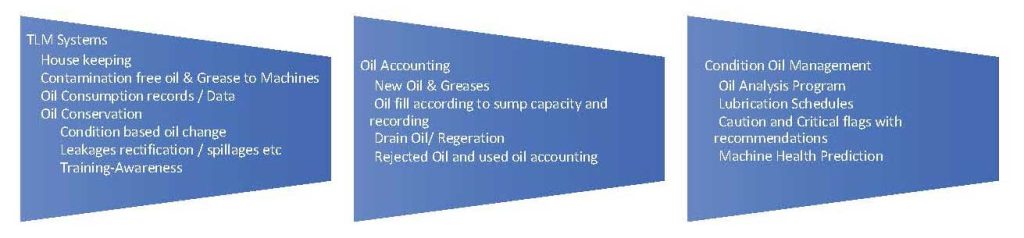
Periodic oil analysis has resulted in significant savings in oil life extension and also savings from proactively detecting potential failures caused by poor oil quality and degrading components. Condition monitoring provides gradual information and warnings according to the significance of the abnormality in the oil analysis.
Many of the industrial plants condemn their lubricating oils based on water and particulate contamination or sometimes on the recommended oil change interval. These oils can be regenerated by using high quality efficient filtration systems and sometimes by topping up with additives to restore their performance to original. Oil never dies, just
gets contaminated and depleted. It is possible to restore many such lubricants to their original performance levels.
Total Lubrication Management (TLM) is a very productive practice followed by many companies, its key features being:
TLM is now augmented with vibration sensors, thermal imaging and ultrasound analysis integrated with software driven by AI, making the equipment more reliable and predictive to operate and manage.
Condition-based oil monitoring in modern industries has progressed to a broader perspective of condition-based maintenance, which is to implement maintenance schedules that can be considered as actual condition of the equipment. Shorter response time with more targeted and corrective actions are resulting in improved productivity.
(Communication by the management of the company)
Image Source: Google Images











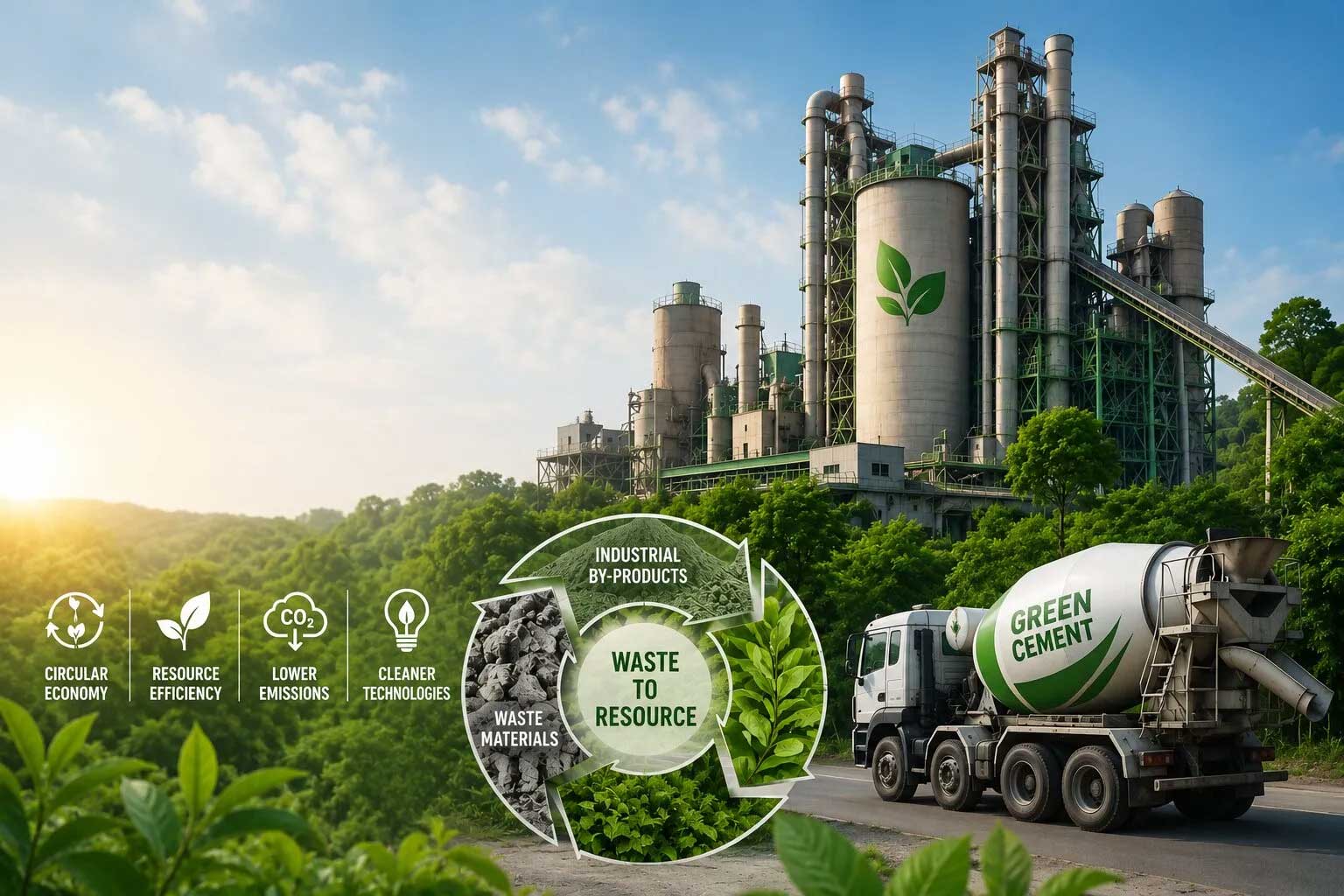
World Environment Day spotlight on innovation and circularity
On World Environment Day, the Indian cement industry reiterated its commitment to supporting India’s climate ambitions through sustainable manufacturing, resource efficiency and the adoption of cleaner technologies.
The Cement Manufacturers’ Association (CMA) said the sector remains aligned with the Government of India’s Net Zero commitments and is accelerating efforts to reduce its environmental footprint while supporting the country’s infrastructure and development agenda.

Parth Jindal, President, CMA and Managing Director, JSW Cement, said the industry is increasingly adopting cleaner technologies, improving energy efficiency and expanding the use of alternative fuels and raw materials. He also highlighted the growing importance of circular economy practices, where industrial by-products and waste streams from one sector are utilised as resources in another.
“The Indian Cement Industry is aligned to the Government’s commitments on carbon mitigation and is accelerating the adoption of cleaner technologies, resource efficiency and circular economy practices while actively exploring the potential of Carbon Capture, Utilisation and Storage (CCUS) as a critical pathway for deep decarbonisation,” said Jindal.
He added that coprocessing industrial waste and by-products helps conserve natural resources, reduce disposal requirements and lower the environmental footprint across multiple sectors.
According to Jindal, sustainability is no longer limited to manufacturing processes but is increasingly influencing investment decisions, innovation strategies and long-term growth plans within the industry.
Echoing similar views, Dr Raghavpat Singhania, Vice President, CMA and Managing Director, JK Cement, said sustainable development extends beyond emissions reduction and must also focus on responsible resource utilisation and waste minimisation.

“Sustainability in the built environment cannot be measured by emissions alone. It is equally about how efficiently we use resources, how effectively we minimise waste and how responsibly we create the infrastructure that will serve future generations,” said Singhania.
He noted that the cement industry is advancing its sustainability agenda through greater resource efficiency, increased circularity, technological innovation and continuous improvements in manufacturing practices. As a key contributor to India’s infrastructure development, the sector has a critical role to play in balancing economic growth with environmental responsibility.
On the occasion of World Environment Day, industry leaders reaffirmed their commitment to supporting India’s climate goals while delivering the materials required for resilient, durable and sustainable infrastructure.




Cement Makers Reaffirm Commitment to Sustainable Growth

Building a Greener Future Together

JK Lakshmi Advances LC3 Cement Expansion

Burnpur Cement Reports Standalone Net Loss Of Rs 207.4 Million

Ramco Cements Campaign Wins Six Kyoorius Honours
Cement Makers Reaffirm Commitment to Sustainable Growth
Building a Greener Future Together
JK Lakshmi Advances LC3 Cement Expansion
Burnpur Cement Reports Standalone Net Loss Of Rs 207.4 Million