Decentralised wastewater treatment is paving the way for sustainable construction and water conservation in India. Onkar Tiwari along with Dr Kapil Kukreja, Dr Sanjay Mundra, and Dr LP Singh, National Council for Cement and Building Materials (NCCBM), Ballabgarh, discuss the enabling of on-site reuse of treated water, an eco-friendly alternative to groundwater extraction.
Wastewater treatment has been an area of great interest for many decades due to intermixed pollutants that cause harmful effects on the water bodies. However, with rapid industrialisation and population growth, water quality of conventionally treated effluents is becoming progressively worse. Water quality analysis of treated water from different wastewater treatment facilities reveals that various inorganic as well as organic pollutants still exist in treated streams. However, decentralised modular wastewater treatment systems are one of the best approaches to deal with this problem. This article highlights the application of treating waste water for construction purposes and also discusses the advantages of decentralised/modular treatment systems over centralised treatment systems in India, recent advancements, challenges and future perspectives of indigenous sewage treatment plants (STP), using the latest technology for wastewater treatment systems.
Various wastewater studies suggest that the actual reuse of treated wastewater in India is limited to ~20-30 per cent. However, this wastewater reclamation will be sufficient for the growing need for development in the next 10 years. The potential financial savings from this could amount to a few thousand crores, a promising figure that underscores the potential of wastewater reuse and the significant economic benefits it can bring. This promising financial aspect should still give a sense of optimism about the potential of wastewater reuse in the construction industry.
The National Green Tribunal (NGT) and the Honourable Supreme Court in India do not allow groundwater to be used as construction water, the treated water requirement per IS 3025 and IS 456 is the most easily achievable target compared to Central Pollution Control Board (CPCB) norms and NGT directives.
The primary reasons for not reusing treated wastewater in India include:
a. Almost all our rivers are filled with untreated wastewater.
b. Loss of organic matter, which can be helpful in creating fresh soil; hence, fertile land is reclaimed in acres every year.
c. Wastewater treatment plants are built at the end of the sewer infrastructure, as most sewage water flows are gravity-driven. So, wastewater treatment plants are at the lowest point of the watershed, usually beside the river and sea.
d. In the last 30 years, standards were not focused on reuses, so the Biochemical Oxygen Demand (BOD) of 30, Chemical Oxygen Demand (COD) of 100, and Total Suspended Solids (TSS) of 100 were unsuitable for human touch; hence, no water use was practised or minimum reuse was under the trend.
e. Even if groundwater is precious for use in cement production and grass irrigation, the lack of regulations on groundwater use has facilitated the large-scale use of groundwater for parks and gardens to date.
f. The ‘ecology of commerce’ is a term that describes the interconnected relationship between various industries and their water usage, has not been explored holistically. For example, multiple industries use high amounts of water in any industrial estate. After one uses the water, it is drained in a public utility drain. Other sectors could have used that water with minimum treatment cost and capacity.
g. Most seasonal and small tributaries have been converted into urban drains due to sewage line connections, so various parks use groundwater instead of tributary or treated water.
Areas of concern in centralised wastewater treatment
Centralised wastewater treatment may be the solution for conserving the waste, but it has many challenges:
- Large space requirements
- Bad smell near the treatment plants
- High energy requirement in energy-stressed habitation
- No aesthetic focus in any of the wastewater treatment plants
- No proper guidelines for decentralised wastewater treatment plants.
- No online and live information for the quality and quantity of water treated is available
- Due to long drainage, gravity-fed systems require the construction of pumping and lift stations, which are costly capital/maintenance structures
- Large infrastructure cost of redistribution
- Very long setup time for plant
Decentralised wastewater treatment
The ‘quantum possibility of decentralised wastewater treatment’ is a concept that refers to the significant potential of decentralised treatment to solve major challenges our country faces. It is a promising solution that could pave the way for sustainable water management practices.
If someone builds a decentralised sewage treatment plant and treats its wastewater to comply with CPCB and State Pollution Control Board (SPCB) norms, the treated water quality will be suitable to use in the construction sector as per applicable Indian Standards (IS) codes.
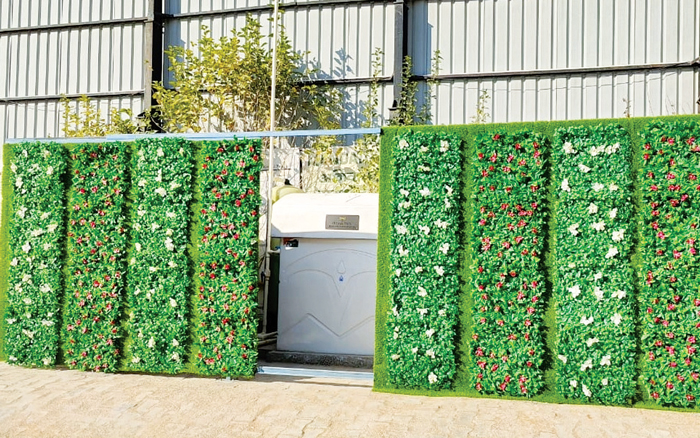
Using on-site treated wastewater for construction is highly recommended, and organisations opting for the same can save money and achieve higher sustainability. These plants can be installed at the site in 1-2 weeks only, and they are operable with solar energy as well, so even if the electrical connections are not available at the site, the decentralised waste water treatment plant will keep generating good water. This emphasis on decentralisation
should install a sense of hope for the future of wastewater management, as it presents a viable and sustainable solution.
Decentralised wastewater treatment plants offer several benefits that make them a sustainable and efficient alternative to centralised systems:
- Cost-effectiveness: These systems reduce the need for extensive piping and pumping infrastructure, leading to lower capital and operational costs.
- Environmental sustainability: By treating wastewater closer to its source as per table 1 shows its enhanced sustainability index.
- Faster implementation: These systems can be implemented more quickly than centralised
plants, especially in areas with limited infrastructure decentralised systems minimise energy use
and promote water reuse, contributing to environmental conservation.
- Flexibility and scalability: They can be tailored to meet the needs of small communities or
specific locations, making them adaptable to various settings.
- Resilience: Decentralised systems are less vulnerable to large-scale failures, ensuring continued operation during disasters or infrastructure breakdowns.
Conclusion
The Corporate Social Responsibility (CSR) funds can be used to treat a sizeable nearby drain, and that treated water can be provided to nearby farmers, which will increase the industry-society connection
Groundwater use for construction purposes is banned. Most of the Urban Local Bodies (ULB) have banned groundwater use for construction. Still, the public has not been given options and facilities for the alternative of the same and treated wastewater availability, if each pincode again saves a massive amount of groundwater being illegally used.
Under the clean air programme, various ULBs use sprinklers on roads and tree washing, for which treated drinking water from groundwater is used on a large scale; again, treated wastewater can be used.
Almost every urban space, including state roads and highways, has vegetation beside the road or on the road’s median; treated wastewater again will help availability near the point of use and have a good volume of groundwater.
About the authors:
Onkar Tiwari is a Managing Director of Biomimicry Technologies, with 25 years of experience in the field of environment and waste water treatment.
Dr Kapil Kukreja is the General Manager at NCB, with 21 years of experience in R&D and cement Industry, He earned his PhD from BITS Pilani and is at present heading the NCB Incubation Centre.
Dr Sanjay Mundra is the General Manager at NCB, with 26 years experience in R&D and cement, He has a PhD from MNIT Jaipur.
Dr L P Singh is the Director General of NCB. He is a profound scientist/researcher with a distinguished career spanning over 30 years in R&D, with a PhD (1996) in Physical Chemistry from the University of Roorkee (now IIT Roorkee).


















 Concrete1 month ago
 Concrete4 weeks ago
 Concrete1 month ago
 Concrete3 weeks ago