Concrete
Impact of PCC on Reduction of Carbon Footprint
Published
3 years agoon
By
admin
Dr Bibekananda Mohapatra, Director General, National Council for Cement and Building Materials (NCB), shares insights from the extensive research for development of low carbon cements such as Portland Composite Cement (PCC).
India has updated its Nationally Determined Contribution (NDC) submitted to the United Nations Framework Convention on Climate Change (UNFCCC) based on the commitment of the Honourable Prime Minister at the 26th session of the Conference of the Parties (COP26) held in Glasgow, in November 2021. India presented to the world five nectar elements (Panchamrit) of India’s climate action into enhanced climate targets. The new climate action targets ‘Panchamrit’ by India included:
- Net Zero target for India by the year 2070;
- Achieving carbon intensity reduction of 45 per cent over 2005 levels by 2030; reducing 1 billion tonnes of projected emissions from now till 2030;
- Installing non-fossil fuel electricity capacity of 500 GW by 2030; and
Sourcing 50 per cent of energy requirements from renewables by 2030.
Recently, the Intergovernmental Panel on Climate Change (IPCC) published a report on global warming. The report highlighted that limiting the increase in global temperature to 1.5°C requires achieving net zero carbon dioxide emissions globally in the early 2050s. As per IPCC report, major transitions in the energy and industrial sector will be required to limit global warming such as:
- substantial reduction in fossil fuel use
- widespread electrification
- improved energy efficiency
- use of alternative fuels (such as hydrogen)
- using materials more efficiently
- reusing and recycling products
- minimising waste
Globally, the cement sector generates about 7 per cent of the total anthropogenic emissions. In India, the energy consumption and process emissions from cement industry contributes about 4.2 per cent and 2.1 per cent of the total Greenhouse Gas (GHG) emissions of 2531.1 million tonnes CO2 equivalent in 2016 (Source: Third biennial update report of India to UNFCCC). Therefore, the cement sector in India has an important role to play to achieve the enhanced climate targets.
The low carbon roadmap has identified clinker substitution and Carbon Capture and Utilisation as having the highest potential for reduction in carbon footprint
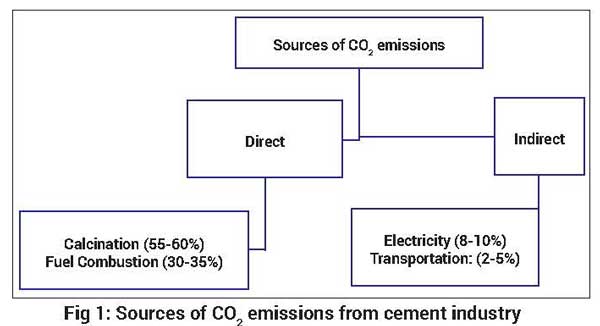
In hard-to-abate sectors such as cement, it is technologically very difficult to reduce the process related CO2 emissions. The sources of CO2 emissions in cement manufacture are categorised as direct sources, which includes calcination (55-60 per cent), combustion (25-30 per cent) and indirect sources of CO2 including electricity (8-10 per cent) and transportation (2-5 per cent) as shown in Fig 1. The Indian cement industry has been working on the issue of its GHG emissions and has brought down the CO2 emission factor from 1.12 t of CO2/t of cement in 1996 to 0.670 t of CO2/t of cement in 2017.
The global cement industry and cement associations worldwide have prepared roadmaps to achieve Net Zero Concrete to meet the sector commitments for reduction of GHG emissions in line with their respective national commitments at COP 26. Last year, Global Cement and Concrete Association (GCCA), CEMBUREAU and Portland Cement Association (PCA) announced roadmaps to achieve Carbon Neutrality across the cement and concrete value chain by 2050 with the highest contribution from carbon capture and utilisation.
The journey towards decarbonisation of Indian cement industry started in 2012 with preparation of a Low Carbon Technology Roadmap specifically for the Indian cement industry, when International Energy Agency (IEA) and Cement Sustainability Initiative (CSI), in collaboration with the Confederation of Indian Industry (CII) and the National Council for Cement and Building Materials (NCB) prepared this document.
The identified levers in the low carbon technology roadmap of the Indian cement industry are:
i. Substitution of clinker
ii. Alternative fuel and raw materials
iii. Improving energy efficiency
iv. Installation of Waste Heat Recovery (WHS)
v. Newer technologies like renewable energy, novel cements, carbon capture and storage/utilisation.
The first four levers have already been implemented by the Indian cement industry and the impact has already been reflected in the reduction of CO2 emission factor from cement industry. The specific direct CO2 emissions of major cement companies in the year 2021-22 is given in Table 1 below:

The low carbon roadmap identified clinker substitution and Carbon Capture and Utilisation as having the highest potential for reduction in carbon footprint of the Indian Cement Industry as shown in Fig. 2. India is blessed to have supplementary cementitious materials like fly ash and blast furnace slag. In 2021-22, 270.8 million tonnes of fly ash and about 12 million tonnes of blast furnace slag were generated in our country. Apart from annual generation, 1,700 million tonnes of legacy fly ash lie at various thermal power plants in our country.
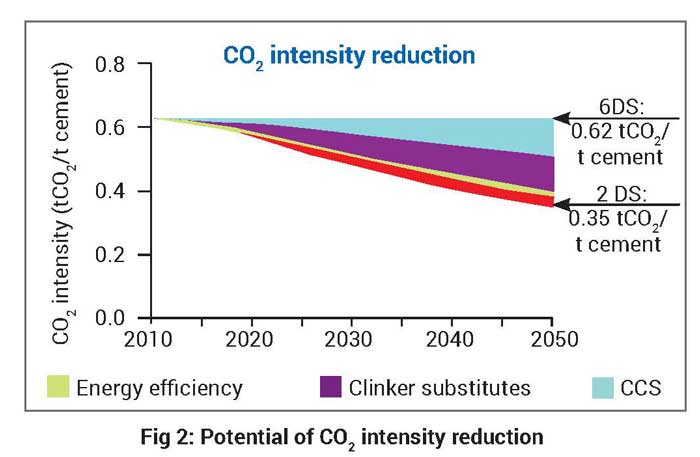
The Indian Cement Industry is quite proactive and has taken several steps to mitigate greenhouse gas emissions systematically following the low carbon technology roadmap. This reduction in the carbon footprint of the cement industry could have been achieved due to production of low carbon blended cements like Portland Pozzolana Cement (PPC) and Portland Slag Cement (PSC).
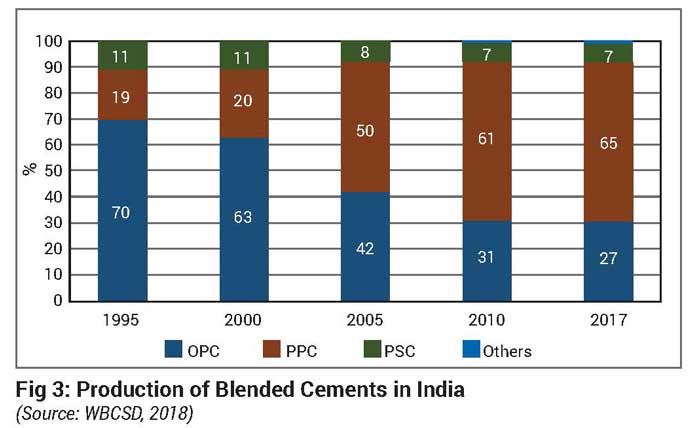
The production of blended cements like PPC and PSC has seen constant increase since the year 1995 when only 30 per cent blended cements were produced in India as compared to 2017, when the production of blended cements has increased to 73 per cent as shown in Fig 3. This could have been achieved due to acceptance of blended cements in Indian markets by the awareness efforts of cement companies and research organisations like NCB.
Keeping in line with the current global scenario, NCB in its endeavour to help the cement industry realise the target of net zero carbon by 2070 has been working on various levers of CO2 reduction especially clinker substitution.
Accordingly, NCB has undertaken extensive research for development of low carbon
cements like:
- Portland Composite Cement based on fly ash and limestone
- Composite cement based on fly ash and slag
- Portland Limestone Cement
- Geopolymer cement
- Multi component blended cement
- Portland dolomite Cement
The impact of low carbon cements like PCC based on fly ash and limestone on carbon footprint of Indian Cement Industry is discussed below:
PCC based on Fly Ash and Limestone
The blended cements, which are produced using more than one mineral addition, are known as composite cements. Fly ash conforming to IS 3812 (Part 1): 2003 and granulated blast furnace slag conforming to IS 12089: 1987 are used in the manufacture of composite cements (16415-2015) with 15-35 per cent and 20-50 per cent respectively. Presently there is almost complete utilisation of granulated blast furnace slag in India. However, utilisation of fly ash in manufacture of PPC is still only 25 per cent out of around 270 million tonnes generated annually. Additionally, India has large reserves of low grade, dolomitic and siliceous limestones, manufacture of limestone and fly ash based composite cements will reduce the impact of CO2 on environment, utilisation of industrial wastes and enable production of cements with lower clinker factor leading to resource conservation, enhanced waste utilisation and greater sustainability in cement manufacture. In this study, PCC blends were prepared (140 nos) with four types of clinker from different regions of India along with the regional available fly ash (15-35 per cent) and limestone (5, 7 and 10 per cent). The results depicted that the clinker quality plays an important role on performance of limestone and fly ash based composite cements. NCB studies indicated PCC based on limestone and fly ash with 35 per cent replacement of clinker by fly ash and limestone (keeping limestone content up to 7 per cent in it). NCB has submitted the report to Bureau of Indian Standards (BIS) for standard formulation and it is under consideration of BIS.

Comparison of CO2 Emissions
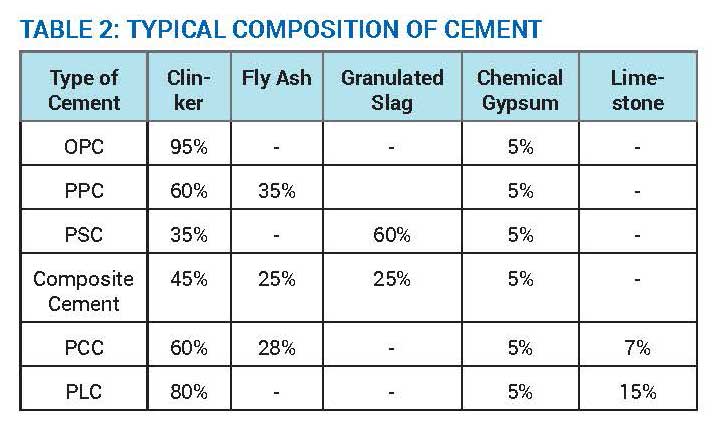
The specific CO2 emissions associated with various types of cements like OPC, PPC, PSC, composite cement based on fly ash and slag, PCC and PLC are calculated considering the typical composition of cements as given in Table 2. The composition of PCC is taken as 60 per cent clinker, 28 per cent fly ash, 7 per cent limestone and 5 per cent gypsum whereas the composition of PLC is taken as 80 per cent clinker, 15 per cent limestone and 5 per cent gypsum as shown in Table 2.
For calculating the specific CO2 emissions of each type of cement, the contribution of CO2 from calcination, fuel combustion and electricity have been taken into consideration. The comparison of the specific CO2 emission for various cements is shown in Fig 4. The CO2 intensity of OPC is 842 kg CO2 per tonne, whereas it is 536 kg CO2 per tonne for PCC, and 703 kg CO2 per tonne for PLC. The major contributors for CO2 intensity reduction of low carbon cements as compared to OPC are the varying clinker content and the different grinding energy requirement for the cements. The grinding energy required for PCC and PLC is considered lower as compared to PPC as limestone acts as a grinding agent.
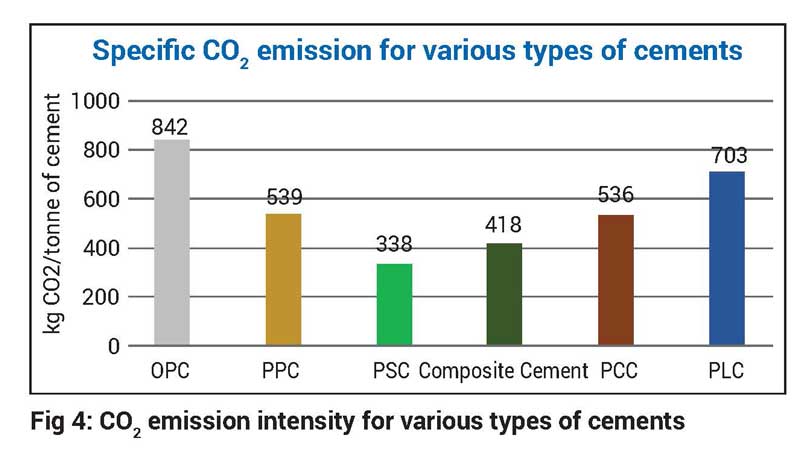
As shown in Fig 4, the specific CO2 emissions from PCC production are equivalent to PPC. The availability of fly ash will gradually reduce due to the focus of the Government of India on renewable energy generation and utilisation of alternative fuels in thermal power plants. In this scenario, PCC will emerge as a viable alternate option to PPC, with utilisation of lower grade of limestone replacing portions of fly ash. As compared to specific CO2 emissions of 842 kg per tonne of OPC, the specific CO2 emissions associated with PCC are 536 kg CO2 per tonne i.e., about 36 per cent lower. Thus, the replacement of OPC by low carbon cements like PCC will result in a lower carbon footprint of the Indian cement industry.
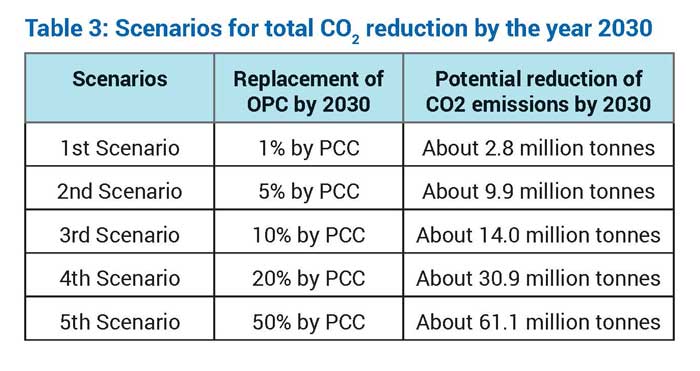
Presently, 27 per cent OPC is produced, out of the total cement mix produced in India. Table 3 showcases different scenarios of CO2 reduction due to gradual replacement of OPC at varying per cent by PCC ranging from 1 per cent to 50 per cent as shown in Table 3. PCC has a potential to reduce CO2 emissions up to 61.1 million tonnes in the next 10 years by 2030, if 50 per cent OPC may be replaced by PCC after standard formulation by BIS.
ABOUT THE AUTHOR:
Dr. BN Mohapatra is the Director General of National Council for Cement and Building Materials (NCCBM). He is a Phd in Cement Mineral Chemistry, enriched with 13 years of research and development and over 22 years of industry experience with a strong academic relations with premier institutes. He is the chairman of the Cement Sectoral Committee of the Bureau of Energy Efficiency (BEE).

Operational excellence in cement is no longer about producing more—it is about producing smarter, cleaner and more reliably, where cost per tonne meets carbon per tonne.
Operational excellence in cement has moved far beyond the old pursuit of ‘more tonne’. The new benchmark is smarter, cleaner, more reliable production—delivered with discipline across process, people and data. In an industry where energy can account for nearly 30 per cent of manufacturing cost, even marginal gains translate into meaningful value. As Dr SB Hegde, Professor, Jain College of Engineering & Technology, Hubli and Visiting Professor, Pennsylvania State University, USA, puts it, “Operational excellence… is no longer about producing more. It is about producing smarter, cleaner, more reliably, and more sustainably.” The shift is structural: carbon per tonne will increasingly matter as much as cost per tonne, and competitiveness will be defined by the ability to stabilise operations while steadily lowering emissions.
From control rooms to command centres
The modern cement plant is no longer a handful of loops watched by a few operators. Control rooms have evolved from a few hundred signals to thousands—today, up to 25,000 signals can compete for attention. Dr Rizwan Sabjan, Head – Global Sales and Proposals, Process Control and Optimization, Fuller Technologies, frames the core problem plainly: plants have added WHRS circuits, alternative fuels, higher line capacities and tighter quality expectations, but human attention remains finite. “It is very impossible for an operator to operate the plant with so many things being added,” he says. “We need somebody who can operate 24×7… without any tiredness, without any distraction… The software can do that for us better.”
This is where advanced process control shifts from ‘automation spend’ to a financial lever. Dr Hegde underlines the logic: “Automation is not a technology expense. It is a financial strategy.” In large kilns, a one per cent improvement is not incremental—it is compounding.
Stability is the new productivity
At the heart of operational excellence lies stability. Not because stability is comfortable, but because it is profitable—and increasingly, low-carbon. When setpoints drift and operators chase variability, costs hide in refractory damage, thermal shocks, stop-start losses and quality swings. Dr Sabjan argues that algorithmic control can absorb process disturbances faster than any operator, acting as ‘a co-pilot or an autopilot’, making changes ‘as quick as possible’ rather than waiting for manual intervention. The result is not just fuel saving—it is steadier operation that extends refractory life and reduces avoidable downtime.
The pay-off can be seen through the lens of variability: manual operation often amplifies swings, while closed-loop optimisation tightens control. As Dr Sabjan notes, “It’s not only about savings… there are many indirect benefits, like increasing the refractory life, because we are avoiding the thermal shocks.”
Quality control
If stability is the base, quality is the multiplier. A high-capacity plant can dispatch enormous volumes daily, and quality cannot be a periodic check—it must be continuous. Yet, as Dr Sabjan points out, the biggest error is not in analysis equipment but upstream: “80 per cent of the error is happening at the sampling level.” If sampling is inconsistent, even the best XRF and XRD become expensive spectators.
Automation closes the loop by standardising sample collection, transport, preparation, analysis and corrective action. “We do invest a lot of money on analytical equipment like XRD and XRF, but if it is not put on the closed loop then there’s no use of it,” he says, because results become person-dependent and slow.
Raju Ramachandran, Chief Manufacturing Officer (East), Nuvoco Vistas Corp, reinforces the operational impact from the plant floor: “There’s a stark difference in what a RoboLab does… ensuring that the consistent quality is there… starts right from the sample collection.” For him, automation is not about removing people; it is about making outcomes repeatable.
Human-centric automation
One of the biggest barriers to performance is not hardware—it is fear. Dr Sabjan describes a persistent concern that digital tools exist to replace operators. “That’s not the way,” he says. “The technology is here to help operator… not to replace them… but to complement them.” The plants that realise this early tend to sustain performance because adoption becomes collaborative rather than forced.
Dr Hegde adds an important caveat: tools can mislead without competence. “If you don’t have the knowledge about the data… this will mislead you… it is like… using ChatGPT… it may tell the garbage.” His point is not anti-technology; it is pro-capability. Operational excellence now requires multidisciplinary teams—process, chemistry, physics, automation and reliability—working as one.
GS Daga, Managing Director, SecMec Consultants, takes the argument further, warning that the technology curve can outpace human readiness: “Our technology movement AI will move fast, and our people will be lagging behind.” For him, the industry’s most urgent intervention is systematic skilling—paired with the environment to apply those skills. Without that, even high-end systems remain underutilised.
Digital energy management
Digital optimisation is no longer confined to pilots; its impact is increasingly quantifiable. Raghu Vokuda, Chief Digital Officer, JSW Cement, describes the outcomes in practical terms: reductions in specific power consumption ‘close to 3 per cent to 7 per cent’, improvements in process stability ‘10 per cent to 20 per cent’, and thermal energy reductions ‘2–5 per cent’. He also highlights value beyond the process line—demand optimisation through forecasting models can reduce peak charges, and optimisation of WHRS can deliver ‘1 per cent to 3 per cent’ efficiency gains.
What matters is the operating approach. Rather than patchwork point solutions, he advocates blueprinting a model digital plant across pillars—maintenance, quality, energy, process, people, safety and sustainability—and then scaling. The difference is governance: defined ownership of data, harmonised OT–IT integration, and dashboards designed for each decision layer—from shopfloor to plant head to network leadership.
Predictive maintenance
Reliability has become a boardroom priority because the cost of failure is blunt and immediate. Dr Hegde captures it crisply: “One day of kiln stoppage can cost several crores.” Predictive maintenance and condition monitoring change reliability from reaction to anticipation—provided plants invest in the right sensors and a holistic architecture.
Dr Sabjan stresses the need for ‘extra investment’ where existing instrumentation is insufficient—kiln shell monitoring, refractory monitoring and other critical measurements. The goal is early warning: “How to have those pre-warnings… where the failures are going to come… and then ensure that the plant availability is high, the downtime is low.”
Ramachandran adds that IoT sensors are increasingly enabling early intervention—temperature rise in bearings, vibration patterns, motor and gearbox signals—moving from prediction to prescription. The operational advantage is not only fewer failures, but planned shutdowns: “Once the shutdown is planned in advance… you have lesser… unpredictable downtimes… and overall… you gain on the productivity.”
Alternative fuels and raw materials
As decarbonisation tightens, AFR becomes central—but scaling it is not simply a procurement decision. Vimal Kumar Jain, Technical Director, Heidelberg Cement, frames AFR as a structured programme built on three foundations: strong pre-processing infrastructure, consistent AFR quality, and a stable pyro process. “Only with the fundamentals in place can AFR be scaled safely—without compromising clinker quality or production stability.”
He also flags a ground reality: India’s AFR streams are often seasonal and variable. “In one season to another season, there is major change… high variation in the quality,” he says, making preprocessing capacity and quality discipline mandatory.
Ramachandran argues the sector also needs ecosystem support: a framework for AFR preprocessing ‘hand-in-hand’ between government and private players, so fuels arrive in forms that can be used efficiently and consistently.
Design and execution discipline
Operational excellence is increasingly determined upstream—by the choices made in concept, layout, technology selection, operability and maintainability. Jain puts it unambiguously: “Long term performance is largely decided before the plant is commissioned.” A disciplined design avoids bottlenecks that are expensive to fix later; disciplined execution ensures safe, smooth start-up with fewer issues.
He highlights an often-missed factor: continuity between project and operations teams. “When knowledge transfer is strong and ownership carries beyond commissioning, the plant stabilises much faster… and lifecycle costs reduce significantly.”
What will define the next decade
Across the value chain, the future benchmark is clear: carbon intensity. “Carbon per ton will matter as much as cost per ton,” says Dr Hegde. Vokuda echoes it: the industry will shift from optimising cost per tonne to carbon per ton.
The pathway, however, is practical rather than idealistic—low-clinker and blended cements, higher thermal substitution, renewable power integration, WHRS scaling and tighter energy efficiency. Jain argues for policy realism: if blended cement can meet quality, why it shall not be allowed more widely, particularly in government projects, and why supplementary materials cannot be used more ambitiously where performance is proven.
At the same time, the sector must prepare for CCUS without waiting for it. Jain calls for CCUS readiness—designing plants so capture can be added later without disruptive retrofits—while acknowledging that large-scale rollout may take time as costs remain high.
Ultimately, operational excellence will belong to plants that integrate—not isolate—the levers: process stability, quality automation, structured AFR, predictive reliability, disciplined execution, secure digitalisation and continuous learning. As Dr Sabjan notes, success will not come from one department owning the change: “Everybody has to own it… then only… the results could be wonderful.”
And as Daga reminds the industry, the future will reward those who keep their feet on the ground while adopting the new: “I don’t buy technology for the sake of technology. It has to make a commercial sense.” In the next decade, that commercial sense will be written in two numbers—cost per tonne and carbon per tonne—delivered through stable, skilled and digitally disciplined operations.
Concrete
World Cement Association Annual Conference 2026 in Bangkok
Global leaders to focus on decarbonisation and digitisation
Published
4 days agoon
March 2, 2026By
admin
The World Cement Association (WCA) will host its 2026 Annual Conference from 19–21 April 2026 at The Athenee Hotel in Bangkok, Thailand. The two-day programme will convene global cement industry leaders, policymakers, technology providers and stakeholders to examine strategic, operational and sustainability challenges shaping the sector’s next phase of transformation. The conference theme of shaping a sustainable future through digitisation, innovation and performance will frame sessions and networking opportunities across the event.\n\nThe programme will open with a comprehensive assessment of the global economic environment and its impact on cement markets, alongside regional outlooks across Asia and Europe. Speakers will address regulatory developments including carbon border adjustment mechanisms (CBAM) in Europe, progress in China’s carbon trading system and market dynamics in Thailand and South East Asia, and will outline practical decarbonisation pathways such as alternative fuels, next-generation supplementary cementitious materials (SCMs) and calcined clay developments. Sessions will also examine AI-enabled kiln optimisation and other digital approaches to improve plant performance.\n\nDay two will focus on overcapacity challenges and industry restructuring, using case studies and regional perspectives to provide delegates with practical insights into unlocking performance while accelerating decarbonisation. Discussions will explore digital maturity and AI-driven plant operations, manufacturing optimisation, sustainable building solutions and circular concrete models, together with evolving customer requirements across the construction value chain. The event will include the WCA Awards Ceremony at the Awards Gala Dinner on 20 April to recognise excellence in sustainability, innovation, safety and leadership.\n\nPhilippe Richart, chief executive officer of the WCA, said the sector was navigating a period of profound transformation, from managing overcapacity and market volatility to deploying AI and delivering measurable decarbonisation, and that the Annual Conference would bring global leaders together to exchange practical solutions and strengthen collaboration. Registration is open and tickets include admission to the two-day event, all sessions, refreshments and lunch, exhibition access and the Awards Gala Dinner. Further information on the programme is available via the WCA Annual Conference 2026 event page and queries on sponsorship or exhibition may be directed to events@worldcementassociation.org.
Concrete
Assam Chief Minister Opens Star Cement Plant In Cachar
New plant aims to boost local industry and supply chains
Published
4 days agoon
March 2, 2026By
admin
Chief Minister Himanta Biswa Sarma inaugurated the Star Cement plant in Cachar on 28 February 2026, marking the opening of a manufacturing facility designed to serve the region. The event was attended by state officials and company representatives, and it was reported with inputs from ANI. The plant is positioned as a strategic addition to the industrial landscape of southern Assam and is expected to improve the availability of construction materials for local projects.
The establishment is expected to generate employment opportunities and to stimulate ancillary businesses in the supply chain, including transport and local vendors. State officials indicated that the plant will enhance logistical efficiency by reducing the need to transport cement over long distances, which may lower construction costs for public and private projects. Observers said the presence of a regional cement facility can support housing and infrastructure initiatives that are underway or planned.
Government representatives reiterated that the state seeks to attract responsible investment that complements regional priorities and that the administration will continue to facilitate infrastructure and connectivity to support industrial operations. The inauguration was presented as consistent with broader efforts to diversify the industrial base in the northeast and to create an enabling environment for small and medium enterprises that supply goods and services to larger manufacturers.
Company sources and the state leadership underlined the importance of maintaining environmental safeguards while pursuing industrial growth, and they signalled that compliance with applicable norms will be a priority at the new facility. The announcement was framed as a step towards balanced development that links job creation, regional supply chains and local economic resilience. The report was prepared by the TNM Bureau with inputs from ANI.
Operational Excellence Redefined!
World Cement Association Annual Conference 2026 in Bangkok
Assam Chief Minister Opens Star Cement Plant In Cachar
Adani Cement, NAREDCO Form Strategic Alliance
Walplast’s GypEx Range Secures GreenPro Certification
Operational Excellence Redefined!
World Cement Association Annual Conference 2026 in Bangkok
Assam Chief Minister Opens Star Cement Plant In Cachar
Adani Cement, NAREDCO Form Strategic Alliance
Walplast’s GypEx Range Secures GreenPro Certification
Trending News
-
Economy & Market4 weeks agoFORNNAX Appoints Dieter Jerschl as Sales Partner for Central Europe
-
Concrete2 weeks agoRefractory demands in our kiln have changed
-
Concrete2 weeks agoDigital supply chain visibility is critical
-
Concrete2 weeks agoOur strategy is to establish reliable local partnerships