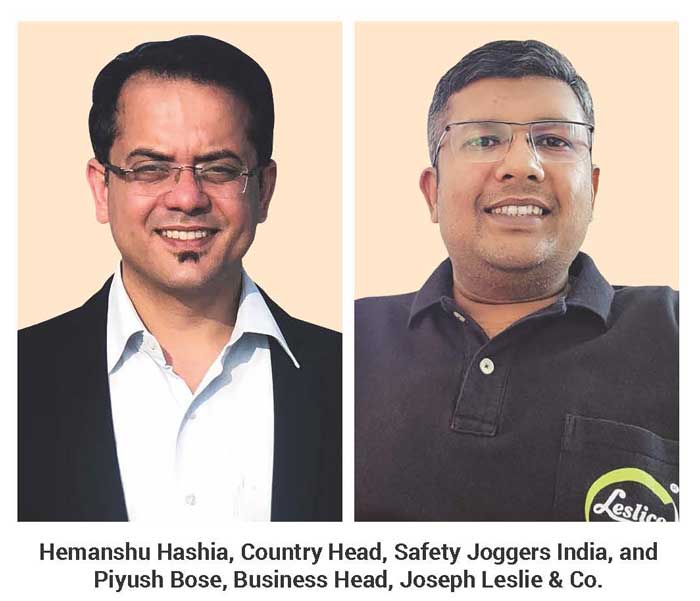
Hemanshu Hashia, Country Head, Safety Jogger India, and Piyush Bose, Business Head, Joseph Leslie & Co. LLP discuss the various aspects of safety equipment required for smooth adaptability of HSE operations in a highly intensive industry such as cement manufacturing. Leslico is the strategy consultant to Safety Jogger India.
Tell us about the safety gear that you manufacture and their components and use at a cement plant? What is the quality standard that is followed for the safety gear?
Safety Jogger manufactures footwear, which acts as a basic protection gear for workers in the cement plants. This industry has a high unpredictable risk averse environment, thus, all the safety footwear that we manufacture is in accordance with the global quality standards and Indian BIS standards. Apart from safety shoes, Leslico manufactures other PPE parts like safety helmets, safety eyewear, safety ear protection and specialised work wear along with safety gloves, which are relevant to the cement industry.
Cement industry is one of the biggest providers in the India construction movement. The safety starts from the head and goes up to the toes and we call it the head-to-toe protection. It talks about head protection, face protection, eye protection, respiratory protection, garments, hand protection and the safety shoes, which make for an important part of the safety gear for the cement industry working professionals and Leslico are at the top of the list.
The major consumables in the cement industry are: head protection, hand protection and foot protection. Apart from these there are other parts that form a part of the PPE kit, which protect from high heat, dust environment and respiratory protection. We have a wide range of head protection products suited for cement industry workers at different levels. Every product is certified to its relevant quality standard. We offer products that offer global standards of quality. Being in the global era, we believe that our PPE should also be global. Hence, our products are approved and certified to at least 70 per cent of the global domain, i.e., ANSI Standards, ASTM International Standard, EU Standards and the BIS norms.
Our safety jogger shoes have been tested in accordance with three global quality standards namely, BIS 15298, EN 20345, ASTM 2413-18. Each standard has its own advantages. The BIS and European Norms test products according to impact resistance, the ASTM Norms also test them according to compression resistance. Certain components have slip resistance, however, that is a subjective term, and all the standards have a different set of tests and approval for the same. So, a composition of a good product should not only have the certification requirements but also the important takeaways like properties of water repellent upper and compression resistance requirements.
In India, typically safety equipment manufacturers have been following only one standard of norms for their quality tests. However, the times have changed and globally the demand is for all standard certifications in one product. Therefore, we are also educating the users of safety equipment in India to ask for global quality standard norms and are making it available for them at the same price.
We look at the hazards and the people working in the cement industry. There are multiple people visiting the cement plants in various capacities. The pandemic and post pandemic era have made people aware and more conscious of their safety and hygiene.
We have a product named TigerGrip Overshoes by Safety Jogger, which is something a visitor to the plant can wear over their shoes. This is to avoid them wearing previously worn shoes and raise concerns of hygiene. It can be washed easily and prevents contamination due to sweat or any other impurities. Safety Jogger has a software that allows us to accommodate and determine shoe size 4 to 11 within just four SKUs of this product. This is a revolution in the safety industry.
Safety is lifesaving equipment. From a consumer’s point of view, we often know specifications of consumer durables that we want, but as the safety equipment market is crowded, there is a lot of confusion on what the consumer of these equipment wants.
What is the tolerance of your personal protective gear when exposed to harsh conditions at the cement plants?
Tolerance is the measure where performance of a product comes into picture. Safety gears are meant to withstand the harshest of conditions. Which means that when a standard of a product is made, it is made to harsh conditions where the impact can come from any side to it. For example, a high heat application product is supposed to protect the worker from heat. But given a situation where accidently, some molten metal comes to the clothing, it should also be resistant to this condition. Thus, what the industry needs today against its existing practices is to go 20 per cent higher than the minimum tolerance required.
All their safety gear specifications should be driven in a manner where they have to withstand the minimum tolerance required. The BIS requires a product to have a minimum of 14mm clearance in a size 8 show after an impact of 200J on the toe cap. Safety Jogger toe caps have a minimum tolerance of 17mm to 22mm along with compression resistance tests. Our safety shoes are tested at an impact of 240J against 200J to ensure maximum safety for its users. It is by default a higher tolerance level than the minimum required standard. The outsole of the shoe, a very important part, ensures slip resistance which is also tested at 20 per cent over and above set standard. Along with these resistance features, we also do a tolerance test for penetration resistance for the shoe. This protects its users from getting injured with any objects like nails etc., by penetration in their feet. Thus, the safety factor is built into our shoes.
Another example for withstanding harsh conditions would be the testing of a helmet. In real scenarios, it is not necessary that the helmet is hit only from the top. It can be hit from any angle. Leslico products protect the wearers of head protection from vertical as well as lateral impacts. We also have electrical insulation of 20KV.
To further ensure the users of our shoes, anyone who is wearing the Safety Jogger shoes are protected by an insurance amount of $5 million. This is a global insurance we do for every user. The real question is how will the end customer check the tolerance of the protective gear that they are using. For that, they need to deep dive into the minimum required tolerances and also understand what the markets have to offer.
Our products are available globally and maintain the same tolerance levels for every single one of them. Safety PPE works with trust and to gain trust, any manufacturer cannot cut corners. It becomes our duty to ensure that those wearing our safety gears are protected under the harshest of conditions and go back home safely.
What is the role of technology in understanding the safety requirements and subsequently making equipment for the industry?
We are one of the biggest safety shoe manufacturers globally, which makes it imperative to use technology and assess gaps in safety in the industry and act upon it.
For example, our shoes come with a barcode and with a phone’s QR code scanner, the barcode can be scanned and can be connected to the internet, thus giving all the information of the shoe. This scanner can determine the type of shoe, its use and tolerance levels. This barcode also allows the user to give feedback directly to us and helps us address the issues and experience of the users for the shoe and make the product even better. The information is shared with teams across the globe.
We also have a Safety Jogger foot sizer app, which allows you to check your foot size with a picture of your foot. This way you will end up getting the correct size of the shoe for yourself.
We use powerBI. With this, we check our performance at the user end. For example, the cement industry uses our products. With the powerBI, we can check the popular models of shoes used, feedback on each shoe by user, the sales and prices of the product in the industry. It gives us an industry based snapshot and information, based on which we can tweak our designs and make products better suited to the cement industry.
This app also allows us to forecast the requirements of our products. Since these products – gloves, helmets, safety shoes etc., are life saving products and critical to industries, it allows us to stock them up and make them available to the customer as soon as they raise a requirement for the same. We understand that PPE enables the functioning of processes at cement plants. We maintain stock so that there is no lag due to the non-availability of safety gear as that is a huge cost to the organisation as well.
What are the key preventive measures for the cement plants?
One of the main challenges with the cement industry is the training with safety equipment. So, training at the local level or grassroot level is the challenge. Care for the shoe needs to be taught to the user so as to maintain its longevity. Industry experts should be invited to give these training sessions to the workers at the plant level and the sessions should be interactive to ensure that there are no doubts in the use of our safety gear.
Tell us about some innovative or upcoming safety gear by your organisation that can be beneficial for the cement industry.
One of the critical projects that we are working on is a high heat application product. It has the required approval standards along with wearer comfort.
The wearer comfort refers to the breathability of the fabric and the wearing of the product. It is a seven layer suit, which is usually very heavy and we are trying to bring down its weight by 50 per cent. This is a product in the pipeline.
Leslico is going to be coming up with Global Product Recyclability. In this work system, we recycle old helmets by turning them into granules and then making a new product out of them. This is our drive for sustainability. Our endeavour is to increase customer engagement, to make the safety industry and cement industry safe places to work. We are setting this
up and trying to build it up commercially for better results.
Globally, every shoe manufactured leaves a carbon footprint globally. We have understood that lower the carbon footprint, more is its demand. At Safety Joggers, we have manufactured a shoe where we have used plastic bottles that have been thrown away in the ocean. Our experts collect these bottles and make shoes that are recyclable. My dream is to make a standard safety shoe for the Indian cement industry as it reduces waste, reduces carbon emission and has a long lifecycle as well.
In 2022, we launched our own ‘Make in India’ campaign and in November we started manufacturing shoes in India itself. We did great sales and have also started exporting these shoes to approximately 20 countries globally. We are trying to explore the Indian market extensively and are trying to make the most of the available opportunity. It is a proud moment for us as Indians.
-Kanika Mathur


















 Concrete4 weeks ago
 Concrete2 weeks ago
 Concrete2 weeks ago
 Concrete4 weeks ago